格物
- 类型
- 物理定律
- 命名来源
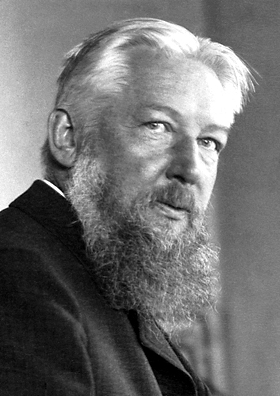
- 威廉·奥斯特瓦尔德
- 学科
- 物理学
相关科学家
百科正文
如果考虑电导率,则有以下关系: (公式略)
以上内容摘自维基百科「稀释定律」,按 CC BY-SA 4.0 使用,去掉了参考文献、外部链接等尾部小节,公式改写成了纯文本。全文、配图和出处见原文。
英文维基百科补充中文条目比较短,下面是英文条目「Law of dilution」的原文
Wilhelm Ostwald’s dilution law is a relationship proposed in 1888 between the dissociation constant Kd and the degree of dissociation α of a weak electrolyte. The law takes the form (公式略)
Where the square brackets denote concentration, and c0 is the total concentration of electrolyte.
Using α =Λ _(c)/Λ ₀, where Λ _(c) is the molar conductivity at concentration c and Λ ₀ is the limiting value of molar conductivity extrapolated to zero concentration or infinite dilution, this results in the following relation: (公式略)
Derivation
Consider a binary electrolyte AB which dissociates reversibly into A+ and B− ions. Ostwald noted that the law of mass action can be applied to such systems as dissociating electrolytes. The equilibrium state is represented by the equation: (公式略)
If α is the fraction of dissociated electrolyte, then αc0 is the concentration of each ionic species. (1 - α) must, therefore be the fraction of undissociated electrolyte, and (1 - α)c0 the concentration of same. The dissociation constant may therefore be given as (公式略)
For very weak electrolytes (公式略) , implying that (1 - α) ≈ 1. (公式略)
This gives the following results; (公式略)
Thus, the degree of dissociation of a weak electrolyte is proportional to the inverse square root of the concentration, or the square root of the dilution. The concentration of any one ionic species is given by the root of the product of the dissociation constant and the concentration of the electrolyte. (公式略)
Limitations
The Ostwald law of dilution provides a satisfactory description of the concentration dependence of the conductivity of weak electrolytes like CH3COOH and NH4OH. The variation of molar conductivity is essentially due to the incomplete dissociation of weak electrolytes into ions.
For strong electrolytes, however, Lewis and Randall recognized that the law fails badly since the supposed equilibrium constant is actually far from constant. This is because the dissociation of strong electrolytes into ions is essentially complete below a concentration threshold value. The decrease in molar conductivity as a function of concentration is actually due to attraction between ions of opposite charge as expressed in the Debye-Hückel-Onsager equation and later revisions.
Even for weak electrolytes the equation is not exact. Chemical thermodynamics shows that the true equilibrium constant is a ratio of thermodynamic activities, and that each concentration must be multiplied by an activity coefficient. This correction is important for ionic solutions due to the strong forces between ionic charges. An estimate of their values is given by the Debye–Hückel theory at low concentrations.
以上内容摘自英文维基百科「Law of dilution」,按 CC BY-SA 4.0 使用,去掉了参考文献、外部链接等尾部小节,公式改写成了纯文本。全文、配图和出处见原文。