格物
- 类型
- 物理定律
- 命名来源
- 瓦尔特·能斯特
- 学科
- 物理学
相关科学家
百科正文
公式: (公式略)
⇔ (公式略)
在常温下(25℃ = 298.15 K),有以下关系式: (R T)/F ln 10≈ 0.05916
- 因此,能斯特方程可以被简化为:
- 在25℃: E=E⁰-0.05916/nlog ([red])/([ox])
- ⇔ ⇔ E=E⁰+0.05916/nlog ([ox])/([red])
R是理想气体常数,等于8.314472 (15) J.K-1.mol-1。
T是温度,单位K。
a是氧化型和还原型化学物质的活度(活度 = 浓度*活度系数),其中[ox]代表氧化型,[red]代表还原型。
F是法拉第常数,1F等于96,485.3365 (21) C/mol。
n是半反应式的电子计量数,无单位]。
[ox]/[red]表示参与电极反应所有物质浓度的乘积与反应产物浓度乘积之比。而且浓度的方次应等于他们在电极反应中的系数。
历史
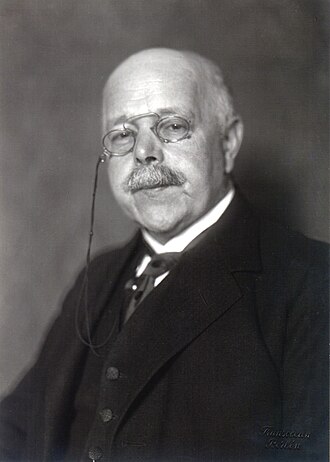
能斯特方程命名于它的提出者德国化学家瓦尔特·能斯特,他建立的这个联系化学能和原电池电极电位关系的方程,对化学热力学有重要贡献。1920年的诺贝尔化学奖颁发给了他,以表彰他在热化学方面的工作。
以上内容摘自维基百科「能斯特方程」,按 CC BY-SA 4.0 使用,去掉了参考文献、外部链接等尾部小节,公式改写成了纯文本。全文、配图和出处见原文。
英文维基百科补充中文条目比较短,下面是英文条目「Nernst equation」的原文
In electrochemistry, the Nernst equation is a chemical thermodynamical relationship in electrochemistry that permits the calculation of the reduction potential of a reaction (half-cell or full cell reaction) from the standard electrode potential, absolute temperature, the number of electrons transferred in the redox reaction, and activities (often approximated by concentrations) of the chemical species undergoing reduction and oxidation respectively. It was named after Walther Nernst, a German physical chemist who is the author of the equation.
It has applications in cell physiology and biophysics, concerning the cell membrane potential.
Expression
General form with chemical activities
When an oxidized species (Ox) accepts a number z of electrons ( e−) to be converted in its reduced form (Red), the half-reaction is expressed as: (公式略)
The reaction quotient (Qr), also often called the ion activity product (IAP), is the ratio between the chemical activities (a) of the reduced form (the reductant, aRed) and the oxidized form (the oxidant, aOx). The chemical activity of a dissolved species is a quantity used for taking into account the electrical interactions between all ions present in solution at elevated concentrations.
Applications in biology
Beside important redox reactions in biochemistry and microbiology, the Nernst equation is also used in physiology for calculating the electric potential of a cell membrane with respect to one type of ion. It can be linked to the acid dissociation constant.
Nernst potential
The Nernst equation has a physiological application when used to calculate the potential of an ion of charge z across a membrane. This potential is determined using the concentration of the ion both inside and outside the cell: (公式略)
Derivation
Using Boltzmann factor
For simplicity, we will consider a solution of redox-active molecules that undergo a one-electron reversible reaction
Ox + e− ⇌ Red
and that have a standard potential of zero, and in which the activities are well represented by the concentrations (i.e. unit activity coefficient). The chemical potential μc of this solution is the difference between the energy barriers for taking electrons from and for giving electrons to the working electrode that is setting the solution's electrochemical potential.
Relation to the chemical equilibrium
The standard Gibbs free energy (公式略) is related to the equilibrium constant K as follows: (公式略)
At the same time, (公式略) is also equal to the product of the total charge (zF) transferred during the reaction and the cell potential ( (公式略)): (公式略)
The sign is negative, because the considered system performs the work and thus releases energy.
So, (公式略)
And therefore: (公式略)
Starting from the Nernst equation, one can also demonstrate the same relationship in the reverse way.
Limitations
In dilute solutions, the Nernst equation can be expressed directly in the terms of concentrations (since activity coefficients are close to unity). But at higher concentrations, the true activities of the ions must be used. This complicates the use of the Nernst equation, since estimation of non-ideal activities of ions generally requires experimental measurements. The Nernst equation also only applies when there is no net current flow through the electrode.
Significance in other scientific fields
The Nernst equation has been involved in the scientific controversy about cold fusion. Fleischmann and Pons, claiming that cold fusion could exist, calculated that a palladium cathode immersed in a heavy water electrolysis cell could achieve up to 1027 atmospheres of pressure inside the crystal lattice of the metal of the cathode, enough pressure to cause spontaneous nuclear fusion. In reality, only 10,000–20,000 atmospheres were achieved. The American physicist John R. Huizenga claimed their original calculation was affected by a misinterpretation of the Nernst equation. He cited a paper about Pd–Zr alloys.
以上节选摘自英文维基百科「Nernst equation」,按 CC BY-SA 4.0 使用,去掉了参考文献、外部链接等尾部小节,公式改写成了纯文本。篇幅所限,较长的小节只摘了开头一部分,有的小节没有收;全文、配图和出处见原文。