格物
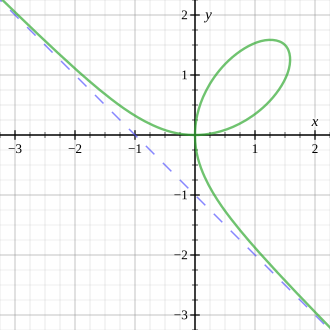
图:Georg-Johann · CC BY-SA 3.0 · Wikimedia Commons
- 类型
- 三次平面曲线
- 发现 / 发明时间
- 1638 年
- 发现者 / 提出者
- 勒内·笛卡儿
- 命名来源
- 勒内·笛卡儿
- 学科
- 物理学
相关科学家

百科正文
在极坐标中的方程为: (公式略)
这个名字来自 拉丁文 的 folium,意思是 "leaf"(叶子)。
曲线的特征
切线的方程
利用隐函数的求导法则,我们可以求出y': (公式略)
利用直线的点斜式方程,我们可以求出点 (x₁,y₁) 处的切线方程: (公式略)
水平和竖直切线
当 ay-x²=0 时,笛卡儿叶形线的切线是水平的。所以: (公式略)
当 y²-ax=0 时,笛卡儿叶形线的切线是竖直的。所以: (公式略)
这可以通过曲线的对称来解释。我们可以看到,曲线有两条水平切线和两条竖直切线。笛卡儿叶形线关于 y=x 对称,所以如果水平切线有坐标 (x₁,y₁) 的话,则一定有一个对应的竖直切线,坐标为 (y₁,x₁)。
渐近线
曲线有一条渐近线: x+y+a=0.
这个渐近线的斜率是-1,x截矩和y截矩都是-a。
以上内容摘自维基百科「笛卡儿叶形线」,按 CC BY-SA 4.0 使用,去掉了参考文献、外部链接等尾部小节,公式改写成了纯文本。全文、配图和出处见原文。
英文维基百科补充中文条目比较短,下面是英文条目「Folium of Descartes」的原文
In geometry, the folium of Descartes (from Latin folium 'leaf') is an algebraic curve defined by the implicit equation x³+y³-3ayx=0 . It is named after the mathematician and philosopher René Descartes.
History
The curve was first proposed and studied in 1638 by René Descartes, who was interested in classifying curves by the degrees of their algebraic equations. Its claim to fame lies in an incident in the development of calculus. Descartes challenged Pierre de Fermat to find the tangent line to the curve at an arbitrary point, since Fermat had recently discovered a method for finding tangent lines. Fermat solved the problem easily, something Descartes was unable to do. Since the invention of calculus, the slope of the tangent line can be found easily using implicit differentiation.
Graphing the curve
The folium of Descartes can be expressed in polar coordinates as (公式略)
This is equivalent to (公式略)
Another technique is to write y=px and solve for x and y in terms of p . This yields the rational parametric equations: (公式略)
We can see that the parameter is related to the position on the curve as follows: p<-1 corresponds to x>0 , y<0 : the right, lower, "wing". -1<p<0 corresponds to x<0 , y>0 : the left, upper "wing". p>0 corresponds to x>0 , y>0 : the loop of the curve.
Another way of plotting the function can be derived from symmetry over y=x . The symmetry can be seen directly from its equation ( x and y can be interchanged). By applying rotation of 45° clockwise for example, one can plot the function symmetric over rotated x -axis.This operation is equivalent to a substitution: (公式略)
and yields v=± u√((3a√2-2u)/(6u+3a√2)), u<3a/√2.
Plotting in the Cartesian system of (u,v) gives the folium rotated by 45° and therefore symmetric by u -axis.
Properties
It forms a loop in the first quadrant with a double point at the origin and has asymptote x+y=-a.
It is symmetrical about the line y=x . As such, the curve and this line intersect at the origin and at the point (3a/2,3a/2).
Implicit differentiation gives the formula for the slope of the tangent line to this curve to be (公式略)
with poles x=y²/a and value 0 or ± ∞ at the origin.
Using either one of the polar representations above, the area of the interior of the loop is found to be 3a²/2 . Moreover, the area between the "wings" of the curve and its slanted asymptote is also 3a²/2 .
Relationship to the trisectrix of Maclaurin
The folium of Descartes is related to the trisectrix of Maclaurin by affine transformation. To see this, start with the equation x³+y³=3a· xy,
and change variables to find the equation in a coordinate system rotated 45 degrees. This amounts to setting (公式略)
In the X,Y plane the equation is 2X(X²+3Y²)=3√2a(X²-Y²).
If we stretch the curve in the Y direction by a factor of √3 this becomes 2X(X²+Y²)=a√2(3X²-Y²),
which is the equation of the trisectrix of Maclaurin.
以上内容摘自英文维基百科「Folium of Descartes」,按 CC BY-SA 4.0 使用,去掉了参考文献、外部链接等尾部小节,公式改写成了纯文本。全文、配图和出处见原文。