格物
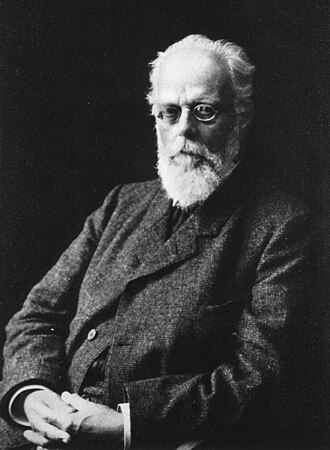
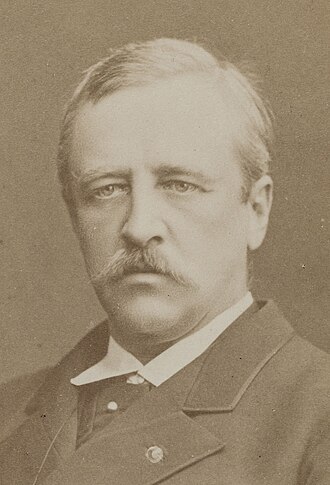
图:作者不详 · Public domain · Wikimedia Commons
奥古斯特·魏斯曼1834—1914
August Weismann
德国进化生物学家
弗里德里希·利奥波德·奥古斯特·魏斯曼,德国进化生物学家。恩斯特·迈尔将他列为19世纪第二个最显着重要的进化理论家,仅次于达尔文。魏斯曼曾任弗赖堡动物学研究所主任和第一动物学教授。他的主要贡献是提出种质学说,有时也称为魏斯曼主义,根据该理论,多细胞动物的遗传仅通过生殖细胞(例如卵细胞和精子细胞等配子)发生。身体的其他细胞也就是体细胞不作为遗传媒介发挥作用。这种影响是单向的:生殖细胞产生体细胞,不受体细胞学习的任何东西的影响,也不受个体在其一生中获得的任何能力的影响。遗传信息不能从体细胞传递到种质并传递给下一代。生物学家将这个概念称为魏斯曼屏障。这个想法如果属实,就排除了让-巴蒂斯特·拉马克提出的后天特征的继承理论。
摘自维基百科「奥古斯特·魏斯曼」,CC BY-SA 4.0
- 出生
- 1834 年 1 月 17 日,美因河畔法兰克福
- 逝世
- 1914 年 11 月 5 日,布赖斯高地区弗赖堡
- 国籍
- 普鲁士王国
- 学科
- 生物学、医学
- 职业
- 动物学家、遗传学家、医生
- 母语 / 工作语言
- 德语
- 母校
- 哥廷根大学
- 工作单位
- 弗赖堡大学
研究领域
主要贡献
以他 / 她命名
师承
学生1
来自 Wikidata 的「博士导师」「师从」「博士生」「学生」记录,可能不全。
所获奖项(5)
- 1876Cothenius Medal
- 1894巴伐利亚马克西米兰科学与艺术勋章
- 1908达尔文奖章
- 1908达尔文-华莱士奖章
- 1910英国皇家学会外籍会员
学会与院士
百科正文
魏斯曼屏障的概念是20世纪初现代进化综论的核心,尽管今天的学者并没有用同样术语表达。魏斯曼认为,大部分随机突变过程是自然选择发挥作用的唯一变化来源,这一过程在配子产生时或者在干细胞中发生。因此,魏斯曼是最早完全否认拉马克主义的生物学家之一。
获奖
他在1908年获伦敦林奈学会授予的达尔文-华莱士奖章。
以上内容摘自维基百科「奥古斯特·魏斯曼」,按 CC BY-SA 4.0 使用,去掉了参考文献、外部链接等尾部小节,公式改写成了纯文本。全文、配图和出处见原文。
英文维基百科补充中文条目比较短,下面是英文条目「August Weismann」的原文
August Friedrich Leopold Weismann (German: [ˈvaɪsman]; 17 January 1834 – 5 November 1914) was a German evolutionary biologist. Fellow German Ernst Mayr ranked him as the second most notable evolutionary theorist of the 19th century, after Charles Darwin. Weismann became the Director of the Zoological Institute and the first Professor of Zoology at Freiburg.
His main contribution involved germ plasm theory, at one time also known as Weismannism, according to which inheritance (in a multicellular animal) only takes place by means of the germ cells—the gametes such as egg cells and sperm cells. Other cells of the body—somatic cells—do not function as agents of heredity. The effect is one-way: germ cells produce somatic cells and are not affected by anything the somatic cells learn or therefore any ability an individual acquires during its life. Genetic information cannot pass from soma to germ plasm and on to the next generation. Biologists refer to this concept as the Weismann barrier. This idea, if true, rules out the inheritance of acquired characteristics as proposed by Jean-Baptiste Lamarck. However, a careful reading of Weismann's work over the span of his entire career shows that he had more nuanced views, insisting, like Darwin, that a variable environment was necessary to cause variation in the hereditary material.
The idea of the Weismann barrier is central to the modern synthesis of the early 20th century, though scholars do not express it today in the same terms. In Weismann's opinion the largely random process of mutation, which must occur in the gametes (or stem cells that make them) is the only source of change for natural selection to work on. Weismann became one of the first biologists to deny Lamarckism entirely. Weismann's ideas preceded the rediscovery of Gregor Mendel's work, and though Weismann was cagey about accepting Mendelism, younger workers soon made the connection.
Life
Youth and studies
Weismann was born a son of high school teacher Johann (Jean) Konrad Weismann (1804–1880), a graduate of ancient languages and theology, and his wife Elise (1803–1850), née Lübbren, the daughter of the county councillor and mayor of Stade, on 17 January 1834 in Frankfurt am Main. He had a typical 19th century bourgeois education, receiving music lessons from the age of four, and drafting and painting lessons from Jakob Becker (1810–1872) at the Frankfurter Städelsche Institut from the age of 14. His piano teacher was a devoted butterfly collector and introduced him to the collecting of imagos and caterpillars. But studying natural sciences was out of the question due to the cost involved and limited job prospects. A friend of the family, chemist Friedrich Wöhler (1800–1882), recommended studying medicine. A foundation from the inheritance of Weismann's mother allowed him to take up studies in Göttingen.
Family
In 1867 he married Mary Dorothea Gruber.
Their son, Julius Weismann (1879–1950), was a composer.
Contributions to evolutionary biology
At the beginning of Weismann's preoccupation with evolutionary theory was his grappling with Christian creationism as a possible alternative. In his work Über die Berechtigung der Darwin'schen Theorie (On the justification of the Darwinian theory) he compared creationism and evolutionary theory, and concluded that many biological facts can be seamlessly accommodated within evolutionary theory, but remain puzzling if considered the result of acts of creation.
After this work, Weismann accepted evolution as a fact on a par with the fundamental assumptions of astronomy (e.g. Heliocentrism). Weismann's position towards the mechanism of inheritance and its role for evolution changed during his life. Three periods can be distinguished.
German work on cells
Weismann's work on the demarcation between germ-line and soma can scarcely be appreciated without considering the work of (mostly) German biologists during the second half of the 19th century.
Awards and honors
Weismann was elected to honorary membership of the Manchester Literary and Philosophical Society in 1894. He was nominated the Honorary Fellow of the University of Tartu in 1902. He was elected an International Member of the American Philosophical Society in 1906. He was awarded the Linnean Society of London's Darwin-Wallace Medal in 1908. He was elected an International Member of the United States National Academy of Sciences in 1913.
Ernst Mayr judged Weismann to be the most important evolutionary thinker between Darwin and the evolutionary synthesis around 1930–1940, and "one of the great biologists of all time".
以上节选摘自英文维基百科「August Weismann」,按 CC BY-SA 4.0 使用,去掉了参考文献、外部链接等尾部小节,公式改写成了纯文本。篇幅所限,较长的小节只摘了开头一部分,有的小节没有收;全文、配图和出处见原文。
同一学科、同时代的科学家


同一学科的科学家
更多 ›