格物
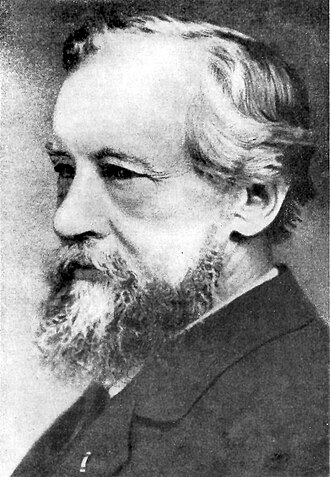
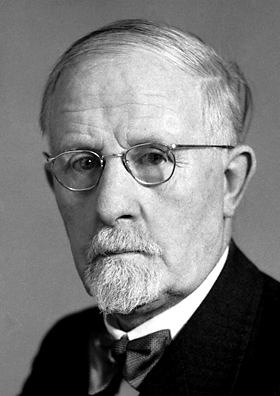
图:Public domain · Wikimedia Commons
胡戈·德弗里斯1848—1935
Hugo de Vries
Dutch botanist (1848-1935)
许霍·马里·德弗里斯,荷兰生物学家,也是第一批研究基因的遗传学家之一。他也是在不知道孟德尔研究成果的时候,独立的进行豌豆实验的三位重现者之一。
摘自维基百科「胡戈·德弗里斯」,CC BY-SA 4.0
- 出生
- 1848 年 2 月 16 日,哈勒姆
- 逝世
- 1935 年 5 月 21 日,林特伦
- 国籍
- 荷兰王国
- 学科
- 生物学
- 职业
- 植物学家、遗传学家、大学教师、生理学家
- 母语 / 工作语言
- 荷兰语
- 母校
- 莱顿大学
- 工作单位
- 阿姆斯特丹大学
研究领域
主要贡献
代表成就
本站收录的发现与发明
所获奖项(4)
- 1905英国皇家学会外籍会员
- 1906达尔文奖章
- 1910Swammerdam Medal
- 1929林奈奖章
学会与院士
百科正文
英文维基百科补充中文条目比较短,下面是英文条目「Hugo de Vries」的原文
Hugo Marie de Vries (Dutch: [ˈɦyɣoː də ˈvris]; 16 February 1848 – 21 May 1935) was a Dutch botanist and one of the first geneticists. He is known chiefly for suggesting the concept of genes, rediscovering the laws of heredity in the 1890s while apparently unaware of Gregor Mendel's work, for introducing the term "mutation", and for developing a mutation theory of evolution.
Early life
De Vries was born in 1848, the eldest son of Gerrit de Vries (1818–1900), a lawyer and deacon in the Mennonite congregation in Haarlem and later Prime Minister of the Netherlands from 1872 until 1874, and Maria Everardina Reuvens (1823–1914), daughter of a professor in archaeology at Leiden University. His father became a member of the Dutch Council of State in 1862 and moved his family over to The Hague. From an early age Hugo showed much interest in botany, winning several prizes for his herbariums while attending gymnasium in Haarlem and The Hague.
In 1866 he enrolled at the Leiden University to major in botany. He enthusiastically took part in W.F.R.
Early career
After a short period of teaching, de Vries left in September 1870 to take classes in chemistry and physics at the Heidelberg University and work in the laboratory of Wilhelm Hofmeister. In the second semester of that school year he joined the lab of the esteemed Julius Sachs in Würzburg to study plant growth. From September 1871 until 1875 he taught botany, zoology and geology at schools in Amsterdam. During each vacation he returned to the lab in Heidelberg to continue his research.
In 1875, the Prussian Ministry of Agriculture offered de Vries a position as professor at the still to be constructed Landwirtschaftliche Hochschule ("Royal Agricultural College") in Berlin.
Definition of the gene
In 1889, de Vries published his book Intracellular Pangenesis, in which, based on a modified version of Charles Darwin's theory of Pangenesis of 1868, he postulated that different characters have different hereditary carriers. He specifically postulated that inheritance of specific traits in organisms comes in particles. He called these units pangenes, a term 20 years later to be shortened to genes by Wilhelm Johannsen.
Rediscovery of genetics
To support his theory of pangenes, which was not widely noticed at the time, de Vries conducted a series of experiments hybridising varieties of multiple plant species in the 1890s. Unaware of Mendel's work, de Vries used the laws of dominance and recessiveness, segregation, and independent assortment to explain the 3:1 ratio of phenotypes in the second generation. His observations also confirmed his hypothesis that inheritance of specific traits in organisms comes in particles.
He further speculated that genes could cross the species barrier, with the same gene being responsible for hairiness in two different species of flower.
Mutation theory
In his own time, de Vries was best known for his mutation theory. In 1886, he had discovered new forms among a group of Oenothera lamarckiana, a species of evening primrose, growing wild in an abandoned potato field near Hilversum, having escaped a nearby garden. Taking seeds from these, he found that they produced many new varieties in his experimental gardens; he introduced the term mutations for these suddenly appearing variations. In his two-volume publication The Mutation Theory (1900–1903) he postulated that evolution, especially the origin of species, might occur more frequently with such large-scale changes than via Darwinian gradualism, basically suggesting a form of saltationism.
Honors and retirement
In 1878 de Vries became member of the Royal Netherlands Academy of Arts and Sciences. He was elected to the American Philosophical Society in 1903 and the United States National Academy of Sciences in 1904. In May 1905, de Vries was elected Foreign Member of the Royal Society. In 1910, he was elected a member of the Royal Swedish Academy of Sciences. In 1921, he was elected to the American Academy of Arts and Sciences. He was awarded the Darwin Medal in 1906 and the Linnean Medal in 1929.
He retired in 1918 from the University of Amsterdam and withdrew to his estate De Boeckhorst in Lunteren where he had large experimental gardens. He continued his studies with new forms until his death in 1935.
以上节选摘自英文维基百科「Hugo de Vries」,按 CC BY-SA 4.0 使用,去掉了参考文献、外部链接等尾部小节,公式改写成了纯文本。篇幅所限,较长的小节只摘了开头一部分,有的小节没有收;全文、配图和出处见原文。
同一学科、同时代的科学家

同一学科的科学家
更多 ›