格物
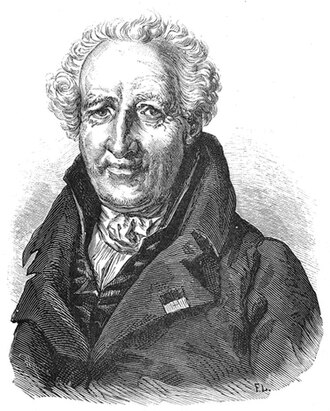
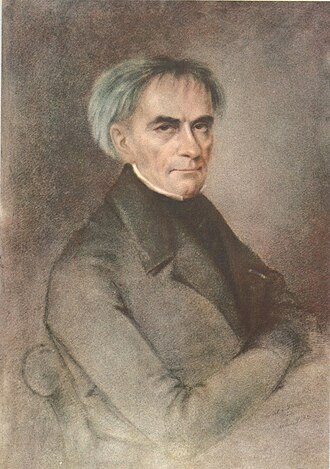
图:Jules Pizzetta · Public domain · Wikimedia Commons
- 出生
- 1748 年 4 月 12 日,里昂
- 逝世
- 1836 年 9 月 17 日,巴黎
- 国籍
- 法国
- 学科
- 生物学、医学
- 职业
- 植物学家、医生、大学教师
- 母语 / 工作语言
- 法语、拉丁语
- 母校
- 巴黎大学
- 工作单位
- Jardin botanique de la Ville de Paris
研究领域
师承
学生3
来自 Wikidata 的「博士导师」「师从」「博士生」「学生」记录,可能不全。
所获奖项(1)
- 1829英国皇家学会外籍会员
学会与院士
百科正文
生平
1748年朱西厄生于里昂,后在巴黎学医,1770年毕业后到1826年间一直担任巴黎植物园的教授。
他依据形态学特征划分植物,改善了林奈主要依据雄蕊和雌蕊个数划分植物的方法,对后世的被子植物分类学影响很大。默顿在他1981年的著作《植物科学的历史》中,统计出朱西厄建立的76个科均被ICBN保留,而林奈建立的科只有11个被保留。
以上内容摘自维基百科「安托万·洛朗·德朱西厄」,按 CC BY-SA 4.0 使用,去掉了参考文献、外部链接等尾部小节,公式改写成了纯文本。全文、配图和出处见原文。
英文维基百科补充中文条目比较短,下面是英文条目「Antoine Laurent de Jussieu」的原文
Antoine Laurent de Jussieu (French pronunciation: [ɑ̃twan loʁɑ̃ də ʒysjø]; 12 April 1748 – 17 September 1836) was a French botanist, notable as the first to publish a natural classification of flowering plants; much of his system remains in use today. His classification was based on an extended unpublished work by his uncle, the botanist Bernard de Jussieu.
Life
Jussieu was born in Lyon, France, in 1748, as one of 10 children, to Christophe de Jussieu, an amateur botanist. His father's three younger brothers were also botanists. He went to Paris in 1765 to be with his uncle Bernard and to study medicine, graduating with a doctorate in 1770, with a thesis on animal and vegetable physiology. His uncle introduced him to the Jardin du Roi, where he was appointed as a botany Demonstrator and deputy to L. G. Le Monnier, professor of botany there in 1770. Le Monnier had succeeded Antoine-Laurent's uncle Antoine in 1759. Lectures by eminent botanists, including the Jusssieu dynasty were popular there, especially among pharmacists.
Jusssieu's lecture on the classification of Ranunculaceae in 1773 to the Académie des Sciences led to his election as a member that year. In 1784 he was appointed to a Royal Commission by Louis XVI, as one of five commissionaires to investigate animal magnetism, publishing a dissenting opinion from the majority, suggesting further investigation was required.
The publication of Jussieu's Genera plantarum in 1789 was rapidly followed by the outbreak of the French Revolution (1789–1799). Jussieu adhered to the revolutionary principles, and was appointed to a position in the municipal government of Paris, where he had the task of managing all the hospitals.
Work
Jussieu's system of plant classification, based on the relative value of their characteristics, served as the basis for natural systems of taxonomy. His system was first published in a paper on Ranunculaceae in 1773. The following year he developed the concept further in a paper on the arrangement of plants in the Jardin de Roi, based on the work of his uncle Bernard at the Trianon garden in Versaille. The work dealt primarily with suprafamilial ranks of classification.
Jussieu devoted the next five years to applying his ideas to the entire plant kingdom, culminating in his epochal work, the Genera plantarum (1789). In preparing this work he had access to a large number of herbaria and botanical gardens. Although at first British and German botanists, firm adherents of the Linnaean system, were wary of what they considered radical ideas emanating from the French revolution, the work soon gained wide acceptance in scientific circles, and was actively promoted by eminent botanists including Robert Brown and A. P. de Candolle.
In the Genera plantarum (1789), Jussieu adopted a methodology based on the use of multiple characters to define groups, an idea derived from naturalist Michel Adanson.
Awards and memberships
Member of the French Académie des Sciences (1773), elected foreign member of the Royal Swedish Academy of Sciences (1788).
Legacy
Jussieu's "natural" system of classification soon replaced the artificial sexual one of Linnaeus. The system of suprageneric nomenclature in botany is officially dated to 4 August 1789 with the publication of the Genera Plantarum (Gen. Pl.). The Genera plantarum was far-reaching in its impact; many of the present-day plant families are still attributed to Jussieu. Morton's 1981 History of botanical science counts 76 of Jussieu's families conserved in the ICBN, versus just 11 for Linnaeus, for instance. Writing of the natural system, Sydney Howard Vines remarked: "The glory of this crowning achievement belongs to Jussieu: he was the capable man who appeared precisely at the psychological moment, and it is the men that so appear who have made, and will continue to make, all the great generalisations of science."
De Jussieu and his family have been commemorated by a number of images, including a bust and medallion by David d'Angers (Pierre-Jean David), upon his death. A statue of Jussieu, commissioned for 10,000 Fr by Jean-François Legendre-Héral in 1842, stands in the Galerie de Botanique of the Jardin des Plantes. Another, by Jean-Baptiste Gustave Deloye is on the balustrade of the Natural History Museum, Vienna (facing Maria-Theresien-Platz).
以上节选摘自英文维基百科「Antoine Laurent de Jussieu」,按 CC BY-SA 4.0 使用,去掉了参考文献、外部链接等尾部小节,公式改写成了纯文本。篇幅所限,较长的小节只摘了开头一部分,有的小节没有收;全文、配图和出处见原文。
同一学科、同时代的科学家


同一学科的科学家
更多 ›