格物

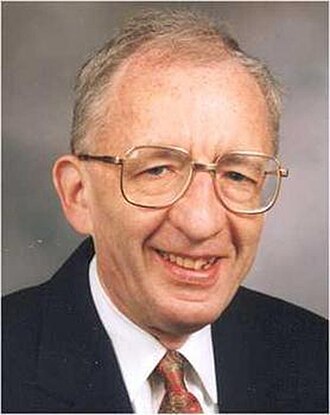
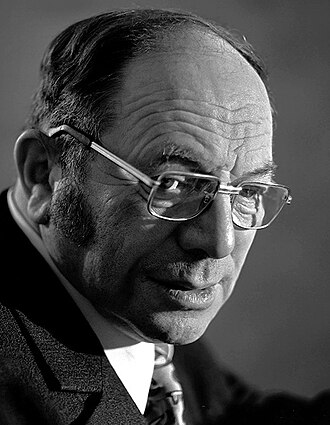
图:Associated Press · Public domain · Wikimedia Commons
- 出生
- 1913 年 8 月 30 日,伦敦
- 逝世
- 1991 年 12 月 6 日,剑桥
- 国籍
- 英国
- 学科
- 数学
- 职业
- 经济学家、统计学家、研究者
- 母语 / 工作语言
- 英语
- 母校
- 西敏公学、剑桥大学冈维尔与凯斯学院、剑桥大学
- 工作单位
- 剑桥大学
研究领域
师承
博士生4
来自 Wikidata 的「博士导师」「师从」「博士生」「学生」记录,可能不全。
所获奖项(7)
- 1945Fellow of the Econometric Society
- 1975honorary doctor of the University of Paris 1 Pantheon-Sorbonne
- 1984诺贝尔经济学奖
- 1994Frederick W. Lanchester Prize
- —英国科学院院士
- —大英帝国司令勋章
- —下级勋位爵士
学会与院士
百科正文
生平
理查德·史东就读于剑桥大学,主修法律。大学期间,受到约翰·梅纳德·凯恩斯与理查德·卡恩的指导,逐渐转向经济学,1935年取得经济学学位。
第二次世界大战期间,与詹姆斯·米德合作,为英国政府进行财政收支统计与规划工作。
以上内容摘自维基百科「理查德·史東」,按 CC BY-SA 4.0 使用,去掉了参考文献、外部链接等尾部小节,公式改写成了纯文本。全文、配图和出处见原文。
英文维基百科补充中文条目比较短,下面是英文条目「Richard Stone」的原文
Sir John Richard Nicholas Stone (30 August 1913 – 6 December 1991) was an eminent British economist. He was educated at Gonville and Caius College and King's College at the University of Cambridge. In 1984, he was awarded the Nobel Memorial Prize in Economic Sciences for developing an accounting model that could be used to track economic activities on a national and, later, an international scale.
Early life and education
Richard Stone was born in London on 30 August 1913. He received an English upper middle class education when he was a child as he attended Cliveden Place and Westminster School. However, he had not been taught mathematics and science until secondary school. When he was 17 years old, he followed his father to India as his father was appointed as a judge in Madras. From India, he visited many Asian countries: Malaya, Singapore, and Indonesia. After travelling for one year, he went back to London and then matriculated at Gonville and Caius College, Cambridge, in 1931, where he studied law for two years.
The young Stone then changed to studying economics. He was interested in economics as he thought that "if there were more economists, the world would be a better place". During the Great Slump of the 1930s, unemployment was very high and this motivated him to know what caused it and how to overcome it. He faced a challenge from his parents as they were disappointed with his choice.
Career
After graduating from Cambridge in 1935 and until World War II he worked at Lloyd's of London. During the war, Stone worked with James Meade as a statistician and economist for the British Government. At the government's request, they analyzed the UK's economy related to the current total resources of the nation for the war time. It was at this time that they developed the early versions of the system of national accounts. Their work resulted in the U.K.'s first national accounts in 1941.
The collaboration between Stone and Meade was over after 1941 as their office was split into two different ones. They then worked separately, Meade being responsible for the Economic Section and Stone, for the national income. In his new office, the Central Statistical Office, Stone became John Maynard Keynes' assistant. Stone left working for the government when the war ended in 1945.
After the war, Stone took up an academic career when he worked at Cambridge as the director of the new Department of Applied Economics (1945–1955).
Achievements
Stone in 1984 received the Nobel Memorial Prize in Economic Sciences for developing an accounting model that could be used to track economic activities on a national and, later, an international scale.
While he was not the first economist to work in this field, he was the first to do so with double entry accounting. Double entry accounting basically states that every income item on one side of the balance sheet must be met by an expenditure item on the opposite side of the accounting sheet therefore creating a system of balance. This double entry system is the basis of nearly all modern accounting today. This allowed for a reliable way of tracking trade and wealth transfer on a global scale.
He is sometimes known as the 'father of national income accounting', and is the author of studies of consumer demand statistics and demand modeling, economic growth, and input-output.
During his acceptance speech Stone mentioned François Quesnay as well as the Tableau économique.
Personal life
Stone married three times. In 1936, he married Winifred Mary Jenkins who was also from Cambridge. Both of them had a passion for Economics and started a monthly paper called Trends, which was a supplement to the periodical, Industry Illustrated. It contained articles about the British economic conditions. Soon after, in 1939, he was asked to join the Ministry of Economic Warfare. The couple's marriage dissolved in 1940.
Soon after, In 1941 Stone married his second wife Feodora Leontinoff. Feodora died in 1956.
In 1960, he married Giovanna Saffi (1919–2009), great-grandchild of Italian patriot Aurelio Saffi, who became his partner in many of his works. They collaborated for some projects in economics, for example in rewriting his book "National Income and Expenditure" in 1961.
Death
Stone died on 6 December 1991 in Cambridge, aged 78. He was survived by his third wife Giovanna, and his daughter Caroline.
以上节选摘自英文维基百科「Richard Stone」,按 CC BY-SA 4.0 使用,去掉了参考文献、外部链接等尾部小节,公式改写成了纯文本。篇幅所限,较长的小节只摘了开头一部分,有的小节没有收;全文、配图和出处见原文。
同一学科、同时代的科学家




同一学科的科学家
更多 ›