格物

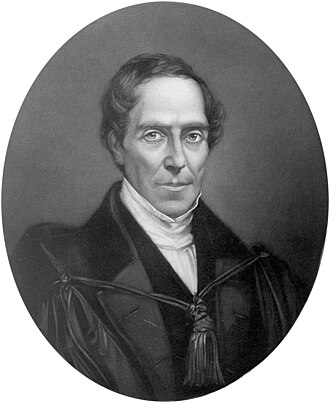
图:Daniel Huntington (1816-1906) · Public domain · Wikimedia Commons
詹姆斯·德怀特·达纳1813—1895
James Dwight Dana
美国地质学家(1813-1895)
詹姆斯·德怀特·达纳,美国地质学,矿物学和动物学家,曾在南太平洋、美国西北部和欧洲等地考察研究,主要研究山脉的形成、火山活动、海洋生物和大部与洋盆的形成与构造等方面。
摘自维基百科「詹姆斯·德怀特·达纳」,CC BY-SA 4.0
- 出生
- 1813 年 2 月 12 日,尤蒂卡
- 逝世
- 1895 年 4 月 14 日,纽黑文
- 国籍
- 美国
- 学科
- 生物学、地球科学
- 职业
- 地质学家、探险家、动物学家、甲壳动物学家
- 母语 / 工作语言
- 英语
- 母校
- 耶鲁学院
- 工作单位
- 耶鲁大学
研究领域
师承
来自 Wikidata 的「博士导师」「师从」「博士生」「学生」记录,可能不全。
所获奖项(5)
学会与院士
百科正文
生平
达纳于1830年进入耶鲁学院学习,1833年毕业后作为一名美国海军军校生巡航地中海。1836年达纳回到纽黑文后成为其耶鲁学院老师本杰明·西利曼(Benjamin Silliman)的助手。1837年,年仅24岁的达纳出版了580页《系统矿物学》(A System of Mineralogy),为早期的矿物分类作出贡献。
1838年,达纳作为地质学家加入了查尔斯·威尔克斯(Charles Wilkes)的探险队前往南太平洋地区进行了4年的考察。1844年,达纳与其导师本杰明·西利曼的女儿亨丽埃塔·西利曼(Henrietta Silliman)结婚,并定居于纽黑文。在1844至1854年,达纳共出版了7000页的论文,主要成就集中在地质学领域。在其著作《矿物学手册》(1848,Manual of Mineralogy)和第三版的《系统矿物学》中包含了根据数学、物理和化学特性对矿物分类的完整修订。达纳担任《美国科学杂志》(American Journal of Science)编辑期间,对美国地质学界产生深远的影响。
以上内容摘自维基百科「詹姆斯·德怀特·达纳」,按 CC BY-SA 4.0 使用,去掉了参考文献、外部链接等尾部小节,公式改写成了纯文本。全文、配图和出处见原文。
英文维基百科补充中文条目比较短,下面是英文条目「James Dwight Dana」的原文
James Dwight Dana FRS FRSE (February 12, 1813 – April 14, 1895) was an American geologist, mineralogist, volcanologist, and zoologist. He made pioneering studies of mountain-building, volcanic activity, and the origin and structure of continents and oceans around the world.
His zoological author abbreviation is Dana.
Early life and career
Dana was born February 12, 1813, in Utica, New York. His father was merchant James Dana (1780–1860) and his mother was Harriet Dwight (1792–1870). Through his mother he was related to the Dwight New England family of missionaries and educators including uncle Harrison Gray Otis Dwight and first cousin Henry Otis Dwight.
He showed an early interest in science, which had been fostered by Fay Edgerton, a teacher in the Utica high school, and in 1830 he entered Yale College in order to study under Benjamin Silliman the elder.
Graduating in 1833, for the next two years he was teacher of mathematics to midshipmen in the Navy, and sailed to the Mediterranean while engaged in his duties. In 1836 and 1837 he was assistant to Professor Silliman in the chemical laboratory at Yale, and then, for four years, acted as mineralogist and geologist of the United States Exploring Expedition, commanded by Captain Charles Wilkes, in the Pacific Ocean. His labors in preparing the reports of his explorations occupied parts of thirteen years after his return to America in 1842. His notebooks from the four years of travel contained fifty sketches, maps, and diagrams, including views of both Mount Shasta and Castle Crags. Dana's sketch of Mount Shasta was engraved in 1849 for publication in the American Journal of Science and Arts (which Silliman had founded in 1818), along with a lengthy article based on Dana's 1841 geological notes. In the article he described in scientific terms the rocks, minerals, and geology of the Shasta region. As far as is known, his sketch of Mount Shasta became the second view of the mountain ever published.
In 1844 he again became a resident of New Haven, and married Professor Silliman's daughter, Henrietta Frances Silliman.
Family
Dana was married to Henrietta Frances, daughter of Benjamin Silliman, in 1844.
Their son, Edward Salisbury Dana (1849–1935), was also a distinguished mineralogist.
Awards and recognition
Dana was awarded the Copley Medal by the Royal Society in 1877, the Wollaston Medal by the Geological Society of London in 1874 and the Clarke Medal by the Royal Society of New South Wales in 1882. Dana was president of the Geological Society of America in 1890.
Named in honor of Dana
- Dana Park in Albany, New York, with a fountain/monument in his honor
- Mount Dana (and the nearby Dana Meadows) in the Sierra Nevada, California, US
- Dorsa Dana (a wrinkle-ridge system) on the Moon
Danalite, a mineral.
Dana Passage in Puget Sound, US
Dana, a crater on Mars
The Dana Medal of the Mineralogical Society of America was named for Dana and his son Edward Salisbury Dana. It recognizes outstanding scientific contributions through research in the mineralogical sciences by an individual in the midst of their career.
The James Dwight Dana House in New Haven, Connecticut was declared a National Historic Landmark in 1965.
The fossil horseshoe crab Euproops danae
Dana Peak in Alaska.
Additional sources
This article incorporates text from a publication now in the public domain: Chisholm, Hugh, ed. (1911). "Dana, James Dwight". Encyclopædia Britannica. Vol. 7 (11th ed.). Cambridge University Press. p. 793.
American Mineralogist, Vol. 21 (1936), 173–177.
*The Life of James Dwight Dana: Scientific Explorer, Mineralogist, Geologist, Zoologist, Professor in Yale University, Daniel Coit Gilman, Harper & Brothers Publishers, New York, 1899
Artikel James Dwight Dana in der Encyclopædia Britannica von 1911. Gemeinfrei.
David R. Oldroyd (1996): Thinking about the Earth, Harvard Press, ISBN 0-674-88382-9; dt.: Die Biographie der Erde. Zur Wissenschaftsgeschichte der Geologie, Frankfurt a.M., 1998.
Johannes Uray, Chemische Theorie und mineralogische Klassifikationssysteme von der chemischen Revolution bis zur Mitte des 19. Jahrhunderts. In: Berhard Hubmann, Elmar Schübl, Johannes Seidl (eds.), Die Anfänge geologischer Forschung in Österreich. Beiträge zur Tagung „10 Jahre Arbeitsgruppe Geschichte der Erdwissenschaften Österreichs“ von 24. bis 26. April 2009 in Graz. Graz 2010, S 107–125.
Stanton, William (1970–1980). "Dana, James Dwight". Dictionary of Scientific Biography. Vol. 3. New York: Charles Scribner's Sons. pp. 549–554. ISBN 978-0-684-10114-9.
以上节选摘自英文维基百科「James Dwight Dana」,按 CC BY-SA 4.0 使用,去掉了参考文献、外部链接等尾部小节,公式改写成了纯文本。篇幅所限,较长的小节只摘了开头一部分,有的小节没有收;全文、配图和出处见原文。
同一学科、同时代的科学家




同一学科的科学家
更多 ›