格物
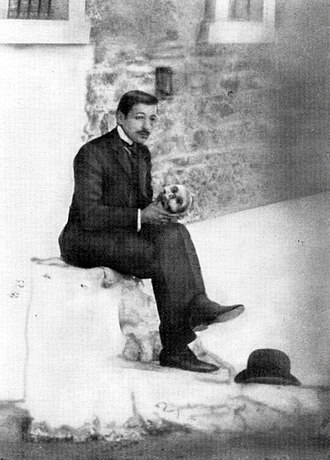
图:作者不详 · Public domain · Wikimedia Commons
- 出生
- 1883 年 5 月 13 日,基米
- 逝世
- 1962 年 2 月 19 日,迈阿密
- 国籍
- 希腊
- 学科
- 医学
- 职业
- 医生、肿瘤科医师、妇科医生
- 母语 / 工作语言
- 英语、现代希腊语
- 母校
- 雅典大学(学士,1904 年)、慕尼黑大学
- 工作单位
- 康奈尔大学、迈阿密大学、威尔·康奈尔医学中心
主要贡献
代表成就
所获奖项(2)
- 1947Amory Prize
- 1950拉斯克临床医学研究奖
学会与院士
百科正文
生平
乔治·帕帕尼古拉乌早年就读于雅典大学,于1904年获得医学学士学位。1910年获得慕尼黑大学博士学位。1913年,移民美国,进入纽约医院病理学部、康奈尔大学医学院解剖学系工作。1961年,前往迈阿密以创建迈阿密大学帕帕尼古拉乌癌症研究所,但不幸的是,在研究所未正式成立前他就去世了。
以上内容摘自维基百科「乔治·帕帕尼古拉乌」,按 CC BY-SA 4.0 使用,去掉了参考文献、外部链接等尾部小节,公式改写成了纯文本。全文、配图和出处见原文。
英文维基百科补充中文条目比较短,下面是英文条目「Georgios Papanikolaou」的原文
Georgios Nikolaou Papanikolaou (or George Papanicolaou; Greek: Γεώργιος Ν. Παπανικολάου [papanikoˈlau]; 13 May 1883 – 19 February 1962) was a Greek physician, zoologist and microscopist who was a pioneer in cytopathology and early cancer detection, and inventor of the pap smear for detection of cervical cancer.
After studying medicine in Greece and Germany, in 1913 he emigrated to the United States and was on the faculty at Cornell Medical College. He first reported that uterine cancer cells could be detected in vaginal smears in 1928, but his work was not widely recognized until the 1940s. An extensive trial of his techniques was carried out in the early 1950s. In 1961 he was invited to the University of Miami to lead and develop there the Papanicolaou Cancer Research Institute.
Early life and education
Papanikolaou was born in Kymi, Greece, on 13 May 1883. He attended the University of Athens, where he studied literature, philosophy, languages and music. Urged by his physician father, he pursued a medical degree, which he received in 1904. He was then conscripted into military service. When his military obligation ended in 1906, he returned to Kymi to practice medicine with his father.
In 1907, he began studying in Germany under Ernst Haeckel at the University of Jena for one semester before moving to the University of Freiburg, where he was supervised by August Weismann. He then attended the Ludwig-Maximilians-Universität München, where in 1910 he received a PhD degree in zoology.
Career
Papanikolaou then returned to Athens, where he married Andromachi Mavrogeni, who would later become his laboratory assistant and research subject. He next departed for Monaco, where he worked for the Oceanographic Institute of Monaco and participated in the Oceanographic Exploration Team of Prince Albert I of Monaco in 1911.
Cornell University
Two years later, in 1913, along with his wife, he immigrated to New York City in order to work in the pathology department at New York Hospital and the Department of Anatomy at Cornell University's Medical College.
Discoveries
In 1914, Papanikolaou and his wife worked at the Department of Anatomy at the Cornell Medical College of Cornell University and contributed to the histological and physiological changes associated with the oestrus cycle in the guinea pig. In 1917, Papanikolaou along with Charles R. Stockard demonstrated that, in the guinea pig, the histologic cyclic changes that occur in the reproductive tract during the estrus cycle also occur in the vaginal mucosa and can be detected by cytologic examination of vaginal smears. This technique (termed the Papanicolaou technique) was groundbreaking and also facilitated the discovery of an ovarian hormone.
Awards and honors
Papanikolaou was nominated five times for the Nobel Prize, but never won. This was likely because the prize is rarely awarded for diagnostic tools, as well as because a death of one of Papanikolaou's great admirers, who was a member of the Nobel Prize Committee, occurred around that time and also due to the committee's reluctance to award a Nobel Prize for another cancer discovery following a former embarrassing award in 1926 to Johannes Fibiger, who claimed that worms caused cancer. Nevertheless, Papanikolaou received many other prestigious prizes and awards for his discoveries, such as the Albert Lasker Award for Clinical Medical Research (the American equivalent to the Nobel Prize in Physiology), which he received in 1950.
Commemorations
In 1958 the Papanicolaou Award, the highest award given by the American Society of Cytopathology, was established in Papanikolaou's honor, and it has since been awarded annually.
In 1978 Papanikolaou's work was honored by the U.S. Postal Service with a 13-cent stamp for early cancer detection.
Between 1995 and 2001, his portrait appeared on the obverse of the Greek ₯10,000 banknote, until its replacement by the euro.
In 2011 A Man of Science, a statue portraying Papanicolaou, was permanently installed in Weill Cornell Medicine's main lobby at 1300 York Avenue, in New York City.
以上节选摘自英文维基百科「Georgios Papanikolaou」,按 CC BY-SA 4.0 使用,去掉了参考文献、外部链接等尾部小节,公式改写成了纯文本。篇幅所限,较长的小节只摘了开头一部分,有的小节没有收;全文、配图和出处见原文。