格物
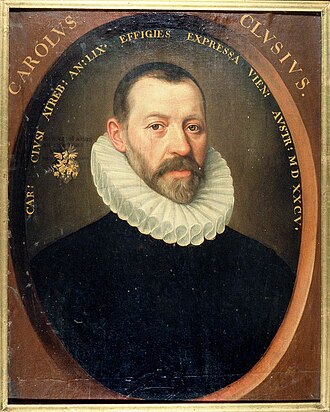
图:Attributed to Jacob de Monte · Public domain · Wikimedia Commons
- 出生
- 1526 年 2 月 19 日,阿拉斯
- 逝世
- 1609 年 4 月 4 日,莱顿
- 国籍
- 南尼德兰、法国
- 学科
- 生物学、医学
- 职业
- 植物学家、医生、译者、大学教师
- 母语 / 工作语言
- 拉丁语、西班牙语、法语
- 母校
- 根特大学、鲁汶大学、马尔堡大学、维滕贝格大学、Faculty of Medicine of Montpellier
- 工作单位
- 莱顿大学(1593—1609)、莱顿大学(1593—1609)
研究领域
主要贡献
代表成就
师承
师从2
来自 Wikidata 的「博士导师」「师从」「博士生」「学生」记录,可能不全。
百科正文
英文维基百科补充中文条目比较短,下面是英文条目「Carolus Clusius」的原文
Charles de l'Écluse, L'Escluse, or Carolus Clusius (19 February 1526 – 4 April 1609), seigneur de Watènes, was an Artois doctor and pioneering botanist, perhaps the most influential of all 16th-century scientific horticulturists.
Life
Clusius was born Charles de l' Écluse in 1526, in Arras (Dutch Atrecht), then in the County of Artois, Spanish Netherlands, now northern France (Hauts-de-France). At the urging of his father, who wanted him to enter the law, he commenced his studies in Latin and Greek at Louvain, followed by civil law. His father then gave him some money to move to Marburg to further his legal studies, but after eight months when his mentor moved away from Marburg he switched to theology, initially at Marburg and then on the suggestion of one of his professors at Wittenberg, where he also began a study of philosophy. Even at Marburg he had also developed an interest in plants that he continued in Wittenberg. Aware of the emerging study of botany, he decided to move to France to study medicine at the University of Montpellier (1551–1554), under professor Guillaume Rondelet, though he never practiced medicine, or styled himself as a physician. He died in Leiden in the Netherlands in 1609, at the age of 83.
While little is known of his relationships, he formed many friendships, both male and female, and his extensive preserved correspondence throws considerable light on those friendships. His male friends were largely academic, with whom he corresponded in Latin, his female friends (at least 35 are known) predominantly collectors and horticulturalists with whom he corresponded in their vernacular, but treated all with the same respect. Unlike his male friends, who were from all over the world, his women friends were all in the Habsburg countries, especially the southern Netherlands and Austria.
Work
In the 1560s Clusius was employed by the Fugger banking family as tutor to one of Anton Fugger's sons and as agent, including a plant collecting expedition to Spain, where he became familiar with plants introduced from the New World. In 1573, with the help of Ogier Ghiselin de Busbecq, he was appointed prefect (director) of the imperial medical garden in Vienna by Emperor Maximilian II (1564–1576) and made Gentleman of the Imperial Chamber. Busbecq, who had been ambassador to the Ottoman Empire (1554–1562) under the previous emperor, Ferdinand I (1558–1564), was a keen gardener and soon arranged for exotic bulbs to be sent from the court at Constantinople to the gardens in Vienna. Clusius was discharged from the imperial court shortly after the death of Maximilian and accession of his son Rudolf II (1576–1612) in 1576.
After leaving Vienna in the late 1580s, he established himself in Frankfurt am Main, before his appointment as professor at the University of Leiden in October 1593, where he also became the first praefectus (prefect) of the city's new botanical garden, the Hortus Academicus, associated with the university. There he helped to create one of the earliest formal botanical gardens of Europe and his detailed planting lists have made it possible to recreate his garden near where it originally lay. He was invited to join the Accademia dei Lincei as a corresponding member in 1604, but declined.
He traveled extensively throughout Europe, furthering his knowledge of plants. Clusius was among the first to study the flora of Austria, under the auspices of Maximilian II. He was the first botanist to climb the Ötscher and the Schneeberg in Lower Austria, which was also the first documented ascent of the latter. His illustrated works form an important chapter in sixteenth century natural history, producing a large body of drawing and watercolours. The latter, forming part of an important collection of late sixteenth century botanical illustration, the Libri picturati. He was responsible for the cultivation of a number of plants, new to Europe, including the tulip, potato, and horse chestnut.
Legacy
Justus Lipsius called Clusius "the father of all the beautiful gardens in this country".
Eponomy
His contribution to the study of alpine plants has led to many of them being named in his honour, such as Gentiana clusii, Potentilla clusiana and Primula clusiana. The genus Clusia (whence the family Clusiaceae) also honours Clusius. His work formed an important step in the development of modern botany.
以上节选摘自英文维基百科「Carolus Clusius」,按 CC BY-SA 4.0 使用,去掉了参考文献、外部链接等尾部小节,公式改写成了纯文本。篇幅所限,较长的小节只摘了开头一部分,有的小节没有收;全文、配图和出处见原文。
同一学科、同时代的科学家


同一学科的科学家
更多 ›