格物
哈罗德·史宾塞·琼斯1890—1960
Harold Spencer Jones
British astronomer (1890–1960)
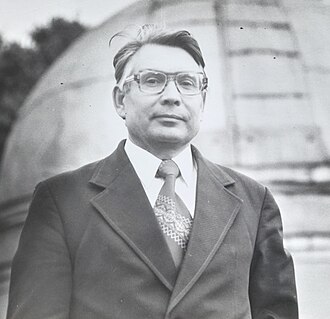
哈罗德·斯宾塞·琼斯KBE FRS FRSE PRAS 是一位英国天文学家。他以位置天文学权威而闻名,并担任了第十任皇家天文学家长达23年。虽然出生时名为“琼斯”,后来姓氏变成了“斯宾塞·琼斯”。
摘自维基百科「哈羅德·斯賓塞·瓊斯」,CC BY-SA 4.0
- 出生
- 1890 年 3 月 29 日,肯辛顿特
- 逝世
- 1960 年 11 月 3 日,伦敦
- 国籍
- 英国
- 学科
- 天文学、博物与综合
- 职业
- 天文学家
- 母语 / 工作语言
- 英语
- 母校
- 拉提默中学、剑桥大学耶稣学院
- 工作单位
- 格林尼治皇家天文台
所获奖项(10)
- 1943皇家奖章
- 1943英国皇家天文学会金质奖章
- 1943下级勋位爵士
- 1945皮埃尔·让森奖
- 1949布鲁斯奖
- 1949honorary doctor of the University of Toulouse
- 1949doctor honoris causa from the University of Paris
- 1955大英帝国爵级司令勋章
- —英国皇家学会院士
- —honorary doctor of the University of Calcutta
学会与院士
百科正文
英文维基百科补充中文条目比较短,下面是英文条目「Harold Spencer Jones」的原文
Sir Harold Spencer Jones KBE FRS FRSE PRAS (29 March 1890 – 3 November 1960) was an English astronomer. He became renowned as an authority on positional astronomy and served as the tenth Astronomer Royal for 23 years. Although born "Jones", his surname became "Spencer Jones".
Early life
Harold Spencer Jones was born in Kensington, London, on 29 March 1890. His father, Henry Charles Jones, was an accountant and his mother, Sarah Ryland, had earlier worked as a school teacher. He was educated at Latymer Upper School, in Hammersmith, West London, from where he obtained a scholarship to Jesus College, Cambridge. He graduated there in 1911, and was awarded a postgraduate studentship. He subsequently became a Fellow of the college.
Chief Assistant at the Royal Observatory, Greenwich, 1913–1923
In 1913 he was appointed Chief Assistant at the Royal Observatory, Greenwich, filling a vacancy created by the departure of Arthur Eddington to become Plumian Professor of Astronomy at Cambridge. In December 1913 Spencer Jones was elected to the Royal Astronomical Society.
Spencer Jones's astronomical work extended over a range of subjects. He specialised in positional astronomy, particularly the motion and orientation of the Earth in space. He also studied the motions of stars. He travelled to Minsk in Eastern Europe in 1914 to observe a total solar eclipse, departing during peacetime but returning after the start of the First World War.
His Majesty's Astronomer at the Cape of Good Hope, 1923–1933
The astronomer in charge of the Royal Observatory at the Cape of Good Hope, Sydney Hough, died in 1923, and Spencer Jones was appointed Hough's successor as His Majesty's Astronomer at the Cape of Good Hope. Spencer Jones and his wife sailed to South Africa, arriving in December 1923.
During his nine years at the observatory, Spencer Jones set about renewing its administration and scientific work. He made efforts to improve working conditions and morale at the observatory. He led efforts by the staff to measure the properties of large numbers of stars from photographic plates exposed on the observatory's telescopes.
Astronomer Royal, 1933–1955
In 1933 Spencer Jones succeeded Sir Frank Dyson as Astronomer Royal, and consequently returned to Britain to take charge of the Royal Observatory, Greenwich.
Spencer Jones took up the administrative challenges, including recruiting new staff and installing new instruments. He upgraded the time service provided by the observatory. He took on overall responsibility for the Nautical Almanac Office. He obtained government agreement to move the observatory from its historic site in Greenwich, which was by then significantly affected by the light and pollution of London, to a darker location away from the city.
Personal life
Sir Harold Spencer Jones had two sons, John (whose early career was spent as a jet pilot with the Royal Air Force) and David, with his wife Lady Gladys Mary Owens Spencer Jones.
Retirement and later life
Spencer Jones retired as Astronomer Royal at the end of 1955. He continued to contribute actively to a number of scientific bodies. He died on 3 November 1960 aged 70. His cause of death was cardiac arrest.
Opinions about space travel
Spencer Jones's successor as Astronomer Royal was Richard Woolley, who on taking up the position in 1956 responded to a question from the press and was misquoted as saying "Space travel is utter bilge". Similarly, it is often stated that Spencer Jones himself had a strong disbelief in the practicalities of space flight, and that he famously said "space travel is bunk" only two weeks before the Sputnik 1 launch in October 1957. Despite recent suggestions that he did not actually make such a statement,
the quote was referenced in 1959 (during his lifetime) in the 17 September issue of New Scientist magazine (page 476).
Honours and awards
Awards
Gold Medal of the Royal Astronomical Society (1943)
Royal Medal (1943)
Prix Jules Janssen, the highest award of the Société astronomique de France, the French astronomical society (1945)
- Bruce Medal (1949)
- Gold medal of the British Horological Institute (1946)
- Lorimer Medal of the Astronomical Society of Edinburgh (1953)
Prize Medal of the Stoke-on-Trent Association of Engineers https://www.rmg.co.uk/collections/objects/rmgc-object-207057
Honors
elected International Member of the American Philosophical Society (1942)
elected International Member of the United States National Academy of Sciences (1943)
以上节选摘自英文维基百科「Harold Spencer Jones」,按 CC BY-SA 4.0 使用,去掉了参考文献、外部链接等尾部小节,公式改写成了纯文本。篇幅所限,较长的小节只摘了开头一部分,有的小节没有收;全文、配图和出处见原文。
同一学科、同时代的科学家



同一学科的科学家
更多 ›