格物
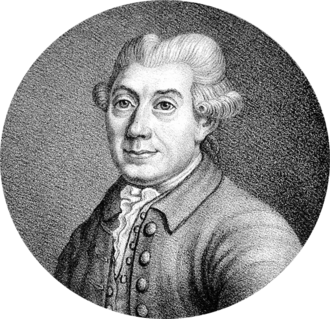
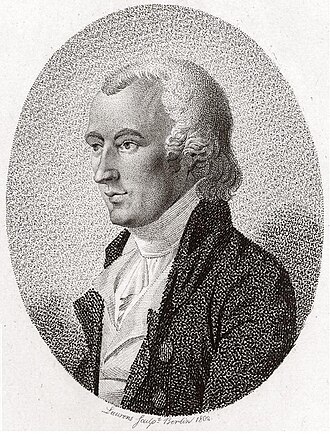
图:Carsten_niebuhr.jpg: Unknown derivative work: PleaseStand (t… · Public domain · Wikimedia Commons
卡斯腾·尼布尔1733—1815
Carsten Niebuhr
German mathematician, botanist, cartographer and explorer in Danish service (1733–1815)
Carsten Niebuhr, or Karsten Niebuhr, was a German mathematician, cartographer, and explorer in the service of Denmark-Norway. He is renowned for participating in the Danish Arabia Expedition (1761–1767) and for publishing the first Hausa language vocabulary in Latin script, in collaboration with the Tripolitan diplomat Abd al-Rahman Aga.
摘自英文维基百科「Carsten Niebuhr」(英文维基百科,暂无中文条目),CC BY-SA 4.0
- 出生
- 1733 年 3 月 17 日,Lüdingworth
- 逝世
- 1815 年 4 月 26 日,梅尔多夫
- 国籍
- 不莱梅-韦尔登、荷尔斯泰因公国
- 学科
- 生物学、数学、天文学、工程与发明、博物与综合
- 职业
- 数学家、探险家、制图师、自然科学家
- 母语 / 工作语言
- 丹麦语
- 母校
- 哥廷根大学
研究领域
学会与院士
百科正文
本条目暂无中文维基百科条目,下面是英文维基百科原文。
He was the father of the Danish-German statesman and historian Barthold Georg Niebuhr, who published an account of his father's life in 1817.
Early life and education
Niebuhr was born in Lüdingworth (now a part of Cuxhaven, Lower Saxony) in what was then Bremen-Verden. His father Barthold Niebuhr (1704-1749) was a successful farmer and owned his own property. Carsten and his sister were educated at home by a local school teacher, then he attended the Latin School in Otterndorf, near Cuxhaven.
Originally Niebuhr had intended to become a surveyor, but in 1757 he went to the Georgia Augusta University of Göttingen, at this time Germany's most progressive institution of higher education. Niebuhr was probably a bright student because in 1760 Johann David Michaelis (1717-1791) recommended him as a participant in the Danish Arabia expedition (1761-1767), mounted by Frederick V of Denmark (1722–1766). For a year and a half before the expedition Niebuhr studied mathematics, cartography and navigational astronomy under Tobias Mayer (1723–1762), one of the premier astronomers of the 18th century, and the author of the Lunar Distance Method for determining longitude. Niebuhr's observations during the Arabia Expedition proved the accuracy and the practicality of this method for use by mariners at sea.
Expeditions
The expedition sailed in January 1761 via Marseille and Malta to Istanbul and Alexandria. Then the members of the expedition visited Cairo and Sinai, before traversing the Red Sea via Jiddah to Yemen, which was their main destination.
In Mokha, on 25 May 1763, the expedition's philologist, Frederik Christian von Haven, died, and on 11 July 1763, on the way to Sanaa, the capital of Yemen, its naturalist Peter Forsskål also died.
In Sanaa the remaining members of the expedition had an audience with the Imam of Yemen al-Mahdi Abbas (1719–1775), but suffered from the climate and returned to Mocha. Niebuhr seems to have preserved his own life and restored his health by adopting native dress and eating native food.
From Mocha the expedition continued to Bombay, the expedition's artist Georg Wilhelm Baurenfeind died on the 29th of August and the expedition's servant Lars Berggren on the following day; both were buried at sea. The surgeon Christian C. Kramer (1732–1763) also died, soon after landing in Bombay. Niebuhr was the only surviving member. He stayed in Bombay for fourteen months and then returned home by way of Muscat, Bushire, Shiraz, and Persepolis.
Scientific collaboration with Abd-al-Rahman Aga
In the summer of 1772, an embassy from the Regency of Tripoli arrived in Copenhagen. Carsten Niebhur was asked to assist the official interpreter, Andreas Æreboe, who did not have a sufficient command of Arabic. The embassy was led by the Tripolitan diplomat and statesman Abd-al-Rahman Aga, who had been a frequent visitor to European courts since 1763. The two men met for the first time at the Tripolitan ambassador’s residence on July 5, and then on numerous occasions thereafter, until November 1772. During these meetings, a very fruitful intellectual collaboration developed, involving the exchange of manuscripts and translations.
Niebhur then wrote a series of articles drawing on the knowledge of Abd-al-Rahman Aga, as well as that of two of his enslaved servants who had accompanied him to Copenhagen—one from Timbuktu and the other from Hausaland. This series of articles consists of “observations by a figure from Tripoli on the interior of Africa, cross-referenced with the accounts of two African servants or slaves, then analyzed and narrated by a German explorer specializing in Arabia”. The text also contains the first list of Hausa language vocabulary ever transcribed into Latin script.
Family and later career
In 1773, Niebuhr married Christiane Sophia Blumenberg, the daughter of the crown physician, and for some years he held a post in the Danish military service, which enabled him to remain in Copenhagen. In 1776 he was elected a foreign member of the Royal Swedish Academy of Sciences. In 1778 he accepted a position in the civil service of Danish Holstein, and went to reside at Meldorf (Ditmarschen). In 1806 he was promoted to Etatsrat, and in 1809 was made a Knight of the Order of the Dannebrog, one of Denmark–Norway's most valued honours for service.
Writing and research
Niebuhr's first book, Beschreibung von Arabien, was published in Copenhagen in 1772, the Danish government providing subsidies for the engraving and printing of its numerous illustrations. This was followed in 1774 and 1778 by the first two volumes of Niebuhr's Reisebeschreibung nach Arabien und andern umliegender Ländern. These works (particularly the one published in 1778), and most specifically the accurate copies of the cuneiform inscriptions found at Persepolis, were to prove to be extremely important to the decipherment of cuneiform writing. Before Niebuhr's publication, cuneiform inscriptions were often thought to be merely decorations and embellishments, and no accurate decipherments or translations had been made up to that point. Niebuhr demonstrated that the three trilingual inscriptions found at Persepolis were in fact three distinct forms of cuneiform writing (which he termed Class I, Class II, and Class III) to be read from left to right. His accurate copies of the trilingual inscriptions gave Orientalists the key to finally crack the cuneiform code, leading to the discovery of Old Persian, Akkadian, and Sumerian.
Death and legacy
Niebuhr died in Meldorf in 1815.
Johann Wolfgang von Goethe (1749-1832) highly prized Niebuhr's works. In 1811 he wrote to Niebuhr's son, Barthold Georg Niebuhr, that "You carry a name which I have learned to honour since my youth."
Carsten Niebuhrs Gade, a street in the port area of Copenhagen, is named after him.
In 2011, Copenhagen's National Library and National Museum held exhibitions of Carsten Niebuhr's life and work, celebrating the 250th anniversary of the Danish Arabia Expedition's commencement. Commemorative Carsten Niebuhr postal stamps were issued. And in the same year the Danish Ministry of Foreign Affairs had planned a series of cultural events based on the Expedition and Niebuhr's work that would take place in Ankara, Cairo, Damascus, Beirut, Tehran, and Yemen. It has been suggested that these efforts were intended in part to repair the reputational damage in the Islamic world caused by the Danish cartoon controversy. Ultimately, the planned events were prevented by the Arab Spring.
以上节选摘自英文维基百科「Carsten Niebuhr」,按 CC BY-SA 4.0 使用,去掉了参考文献、外部链接等尾部小节,公式改写成了纯文本。篇幅所限,较长的小节只摘了开头一部分,有的小节没有收;全文、配图和出处见原文。
同一学科、同时代的科学家





同一学科的科学家
更多 ›