格物
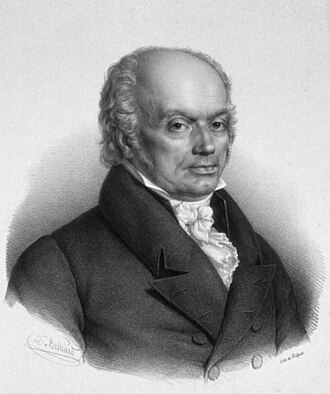
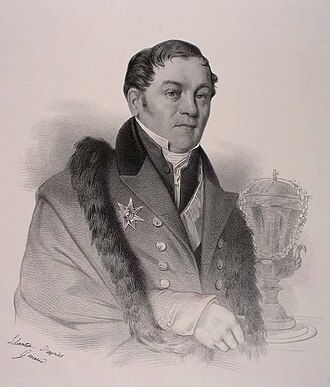
图:Zéphirin Félix Jean Marius Belliard (1798–), engraver Delpec… · Public domain · Wikimedia Commons
- 出生
- 1758 年 3 月 9 日,蒂芬布龙
- 逝世
- 1828 年 8 月 22 日,蒙鲁日
- 国籍
- 巴登大公国、法国
- 学科
- 生物学、医学
- 职业
- 医生、神经学家、解剖学家
- 母语 / 工作语言
- 法语、德语
- 母校
- 斯特拉斯堡大学、维也纳大学
研究领域
师承
来自 Wikidata 的「博士导师」「师从」「博士生」「学生」记录,可能不全。
学会与院士
百科正文
生平
加尔1758年出生在巴登Tiefenbronn村一个富裕的意大利裔罗马天主教羊毛商人家庭。一个多世纪以来,加尔家族在该地区远近闻名。作为第二个长子,他一开始想做神职人员,但后来选择在斯特拉斯堡大学学习医学。1785年,他在奥地利维也纳取得了哲学博士学位,改名为弗朗兹·加洛(Franz Gallo)开始行医。
17世纪90年代,加尔放弃行医,开办讲座,宣扬他的学说。
1806年,加尔和他的助手施普尔次海姆定居巴黎。不久,拿破仑介入,阻止加尔讲授他的学说。加尔重新行医,先后做过梅特涅亲王、圣西门、司汤达的私人医生。
1808年,法兰西学会委托比较解剖学家乔治·居维叶组建一个委员会评估加尔的学说,拒绝承认加尔的学说是科学,也没有排除加尔是正确的可能性。
1813年,加尔和施普尔次海姆因在哲学上的分歧过大而决裂。
1817年,加尔被庇护七世逐出教会,著作成为禁书。他的脑在尸检中被取出称重。
1828年8月22日,加尔在巴黎逝世。他结过婚,但没有直系后裔。奥地利Baden bei Wien的Rollet博物馆收藏着他的几片头盖骨。
工作
1800年,加尔提出了颅相学的概念,一种根据外部的头骨形状来确定人精神道德的个性和发展的方法。尽管他的理论有很多不科学的地方,他还是为神经学做了一定贡献。1823年,他当选为瑞典皇家科学院的外籍院士。
以上内容摘自维基百科「弗朗兹·约瑟夫·加尔」,按 CC BY-SA 4.0 使用,去掉了参考文献、外部链接等尾部小节,公式改写成了纯文本。全文、配图和出处见原文。
英文维基百科补充中文条目比较短,下面是英文条目「Franz Joseph Gall」的原文
Franz Joseph Gall or Franz Josef Gall (German: [gal]; 9 March 1758 – 22 August 1828) was a German neuroanatomist, physiologist, and pioneer in the study of the localization of mental functions in the brain.
Claimed as the founder of the pseudoscience of phrenology,
Gall became an early and important researcher in his fields. His contributions to the field of neuropsychology, controversial at the time, have become widely regarded as pseudoscience. However, Gall's study of phrenology helped to establish psychology, contributed to the emergence of the naturalistic approach to the study of man, and played an important part in the development of theories of evolution,
anthropology, and sociology.
Early life
Gall was born in the village of Tiefenbronn to a wealthy Roman Catholic wool merchant. The Galls, originally a noble family from Lombardy, had been the leading family in the area for over a century. His father was the mayor of Tiefenbronn and he was one of 12 children, only 7 of whom lived to adulthood.
Gall's scientific inquiry began in his youth. As a boy, he was fascinated by the differences between himself, his siblings, and his classmates.
Education and early career
As the second eldest son, he was intended for the priesthood but chose instead to study medicine at the University of Strasbourg. In his advanced studies, he again made observations about his classmates. He noticed that many of the particularly bright students had prominent eyeballs and concluded that this could not be purely coincidental.
He later completed his degree in Vienna, Austria. While in medical school, he studied under Johann Hermann and Maximilian Stoll who impressed upon him the importance of natural observation.
Contributions to phrenology
Based on his early observations about the skull sizes and facial features of his classmates, Gall developed the theory of Organology and the method of Cranioscopy that would later be known as Phrenology. Gall's version of Organology states that the mind is a collection of independent entities housed within the brain. Cranioscopy is a method to determine the personality and development of mental and moral faculties on the basis of the external shape of the skull.
Relationship with Johann Spurzheim
In 1800, Johann Spurzheim attended one of Gall's public lectures and was hired as an assistant to help with public medical demonstrations. In 1804, he became Gall's full-time research partner. They worked together for years to develop theories about brain localization and function. In 1813, Spurzheim separated from Gall in order to make a name for himself in Britain. Gall would later accuse Spurzheim of plagiarism and perverting his work. It was Spurzheim who would give the name phrenology to Gall's theories.
Other achievements
Other than his contributions to phrenology, Gall is lesser known for his other achievements. While developing his theories on localization of function, Gall significantly advanced the science of dissection. Instead of slicing randomly, as had been the practice in previous years, Gall's method involved slow exploration of the entire brain structure and the separation of individual fibers. This shift in methodology was extremely influential in future discoveries of the brain.
Reception and controversy
Gall's concepts on brain localization were revolutionary, and led to many religious leaders and scientists to take exception to his theories. The Catholic Church considered his theory as contrary to the established tenets of Catholicism. Established science also condemned these ideas for lack of scientific proof of his theory. Still others attempted to discredit Gall because they believed he had not given rightful credit to the theories and scientists who influenced him.
Legacy
In spite of many problems associated with his work, Gall made significant contributions to the field of neurological science. He died in Paris, on 22 August 1828. Although married, he remained childless. Some direct descendants of his brothers lived in Germany until 1949. A collection of his skulls can be seen at the Rollett Museum in Baden bei Wien, Austria, where several of his relatives now live.
Today, phrenology is thought of as a huge mis-step by the scientific community.
以上节选摘自英文维基百科「Franz Joseph Gall」,按 CC BY-SA 4.0 使用,去掉了参考文献、外部链接等尾部小节,公式改写成了纯文本。篇幅所限,较长的小节只摘了开头一部分,有的小节没有收;全文、配图和出处见原文。
同一学科、同时代的科学家


同一学科的科学家
更多 ›