格物
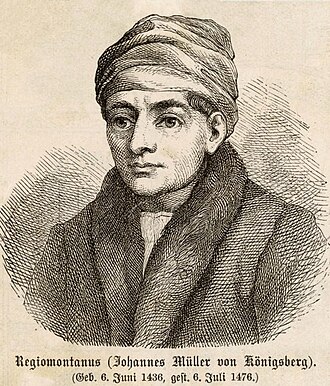
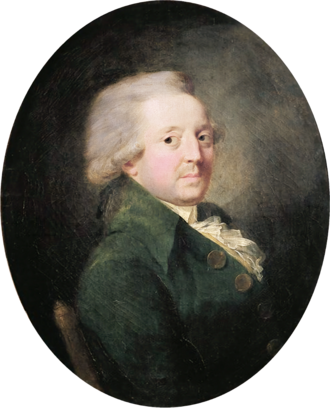
图:作者不详 · Public domain · Wikimedia Commons
- 出生
- 1436 年 6 月 6 日,巴伐利亚州柯尼希斯贝格
- 逝世
- 1476 年 7 月 6 日,罗马
- 国籍
- 神圣罗马帝国
- 学科
- 数学、天文学、博物与综合
- 职业
- 天文学家、数学家、数学史学家、占星家
- 母语 / 工作语言
- 拉丁语、德语
- 母校
- 莱比锡大学(1450 年)、维也纳大学(1457 年)
- 工作单位
- 维也纳大学(1457—1461)
研究领域
主要贡献
代表成就
师承
师从1
来自 Wikidata 的「博士导师」「师从」「博士生」「学生」记录,可能不全。
百科正文
米勒生于神圣罗马帝国柯尼希斯贝格,年仅13随即成为莱比锡大学学生,三年后转往奥地利维也纳大学就读,为格奥尔格·冯·普尔巴赫的学生,曾经到意大利学习托勒密的天文学。米勒后来回到德国,在纽伦堡定居下来后,和他的朋友兼赞助人伯恩哈德·瓦尔特一起进行天文观测。两人一同编印航海历书,他对西班牙和葡萄牙的航海者有极大的帮助。米勒是第一个改正天文观测中光线通过大气的折射差,也是第一个在天文学上使用机制钟的人。后来他去罗马想要改革历法,但是还没有改革成功就在当地去世了。
以上内容摘自维基百科「约翰内斯·米勒」,按 CC BY-SA 4.0 使用,去掉了参考文献、外部链接等尾部小节,公式改写成了纯文本。全文、配图和出处见原文。
英文维基百科补充中文条目比较短,下面是英文条目「Regiomontanus」的原文
Johannes Müller von Königsberg (6 June 1436 – 6 July 1476), better known as Regiomontanus , was a mathematician, astrologer and astronomer of the German Renaissance, active in Vienna, Buda and Nuremberg. His contributions were instrumental in the development of Copernican heliocentrism in the decades following his death.
Regiomontanus wrote under the Latinized name of Ioannes de Monteregio (or Monte Regio; Regio Monte); the toponym Regiomontanus was first used by Philipp Melanchthon in 1534. He is named after Königsberg in Lower Franconia, not the larger Königsberg (modern Kaliningrad) in Prussia.
Life
Although little is known of Regiomontanus' early life, it is believed that at eleven years of age, he became a student at the University of Leipzig, Saxony. In 1451 he continued his studies at Alma Mater Rudolfina, the university in Vienna, in the Duchy of Austria, where he became a pupil and friend of Georg von Peuerbach. In 1452 he was awarded his bachelor's degree (baccalaureus), and he was awarded his master's degree (magister artium) at the age of 21 in 1457. He lectured in optics and ancient literature.
In 1460 the papal legate Basilios Bessarion came to Vienna on a diplomatic mission. Being a humanist scholar with a great interest in the mathematical sciences, Bessarion sought out Peuerbach's company. George of Trebizond who was Bessarion's philosophical rival had recently produced a new Latin translation of Ptolemy's Almagest from the Greek, which Bessarion, correctly, regarded as inaccurate and badly translated, so he asked Peuerbach to produce a new one. Peuerbach's Greek was not good enough to do a translation but he knew the Almagest intimately so instead he started work on a modernised, improved abridgement of the work. Bessarion also invited Peuerbach to become part of his household and to accompany him back to Italy when his work in Vienna was finished. Peuerbach accepted the invitation on the condition that Regiomontanus could also accompany them.
Work
During his time in Italy he completed Peuerbach's abridgement of Almagest, Epytoma in almagesti Ptolemei. In 1464, he completed De triangulis omnimodis ("On Triangles of All Kinds"). De triangulis omnimodis was one of the first textbooks presenting the current state of trigonometry and included lists of questions for review of individual chapters. In it he wrote:
You who wish to study great and wonderful things, who wonder about the movement of the stars, must read these theorems about triangles. Knowing these ideas will open the door to all of astronomy and to certain geometric problems.
In 1465, he built a portable sundial for Pope Paul II.
In Epytoma in almagesti Ptolemei, he critiqued the translation of Almagest by George of Trebizond, pointing out inaccuracies. Later Nicolaus Copernicus would refer to this book as an influence on his own work.
A prolific author, Regiomontanus was internationally famous in his lifetime. Despite having completed only a quarter of what he had intended to write, he left a substantial body of work. Nicolaus Copernicus' teacher, Domenico Maria Novara da Ferrara, referred to Regiomontanus as having been his own teacher.
Legacy
Simon Stevin, in his book describing decimal representation of fractions (De Thiende), cites the trigonometric tables of Regiomontanus as suggestive of positional notation.
Regiomontanus designed his own astrological house system, which became one of the most popular systems in Europe.
In 1561, Daniel Santbech compiled a collected edition of the works of Regiomontanus, De triangulis planis et sphaericis libri quinque (first published in 1533) and Compositio tabularum sinum recto, as well as Santbech's own Problematum astronomicorum et geometricorum sectiones septem. It was published in Basel by Henrich Petri and Petrus Perna.
There is an image of him in Hartmann Schedel's 1493 Nuremberg Chronicle. He is holding an astrolabe. Yet, although there are thirteen illustrations of comets in the Chronicle (from 471 to 1472), they are stylized, rather than representing the actual objects.
The crater Regiomontanus on the Moon is named after him.
An observatory open to the public in Nuremberg, de:Regiomontanus-Sternwarte, is named after him.
以上节选摘自英文维基百科「Regiomontanus」,按 CC BY-SA 4.0 使用,去掉了参考文献、外部链接等尾部小节,公式改写成了纯文本。篇幅所限,较长的小节只摘了开头一部分,有的小节没有收;全文、配图和出处见原文。
同一学科、同时代的科学家
同一学科的科学家
更多 ›