格物
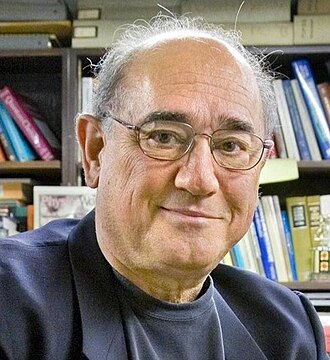
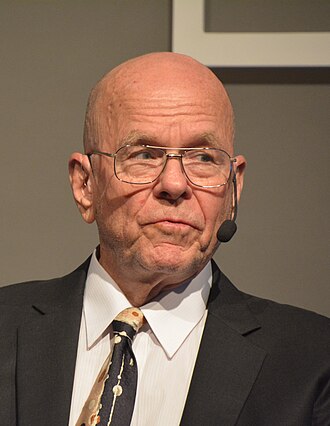
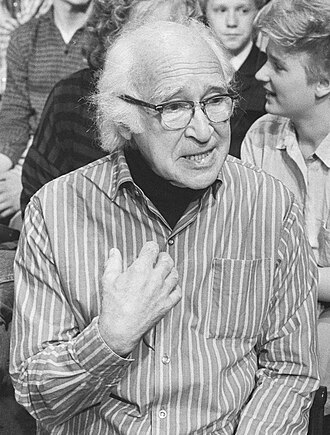
图:The original uploader was Paul Ganssle at English Wikipedia. · CC BY-SA 3.0 · Wikimedia Commons
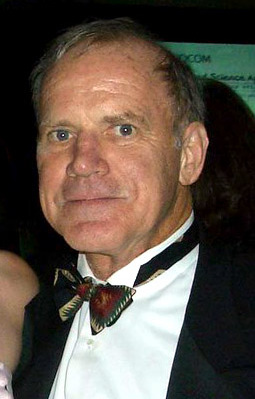
亚历山大·派因斯1945—2024
Alexander Pines
化学教授
亚历山大·派因斯,加州大学伯克利分校格伦·T·西博格化学教授,劳伦斯伯克利国家实验室材料科学部以及QB3定量生物医学研究协会和生物工程部学院联盟的资深科学家。他生于1945年,在罗德西亚长大,在以色列耶路撒冷希伯来大学获学士学位。1968年去美国,1972年在麻省理工获博士学位,同年加入伯克利研究中心。
摘自维基百科「亚历山大·派因斯」,CC BY-SA 4.0
- 出生
- 1945 年 6 月 22 日,特拉维夫
- 逝世
- 2024 年 11 月 1 日,伯克利
- 国籍
- 美国
- 学科
- 化学
- 职业
- 化学家、研究者、大学教师
- 母语 / 工作语言
- 英语
- 母校
- 耶路撒冷希伯来大学、麻省理工学院(哲学博士,1972 年)
- 工作单位
- 加州大学伯克利分校
研究领域
师承
博士导师1
博士生2
来自 Wikidata 的「博士导师」「师从」「博士生」「学生」记录,可能不全。
所获奖项(16)
- 1988欧内斯特·奥兰多·劳伦斯奖
- 1988Bourke Award
- 1991沃尔夫化学奖
- 1993Centenary Prize
- 1998朗缪尔奖
- 1999F. A. Cotton Medal
- 1999doctor honoris causa from the Pierre and Marie Curie University
- 2000Remsen Award
- 2001Dickson Prize in Science
- 2001美国科学促进会会士
- 2002英国皇家学会外籍会员
- 2003格伦·西奥多·西博格奖章
- 2004法拉第讲座奖
- 2010honorary doctor of the Paul Cézanne University
- —古根海姆学者奖
- —美国物理学会会士
学会与院士
百科正文
英文维基百科补充中文条目比较短,下面是英文条目「Alexander Pines」的原文
Alexander Pines (Hebrew: אלכסנדר פינס; June 22, 1945 – November 1, 2024) was an American chemist. He was the Glenn T. Seaborg Professor Emeritus, University of California, Berkeley, Chancellor's Professor Emeritus and Professor of the Graduate School, University of California, Berkeley, and a member of the California Institute for Quantitative Biosciences (QB3) and the Department of Bioengineering.
Background
Pines was born on June 22, 1945, and grew up in Bulawayo in Southern Rhodesia (now Zimbabwe). He studied undergraduate mathematics and chemistry in Israel at Hebrew University of Jerusalem. Coming to the United States in 1968, Pines obtained his Ph.D. in chemical physics at M.I.T. in 1972 and joined the UC Berkeley faculty later that year.
Pines died on November 1, 2024, at the age of 79.
Research
Pines was a pioneer in the development and applications of nuclear magnetic resonance (NMR) spectroscopy of non-liquid samples. In his early work, he demonstrated time-reversal of dipole-dipole couplings in many-body spin systems, and introduced high sensitivity, cross polarization NMR of dilute spins such as carbon-13 in solids (Proton Enhanced Nuclear Induction Spectroscopy), thereby helping to launch the era of modern solid-state NMR in chemistry. He also developed the areas of multiple-quantum spectroscopy, adiabatic sech/tanh inversion pulses, zero-field NMR, double rotation and dynamic-angle spinning, iterative maps for pulse sequences and quantum control, and the quantum geometric phase. His combination of optical pumping and cross-polarization made it possible to observe enhanced NMR of surfaces and the selective "lighting up" of solution NMR and magnetic resonance imaging (MRI) by means of laser-polarized xenon.
Until he retired to emeritus status, his program was composed of two complementary components. The first is the establishment of new concepts and techniques in NMR and MRI, in order to extend their applicability and enhance their capability to investigate molecular structure, organization and function from materials to organisms. Examples of methodologies emanating from these efforts include: novel polarization and detection methods, ex-situ and mobile NMR and MRI, laser-polarized NMR and MRI, functionalized NMR biosensors and molecular imaging, ultralow and zero-field SQUID NMR and MRI, remote detection of NMR and MRI amplified by means of laser magnetometers, and miniaturization including fluid flow through porous materials and "microfluidic chemistry and NMR/MRI on a chip". The second component of his research program involves the application of such novel methods to problems in chemistry, materials science, and biomedicine.
Awards
Among his many prestigious awards and honors, Pines received the Langmuir Medal of the American Chemical Society, the Faraday Medal of the Royal Society of Chemistry, the Wolf Prize for Chemistry (together with Richard R. Ernst) in 1991. He was awarded the F.A. Cotton Medal for Excellence in Chemical Research of the American Chemical Society in 1999. In 2005, an Ampere Symposium was held in honor of Pines' 60th birthday in Chamonix, France, and in 2008, he was awarded the Russell Varian Prize at the European Magnetic Resonance Conference. (Previous Varian Prizes winners: Jean Jeener, Erwin Hahn, Nicolaas Bloembergen, John. S. Waugh, and Alfred G. Redfield.) Pines was also recognized by numerous teaching honors, including the University of California's Distinguished Teaching Award. He was a member of the U.S. National Academy of Sciences, the American Academy of Arts and Sciences and a Foreign Member of the Royal Society (London); he was Doctor Honoris Causa at the Weizmann Institute of Science, Universite Paul Cezanne, University of Paris and the University of Rome, and past President of the International Society of Magnetic Resonance.
以上内容摘自英文维基百科「Alexander Pines」,按 CC BY-SA 4.0 使用,去掉了参考文献、外部链接等尾部小节,公式改写成了纯文本。全文、配图和出处见原文。