格物

图:Daderot · Public domain · Wikimedia Commons
- 学名
- Brassica oleracea
- 分类等级
- 种
- 上级类群
- 芸苔属
- 大类
- 被子植物
- 命名
- 卡尔·林奈,1753 年
- 中文别名
- 野甘蓝、卷心菜
- 保护状况(IUCN)
- 数据缺乏
- 用途
- 药用植物、蔬菜
- 数据库
- NCBI 分类 · GBIF · IUCN 红色名录
百科正文
变种
白花甘蓝 Brassica oleracea var. albiflora Kuntz.
结球甘蓝(Cabbage),包括卷心菜、皱叶甘蓝、普通甘蓝、紫甘蓝。
球茎甘蓝(Kohlrabi),即苤蓝。
抱子甘蓝(Brussels sprout)。
花椰菜(Cauliflower)。
西蓝花(Broccoli)。
羽衣甘蓝(Kale),包括菜用及观赏用。
芥蓝(Chinese kale / Gai Lan)。
杂交变种
西兰苔(Broccolini)
以上内容摘自维基百科「甘藍」,按 CC BY-SA 4.0 使用,去掉了参考文献、外部链接等尾部小节,公式改写成了纯文本。全文、配图和出处见原文。
英文维基百科补充中文条目比较短,下面是英文条目「Brassica oleracea」的原文
Brassica oleracea, also known as wild cabbage in its uncultivated form, is a plant of the family Brassicaceae.
The species originated from feral populations of related plants in the Eastern Mediterranean, where it was most likely first cultivated. It has many common cultivars that are used as culinary vegetables, including cabbage, broccoli, cauliflower, romanesco, kale, Brussels sprout, collard, Savoy cabbage, kohlrabi, and gai lan.
Description
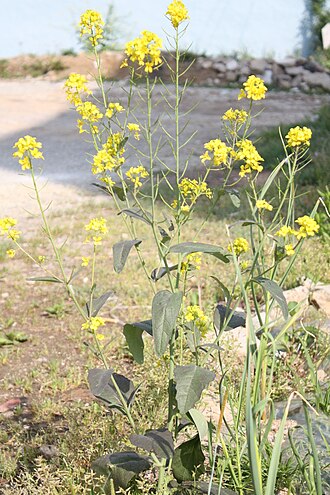
Wild Brassica oleracea is a tall biennial or perennial plant that forms a stout rosette of large leaves in its first year. The grayish-green leaves are fleshy and thick, helping the plant store water and nutrients in difficult environments. In its second year, a woody spike grows up to 1.5 metres (5 ft) tall, from which branch off stems with long clusters of four-petaled yellow flowers.
Taxonomy
Origins
According to the triangle of U theory, B. oleracea is very closely related to five other species of the genus Brassica. A 2021 study suggests that Brassica cretica, native to the Eastern Mediterranean, particularly Greece and the Aegean Islands, was the closest living relative of cultivated B. oleracea, thus supporting the view that its cultivation originated in the Eastern Mediterranean region, with later admixture from other Brassica species. Genetic analysis of nine wild populations on the French Atlantic coast indicated their common feral origin, deriving from domesticated plants escaped from fields and gardens.
The cultivars of B. oleracea are grouped by developmental form into several major cultivar groups, of which the Acephala ("non-heading") group remains most like the natural wild cabbage in appearance.
Etymology
"Brassica" was Pliny the Elder's name for several cabbage-like plants.
Its specific epithet oleracea means 'vegetable/herbal' in Latin and is a form of holeraceus (oleraceus).
Distribution and habitat
Wild cabbage is considered to be native only to the coasts of France, Great Britain, and Spain, although widely naturalized elsewhere. Although rarely abundant, wild cabbage is also found on the coasts of Ireland, Italy, and the German island of Heligoland.
Wild cabbage is a hardy plant with high tolerance for salt and lime. Its intolerance of competition from other plants typically restricts its natural occurrence to limestone sea cliffs, like the chalk cliffs on both sides of the English Channel.
Cultivation
The species has become established as an important human food crop, used because of its large food reserves, which are stored over the winter in its leaves. It has been bred into a wide range of cultivars, including cabbage, broccoli, cauliflower, brussels sprouts, collards, and kale, some of which are hardly recognizable as being members of the same genus, let alone species. The historical genus of Crucifera, meaning "cross-bearing" in reference to the four-petaled flowers, may be the only unifying feature beyond taste.
The plant is tolerant of a variety of soil conditions between pH 6.0 and 7.5, but grows particularly well in alkaline soils in full sunlight, with good drainage and high amounts of nitrogen. The plant can grow in partial shade, but care must be taken to provide sufficient ventilation, as this reduces the prevalence of downy mildew.
History
Researchers believe that B. oleracea has been cultivated for several thousand years, but its history as a domesticated plant is not clear before Greek and Roman times, when it was a well-established garden vegetable.
Uses
Human genetics in relation to taste
The TAS2R38 gene encodes a G protein-coupled receptor that functions as a taste receptor, mediated by ligands such as propylthiouracil (PTU) and phenylthiocarbamide that bind to the receptor and initiate signaling that confers various degrees of taste perception. Vegetables in the brassica family, such as collard greens, kale, broccoli, cabbage, and Brussels sprouts, contain glucosinolates and isothiocyanates, which resemble PTU, and therefore much of the perceived "bitterness" of these vegetables is mediated through TAS2R38. Bitter taste receptors in the TS2R family are also found in gut mucosal and pancreatic cells in humans and rodents. These receptors influence release of hormones involved in appetite regulation, such as peptide YY and glucagon-like peptide-1, and therefore may influence caloric intake and the development of obesity. Thus, bitter taste perception may affect dietary behaviors by influencing both taste preferences and metabolic hormonal regulation.
以上节选摘自英文维基百科「Brassica oleracea」,按 CC BY-SA 4.0 使用,去掉了参考文献、外部链接等尾部小节,公式改写成了纯文本。篇幅所限,较长的小节只摘了开头一部分,有的小节没有收;全文、配图和出处见原文。