格物
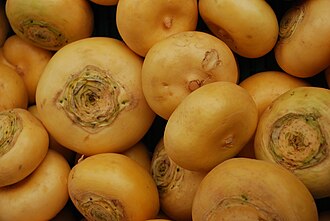
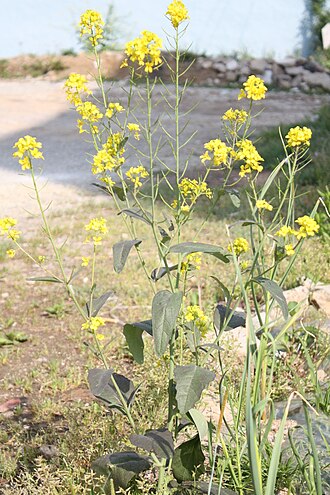
图:Osopolar · CC BY-SA 3.0 · Wikimedia Commons
- 学名
- Brassica rapa
- 分类等级
- 种
- 上级类群
- 芸苔属
- 大类
- 被子植物
- 命名
- 卡尔·林奈,1753 年
- 中文别名
- 芜菁、蔓青、变萝卜、芜青、圆根
- 异名
- Brassica ruvo
- 用途
- 蔬菜、药用植物、饲料、食物
- 数据库
- NCBI 分类 · GBIF
百科正文
在十八世纪时,卡尔·林奈视芜菁和油用的变种(即白菜型油菜)为不同的品种并分别命名为 B. rapa 和 B. campestris。然而二十世纪的分类学家发现这些植物可以互相异体受精,因此认为是相同的物种。因为芜菁更早先被林奈氏命名,Brassica rapa 被继承下来作为种学名,而 B. campestris 已非正式学名。
此品种变种(B. rapa var. campestris)的种子也是植物油的来源,所以此品种被泛称为白菜型油菜;芸苔属其他较常见的品种为甘蓝型油菜(Brassica napus)和芥菜型油菜(Brassica juncea)。
亚种及变种
- 芜菁(学名:Brassica rapa subsp. rapa)
- 芸苔(学名:Brassica rapa subsp. oleifera)
- 北方小油菜
大白菜(学名:Brassica rapa subsp. pekinensis)为结球白菜
华北小白菜
小白菜(学名:Brassica rapa subsp. chinensis)为不结球白菜
上海白菜
南方油白菜
菜苔(学名:Brassica rapa subsp. chinensis var. parachinensis)
- 水菜(学名:Brassica rapa var. nipposinica)
- 小松菜(学名:Brassica rapa var. perviridis)
- 塌棵菜(学名:Brassica rapa var. narinosa)
以上内容摘自维基百科「芸薹」,按 CC BY-SA 4.0 使用,去掉了参考文献、外部链接等尾部小节,公式改写成了纯文本。全文、配图和出处见原文。
英文维基百科补充中文条目比较短,下面是英文条目「Brassica rapa」的原文
Brassica rapa is an annual to biennial plant species native to Eurasia that is from the Brassicaceae family. The B. rapa subspecies oleifera is an oilseed commonly known as turnip rape, field mustard, bird's rape, and keblock.
It has been widely cultivated into many forms, including the turnip (a root vegetable), komatsuna, Chinese cabbage, bomdong, pak choi / bok choy, and rapini. Its domesticated forms include turnips and leafy greens, such as bok choy and napa cabbage. The oilseed types are grown for food and industrial uses. Genetic studies indicate that B. rapa was one of the earliest domesticated brassicas, with turnip-like forms arising first and additional morphotypes developing independently across Eurasia. Wild, feral, and cultivated populations are found worldwide, making the species important agriculturally, economically, and ecologically.
Rapeseed oil is a general term for oil from some Brassica species. Food grade oil made from the seed of low-erucic acid Canadian-developed strains is also called canola oil, while non-food oil is called colza oil. Canola oil can be sourced from Brassica rapa and Brassica napus, which are commonly grown in Canada, and Brassica juncea, which is less common.
History
The geographic and genetic origins of B. rapa have been difficult to identify due to its long history of human cultivation, as well as difficulty finding Brassica seeds at archaeological sites. It is found in most parts of the world, and has returned to the wild many times as a feral plant or weed. Recent genomic studies show that many “wild” populations found in Europe and the Americas are actually feral descendants of cultivated plants, while actual wild populations appear to be from regions such as the Caucasus and Central Asia.
Genetic sequencing and environmental modeling have indicated that ancestral B.
Biology
Brassica rapa is an annual to biennial member of the mustard family. The wild and weedy forms typically have a slender taproot and a leafy rosette, whereas turnip forms form a swollen storage root. The stems are often upright and branched, and they usually grow to around 0.5–1.3 meters in height. The lower leaves are stalked and toothed or lobed, while the upper leaves are narrower. Most flowers have four yellow petals and, after flowering, they develop into narrow seed pods. Many forms of Brassica rapa can be differentiated by the presence of hairs on the stem and the type of fruit pod.
B. rapa can behave as a summer annual, winter annual, or biannual depending on the climate and management.
Adaptation
Brassica rapa is an extremely adaptable plant. It prefers moist soil that is well-drained at around 45-85°F, but it can also grow in heavy clay soils. It tolerates a broad pH range from 4.8 to 8.5. Although it grows best in full sun, it can also succeed in moderate shade. If light and temperature conditions are not ideal, B. rapa seeds can delay germination until conditions are favorable.
Uses
Cultivated varieties of B. rapa are consumed commonly as vegetables, such as turnip roots, napa cabbage, komatsuna, pak choi, and other leafy greens, particularly in East Asian, South Asian, and Mediterranean cuisines. The young leaves are a leaf vegetable eaten raw, while older leaves are typically cooked. The taproot and seeds can also be eaten raw, although the seeds contain an oil that can cause irritation for some people. Rapeseed oil from the plant is also used to make canola and colza oils.
B. rapa is also commonly used as a rotational cover crop for vegetables due to its ability to prevent erosion and deter disease. Because of their fast life-cycle and genetic diversity, the B.
Ecology and pollination
Brassica rapa is an early-season nectar and pollen source for a wide range of insects. Numerous pollinators are attracted to its bright yellow flowers, including bees, flies, and butterflies. A common visitor, the small white butterfly (Pieris rapae) uses the plant both as a nectar source and as a host for larval feeding. Conversely, insect pollination is also very important to the plant; insect pollination of B. rapa leads to 30% more yield when compared to self-fertilizing controls. Furthermore, B. rapa can undergo rapid genomic adaptations when selected on by bumblebees.
以上节选摘自英文维基百科「Brassica rapa」,按 CC BY-SA 4.0 使用,去掉了参考文献、外部链接等尾部小节,公式改写成了纯文本。篇幅所限,较长的小节只摘了开头一部分,有的小节没有收;全文、配图和出处见原文。