格物

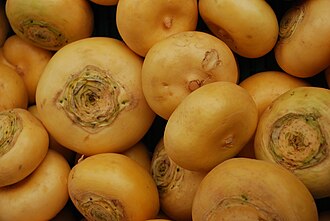
图:Didier Descouens · CC BY-SA 4.0 · Wikimedia Commons
- 学名
- Brassica napus
- 分类等级
- 种
- 上级类群
- 芸苔属
- 大类
- 被子植物
- 命名
- 卡尔·林奈,1753 年
- 用途
- 药用植物
- 数据库
- NCBI 分类 · GBIF
百科正文
油菜籽含芥酸、芥子碱、单宁等化学物质,含毒性。
栽培群
- 欧洲油菜Brassica napus Oleifera Group
- 羽衣油菜Brassica napus Pabularia Group
- 芜菁甘蓝Brassica napus Napobrassica Group
以上内容摘自维基百科「欧洲油菜」,按 CC BY-SA 4.0 使用,去掉了参考文献、外部链接等尾部小节,公式改写成了纯文本。全文、配图和出处见原文。
英文维基百科补充中文条目比较短,下面是英文条目「Rapeseed」的原文
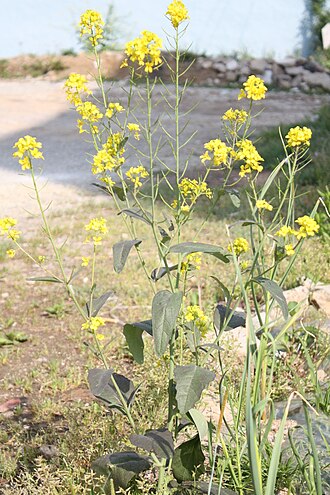
Rapeseed (Brassica napus subsp. napus), also known as rape, oilseed rape and canola, is a yellow-flowered member of the Brassicaceae family.
The plant is cultivated primarily for its oil-rich seed, which naturally contains mildly toxic erucic acid. The term canola refers to a group of rapeseed cultivars with very low levels of erucic acid that are prized as food for humans and animals. The plant is the third-largest source of vegetable oil and the second-largest source of protein meal in the world.
Description
Brassica napus grows to 100 centimetres (39 inches) in height with hairless, fleshy, pinnatifid and glaucous lower leaves which are stalked whereas the upper leaves have no petioles.
Rapeseed flowers are bright yellow and about 17 millimetres (3⁄4 in) across. They are radial and consist of four petals in a typical cross-form, alternating with four sepals. They have indeterminate racemose flowering starting at the lowest bud and growing upward in the following days. The flowers have two lateral stamens with short filaments, and four median stamens with longer filaments whose anthers split away from the flower's center upon flowering.
The rapeseed pods are green and elongated siliquae during development that eventually ripen to brown. They grow on pedicels 1 to 3 cm (3⁄8 to 1+3⁄16 in) long, and can range from 5 to 10 cm (2 to 4 in) in length. Each pod has two compartments separated by an inner central wall within which a row of seeds develops. The seeds are round and have a diameter of 1.5 to 3 mm (1⁄16 to 1⁄8 in).
Taxonomy
The species Brassica napus belongs to the flowering plant family Brassicaceae. Rapeseed is a subspecies with the autonym B. napus subsp. napus. It encompasses winter and spring oilseed, vegetable and fodder rape. Siberian kale is a distinct leaf rape form variety (B. napus var. pabularia) which used to be common as a winter-annual vegetable. The second subspecies of B. napus is B. napus subsp. rapifera (also subsp. napobrassica; the rutabaga, swede, or yellow turnip).
B. napus is a digenomic amphidiploid that occurred due to the interspecific hybridization between B. oleracea and B. rapa. It is a self-compatible pollinating species like the other amphidiploid Brassica species.
Etymology
The term "rape" derives from the Latin word for turnip, rāpa or rāpum, cognate with the Greek word ῥάφη, rhaphe.
Ecology
In Northern Ireland, B. napus and B. rapa are recorded as escapes in roadside verges and waste ground.
Cultivation
Crops from the genus Brassica, including rapeseed, were among the earliest plants to be widely cultivated by humankind as early as 10,000 years ago. Rapeseed was being cultivated in India as early as 4000 B.C.E. and it spread to China and Japan 2000 years ago.
Rapeseed is predominantly cultivated in its winter form in most of Europe and Asia due to the requirement of vernalization to start the process of flowering. It is sown in autumn and remains in a leaf rosette on the soil surface during the winter. The plant grows a long vertical stem in the next spring followed by lateral branch development. It generally flowers in late spring with the process of pod development and ripening occurring over a period of 6–8 weeks until midsummer.
In Europe, winter rapeseed is grown as an annual break crop in three to four-year rotations with cereals such as wheat and barley, and break crops such as peas and beans. This is done to reduce the possibility of pests and diseases being carried over from one crop to another.
Uses
Rapeseed is grown for the production of edible vegetable oils, animal feed, and biodiesel. Rapeseed was the third-leading source of vegetable oil in the world in 2000, after soybean and palm oil. It is the world's second-leading source of protein meal after soybean.
Vegetable oil
Rapeseed oil is one of the oldest known vegetable oils, but historically was used in limited quantities due to high levels of erucic acid, which is damaging to cardiac muscle of animals, and glucosinolates, which made it less nutritious in animal feed. Rapeseed oil previously contained up to 54% erucic acid in the 1970s. Food-grade oil derived from rapeseed cultivars, known as canola oil or low-erucic-acid rapeseed oil (LEAR oil), has now been generally recognized as safe by the United States Food and Drug Administration. Modern food-grade rapeseed/canola varieties are bred to contain very low erucic acid levels (often ≤2% of total fatty acids).
以上节选摘自英文维基百科「Rapeseed」,按 CC BY-SA 4.0 使用,去掉了参考文献、外部链接等尾部小节,公式改写成了纯文本。篇幅所限,较长的小节只摘了开头一部分,有的小节没有收;全文、配图和出处见原文。