格物

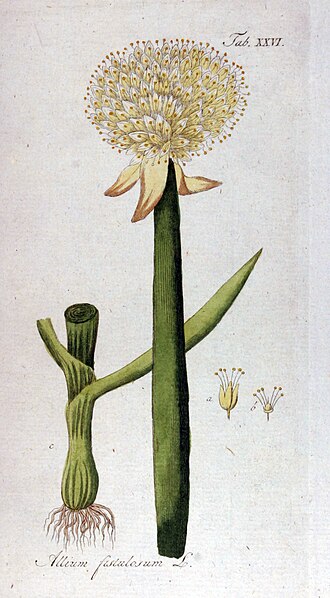
图:No machine-readable author provided. Charles P. assumed (bas… · Public domain · Wikimedia Commons
- 学名
- Allium ascalonicum
- 分类等级
- 种
- 上级类群
- 葱属
- 大类
- 被子植物
- 命名
- 卡尔·林奈,1756 年
- 中文别名
- 分葱、西亚火葱、香葱、细香葱、火葱(细香葱)
- 用途
- 药用植物、食物、香辛料
- 数据库
- NCBI 分类 · GBIF
百科正文
染色体数目16 (2n=16)。
用途
可作油葱酥等调味料。
市场上可见中空呈圆筒状的叶较一般大葱为短,葱管仅0.5厘米,葱头不到一厘米者,可能是不良品,被淘汰为青葱贩卖,或是农家自家栽培贩卖,因本种主要乃采收葱头(鳞茎)为主,本种是制作油葱的重要来源。
同名异物
在台湾花莲,阿美族也将薤(Allium chinense G. Don)称之为“火葱”。
以上内容摘自维基百科「火葱」,按 CC BY-SA 4.0 使用,去掉了参考文献、外部链接等尾部小节,公式改写成了纯文本。全文、配图和出处见原文。
英文维基百科补充中文条目比较短,下面是英文条目「Shallot」的原文
The shallot ( or) is a cultivar group of the onion. Until 2010, the (French red) shallot was classified as a separate species, Allium ascalonicum. The taxon was synonymized with Allium cepa (the common onion) in 2010, as the difference was too small to justify a separate species.
As part of the onion genus Allium, its close relatives include garlic, scallions, leeks, chives, and the Chinese onion.
Etymology and names
The names "scallion" and "shallot" are derived from the Old French eschalotte, by way of eschaloigne, from the Latin Ascalōnia caepa or Ascalonian onion, a namesake of the ancient city of Ascalon.
The term "shallot" is usually applied to the French red shallot (Allium cepa var. aggregatum, or the A. cepa aggregatum group). It is also used for the Persian shallot or musir (A. stipitatum) from the Zagros Mountains in Iran and Iraq, and the French gray shallot (Allium oschaninii), which is also known as griselle or "true shallot"; it grows wild from Central to Southwest Asia. The name shallot is also used for a scallion in New South Wales, Australia and among English-speaking people in Quebec, while the term "French shallot" refers to the plant referred to on this page. In most English-speaking nations, the name is pronounced with the emphasis on the last syllable in common with the French pronunciation, sha-LOT, while the emphasis is commonly made on the first syllable, SHAL-ət, in the United States.
The term "eschalot", derived from the French word échalote, can also be used to refer to the shallot.
Description and cultivation
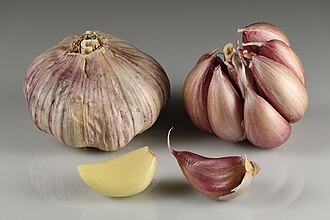
Like garlic, shallots are formed in clusters of offsets with a head composed of multiple cloves. The skin colour of shallots can vary from golden brown to gray to rose red, and their off-white flesh is usually tinged with green or magenta.
Shallots are extensively cultivated for culinary uses, propagated by offsets. In some regions ("long-season areas"), the offsets are usually planted in autumn (September or October in the Northern Hemisphere). In some other regions, the suggested planting time for the principal crop is early spring (typically in February or the beginning of March in the Northern Hemisphere).
In planting, the tops of the bulbs should be kept a little above ground, and the soil surrounding the bulbs is often drawn away when the roots have taken hold. They come to maturity in summer, although fresh shallots can now be found year-round in supermarkets. Shallots should not be planted on ground recently manured. Shallots suffer damage from leek moth larvae, which mine into the leaves or bulbs of the plant.
Nutrition
A raw shallot contains 80% water, 17% carbohydrates, 2.5% protein and a negligible amount of fat (table). In a reference amount of 100 grams (3.5 oz), raw shallot supplies 72 calories and is a rich source of vitamin B6 (20% of the Daily Value, DV), while providing moderate amounts of manganese (13% DV) and potassium (11% DV). No other micronutrients occur in significant amounts (below 10% DV, table).
Uses
Culinary
Shallots are used in cooking. They may be pickled. Finely sliced, deep-fried shallots are used as a condiment in Asian cuisine, often served with porridge. Shallots taste similar to other cultivars of the common onion, but have a milder flavor. Like onions, when sliced, raw shallots release substances that irritate the human eye, resulting in production of tears.
Fresh shallots can be stored in a cool, dry area (0 to 4 °C, 32 to 40 °F, 60 to 70% RH) for six months or longer. Chopped, dried shallots are available.
Europe
In Europe, the 'Pikant', 'Atlas', and 'Ed's Red' cultivars of shallots are the most common.
Asia
Shallots are the traditional choice for many dishes in Sri Lankan cuisine, including pol sambola, lunu miris, and many meat, fish, and vegetable dishes.
In most Indian cuisines, the distinction between onions and shallots is weak; larger varieties of shallot are sometimes confused with small red onions and used interchangeably. Indeed, most parts of India use the regional name for onion interchangeably with shallot (Maharashtra, for instance, where both are called kanda). The southern regions of India distinguish shallots from onions in recipes more often, especially the much-loved, tiny varieties (about the width of a finger); these are widely used in curries and different types of sambar, a lentil-based dish. Shallots pickled in red vinegar are common in many Indian restaurants, served along with sauces and papad on the condiments tray. Fresh, they are also used as a home remedy for sore throats, mixed with jaggery or sugar.
以上节选摘自英文维基百科「Shallot」,按 CC BY-SA 4.0 使用,去掉了参考文献、外部链接等尾部小节,公式改写成了纯文本。篇幅所限,较长的小节只摘了开头一部分,有的小节没有收;全文、配图和出处见原文。