格物
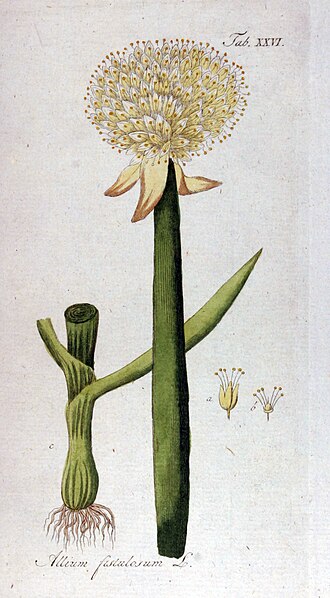
图:Public domain · Wikimedia Commons
- 学名
- Allium fistulosum
- 分类等级
- 种
- 英文名
- Welsh onion
- 上级类群
- 葱属
- 大类
- 被子植物
- 命名
- 卡尔·林奈,1753 年
- 中文别名
- 长喙韭、葱白、葱汁、分葱、葱须
- 用途
- 药用植物、蔬菜、香辛料、食材
- 数据库
- NCBI 分类 · GBIF
百科正文
语源
属名“Allium”为中性名词,意为“葱/蒜”;种名“fistulosum”为形容词“fistulosus”的中性主格形式,意为“中空的”。
型态
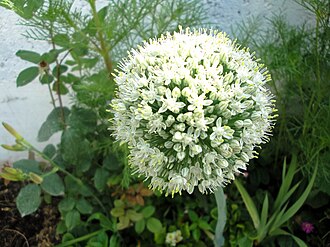
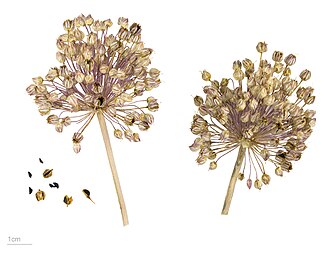
多年生草本,鳞茎上叶基生,白色似茎的部分实为半透明叶鞘紧密抱合而成,称为“葱白”,叶身则管状中空呈绿色;伞形花序,花葶中空与叶等长,两性花;蒴果成熟后裂开,种子黑色。
食用
亚洲许多地区习惯于在炒菜前将葱和姜切碎一起下油锅中炒至金黄(俗称之为“爆香”或“炝锅”),尔后再将其他蔬菜下入锅中炒。此外,将葱生吃在中国山东省和东北三省的某些地区也比较流行并且是一种常见的饮食习惯(或食疗手段),比如山东的传统名吃“煎饼卷大葱”。在做汤面如清汤面或牛肉面时,在面条熟后可将切碎的葱末(也称葱花)撒在面上。在日本料理,台湾料理和韩国料理中,碎葱也是常用材料之一。
居家种植
葱一般种植在土壤里,亦可以水耕栽培的方式种植。若要自行生产,可将市场购买的整株葱去除葱叶及部分葱白供食用后,剩余的部分葱白及根部可拿来种植,只要继续施肥及适度浇灌,即可重新长出葱叶。如果想要生产出较多的葱白,可追加覆土。日光无法照射到的部分即成为葱白。
以上内容摘自维基百科「葱」,按 CC BY-SA 4.0 使用,去掉了参考文献、外部链接等尾部小节,公式改写成了纯文本。全文、配图和出处见原文。
英文维基百科补充中文条目比较短,下面是英文条目「Allium fistulosum」的原文
Allium fistulosum, the Welsh onion, also commonly called Japanese bunching onion, stone-leek, and spring onion, is a species of perennial plant, often considered to be a kind of scallion.
A. fistulosum forms perennial evergreen clumps of tubular leaves up to 0.6 metres (2 feet) tall, topped by white umbels. It is commonly used in Asian cuisine.
Names
The common name "Welsh onion" does not refer to Wales; indeed, the plant is neither indigenous to Wales nor particularly common in Welsh cuisine. (The green Allium common to Wales is the leek, A. ampeloprasum, the national vegetable of Wales.) Instead, it derives from a near-obsolete botanical use of Welsh in the sense 'foreign, non-native' because the species is native to China.
Historically, A. fistulosum was known as the cibol. In Cornwall, they are known as chibols, and in Scotland as sybows or sybies.
The plant may also be called stone-leek or rock onion. Other names that may be applied to this plant include Japanese bunching onion, green onion, salad onion, and spring onion. These names are ambiguous, as they may also be used to refer to any young green onion stalk, whether grown from Welsh onions, common onions, or other similar members of the genus Allium (e.g. the scallion).
Description
Growing from elongate bulbs (sometimes described as not a bulb at all), the plant forms perennial evergreen clumps up to 0.6 metres (2 feet) tall and 0.3 m (1 ft) wide, with tubelike leaves. Blooming from late May to August, the inflorescense is a greenish white umbel 2.5–7.5 centimetres (1–3 inches) in width, containing 50–100 flowers.
Similar species
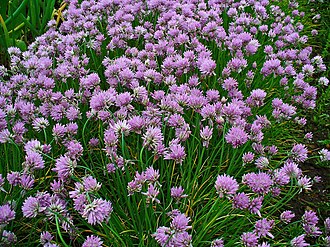
The species is very similar in taste and odor to the related common onion, Allium cepa, and hybrids between the two (tree onions) exist. A. fistulosum, however, does not develop large bulbs, and its leaves and scapes are hollow (fistulosum means 'hollow'). Larger varieties, such as the Japanese negi, resemble the leek, and smaller varieties resemble chives.
Distribution
The species was developed in Asia from a wild relative native to China. It is now widely cultivated for culinary use (being of ornamental value only when in bloom) and has been naturalized in North America and Eurasia.
Culinary uses
A. fistulosum is an ingredient in Asian cuisine, especially in East Asia and Southeast Asia. It is particularly important in China, Japan, Taiwan and Korea.
In the West, A. fistulosum is primarily used as a scallion or salad onion, but is more widely used in other parts of the world, particularly East Asia.
China
In China, it is often used in scallion pancakes, and as a garnish for a variety of dishes. It is also mixed with meat, into shumai dumplings or pearl meatballs.
Japan
The Japanese name is negi (葱), which can also refer to other Allium plants, or more specifically naganegi (長葱), meaning "long onion". Common onions were introduced to East Asia in the 19th century, but A. fistulosum remains more popular and widespread. It is used in miso soup, negimaki (beef and scallion rolls), among other dishes, and it is in wide use as a sliced garnish, such as on teriyaki or takoyaki.
Korea
In Korea, A. fistulosum along with A. × proliferum is called pa (파, "scallion"), while common onions are called yangpa (양파, "Western scallion"). Larger varieties, looking similar to leek and sometimes referred to as "Asian leek", are called daepa (대파, "big scallion"), while the thinner early variety is called silpa (실파, "thread scallion"). A similar scallion plant, A. × wakegi (now considered a synonym of A. × proliferum), is called jjokpa (쪽파). Both daepa and silpa are usually used as a spice, herb, or garnish in Korean cuisine. The white part of daepa is often used as the flavour base for various broths and infused oil, while the green part of silpa is preferred as garnish. Dishes using daepa include pa-jangajji (pickled scallions), pa-mandu (scallion dumplings), pa-sanjeok (skewered beef and scallions), and padak (scallion chicken), which is a variety of Korean fried chicken topped with shredded raw daepa. Dishes using silpa include pa-namul (seasoned scallions), pa-jangguk (scallion beef-broth soup), and pa-ganghoe (parboiled scallion rolls) where silpa is used as a ribbon that bundles other ingredients.
Russia
A. fistulosum is used in Russia in the spring for adding green leaves to salads.
Jamaica
Known as escallion, A. fistulosum is an ingredient in Jamaican cuisine, in combination with thyme, Scotch bonnet pepper, garlic, and allspice (called pimento). Recipes with escallion sometimes suggest leek as a substitute in salads.
以上节选摘自英文维基百科「Allium fistulosum」,按 CC BY-SA 4.0 使用,去掉了参考文献、外部链接等尾部小节,公式改写成了纯文本。篇幅所限,较长的小节只摘了开头一部分,有的小节没有收;全文、配图和出处见原文。