格物
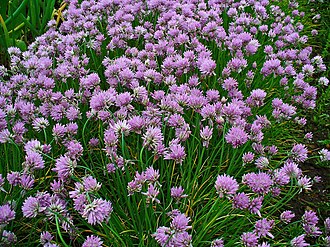
图:H. Zell · CC BY-SA 3.0 · Wikimedia Commons
- 学名
- Allium schoenoprasum
- 分类等级
- 种
- 上级类群
- 葱属
- 大类
- 被子植物
- 命名
- 卡尔·林奈,1753 年
- 中文别名
- 细香葱、北葱、大蒜、北葱(香葱)
- 保护状况(IUCN)
- 无危物种
- 用途
- 药用植物、香辛料、food plant
- 数据库
- NCBI 分类 · GBIF · IUCN 红色名录
百科正文
形态
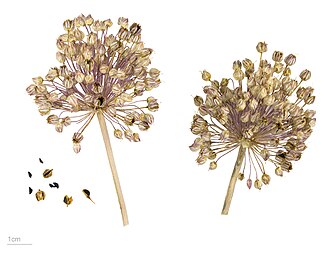
多年生宿根草本;卵圆形小鳞茎,极细的圆筒形绿色叶子;分蘖性强;夏季开红紫色花,很少结果实。
食用方法
北葱的用法为切细生用。中餐中常用于拌面、煮汤、炒菜、火锅蘸料等等。西餐中常用在沙拉或西式蛋饼的调味,或是洒在焗薯上作为点缀。
历史与民间传说
文献记载中,古代中国人早到公元前三千年就开始使用北葱。“虾夷葱”得名于虾夷地。
罗马尼亚的罗姆人则会用北葱来算命。一些欧美人相信在家的周围悬挂一束干燥的北葱可以避免疾病及邪灵,类似东方人悬挂菖蒲或艾草。
罗马人相信北葱可以缓解晒伤的痛或喉咙痛,也相信食用北葱可以提高血压而作为利尿剂;多数专家则倾向不同意这些看法。罗马人也常被认为携带北葱至欧洲,而使其在欧洲繁殖遍野。事实上,野生的北葱目前生长范围涵盖了北半球的大部分地区。
栽培
在排水良好、富含有机质、pH值约6.0-7.0的土壤与阳光充足的条件下,北葱生长良好。虽然它们可以容忍遮荫,但6到8小时的直射光是最好的。
北葱可以利用种子繁殖,从早春播种后开始生长。然而,由于它们需要温暖的土壤,所以在很多国家不建议利用种子繁殖。通常北葱要发芽,需要温度为21 °C(70 °F)及保持潮湿。于温室中发芽长成植株后再移植户外,在寒带地区是一个可以考虑的方案。也可考虑将它们种在钟形玻璃罩底下。经过至少四周之后,幼苗应该可以植于户外。
最简单的栽培法是挖起足量的一丛北葱,将为数良多的鳞茎拨开为几丛后,再分开种植(百合科植物的栽培法)。一般建议每两、三年就进行一次。
如果时间久了外观不佳,则将之剪短。剪至2.5公分(约1英寸)的高度会促进新芽生长。
以上内容摘自维基百科「蝦夷蔥」,按 CC BY-SA 4.0 使用,去掉了参考文献、外部链接等尾部小节,公式改写成了纯文本。全文、配图和出处见原文。
英文维基百科补充中文条目比较短,下面是英文条目「Chives」的原文
Chives, scientific name Allium schoenoprasum, is a species of flowering plant in the family Amaryllidaceae.
A perennial plant, A. schoenoprasum is widespread in nature across much of Eurasia and North America. It is the only species of Allium native to both the New World and Old World.
The leaves and flowers are edible. Chives are a commonly used herb and vegetable with a variety of culinary uses. They are also used to repel insects.
Description
Chives are a bulb-forming herbaceous perennial plant, growing to 25 centimetres (10 in) tall. The bulbs are slender, conical, 2–3 cm (3⁄4–1+1⁄4 in) long and 1 cm (1⁄2 in) broad, and grow in dense clusters from the roots. The scapes (or stems) are hollow and tubular, up to 50 cm (20 in) long and 2–3 mm (1⁄16–1⁄8 in) across, with a soft texture, although, prior to the emergence of a flower, they may appear stiffer than usual. The grass-like leaves, which are shorter than the scapes, are also hollow and tubular, or terete (round in cross-section).
Taxonomy
It was formally described by the Swedish botanist Carl Linnaeus in his seminal publication Species Plantarum in 1753.
The name of the species derives from the Greek σχοίνος, skhoínos (sedge or rush) and πράσον, práson (leek). Its English name, chives, derives from the French word cive, from cepa, the Latin word for onion. In the Middle Ages, it was known as 'rush leek'.
Several subspecies have been proposed, but are not accepted by Plants of the World Online, as of July 2021, which sinks them into two subspecies:
Allium schoenoprasum subsp. gredense (Rivas Goday) Rivas Mart., Fern.Gonz. & Sánchez Mata
Distribution and habitat
Native to temperate areas of Europe, Asia and North America. chives are the only species of Allium native to both the New and the Old Worlds.
It has a wide natural range across much of the Northern Hemisphere.
In Asia it is native from the Ural Mountains in Russia to Kamchatka in the far east. It grows natively in the Korean peninsula, but only the islands of Hokkaido and Honshu in Japan. Likewise its natural range in China only extends to Xinjiang and Inner Mongolia, though it is also found in adjacent Mongolia. It is native to all the nations of the Caucasus.
Ecology
Chives are repulsive to most insects due to their sulfur compounds, but their flowers attract bees, and they are at times kept to increase desired insect life.
The plant provides a great deal of nectar for pollinators. It was rated in the top 10 for most nectar production (nectar per unit cover per year) in a United Kingdom plants survey conducted by the AgriLand project which is supported by the UK Insect Pollinators Initiative.
Cultivation
Chives have been cultivated in Europe since the Middle Ages (from the fifth until the 15th centuries), although their usage dates back 5,000 years.
Chives are cultivated both for their culinary uses and for their ornamental value; the violet flowers are often used in ornamental dry bouquets.
Chives thrive in well-drained soil, rich in organic matter, with a pH of 6–7 and full sun. They can be grown from seed and mature in summer, or early the following spring. Typically, chives need to be germinated at a temperature of 15 to 20 °C (59 to 68 °F) and kept moist.
Uses
Culinary arts
Chives are grown for their scapes and leaves, which are used for culinary purposes as a flavoring herb, and provide a somewhat milder onion-like flavor than those of other Allium species. The edible flowers are used in salads, or used to make blossom vinegars. Both the scapes and the unopened, immature flower buds are diced and used as an ingredient for omelettes, fish, potatoes, soups, and many other dishes. The scapes are often paired with cream cheese.
Chives have a wide variety of culinary uses, such as in traditional dishes in France, Sweden, and elsewhere.
In culture
In Europe, chives were sometimes referred to as "rush leeks".
It was mentioned in 80 A.D. by Marcus Valerius Martialis in his "Epigrams" (13.18 porri sectivi):
Fila Tarentini graviter redolentia porriEdisti quoties, oscula clausa dato.(After eating the heavily scented threads of Tarentine leek, give your kisses closed.)
The Romans believed chives could relieve the pain from sunburn or a sore throat. They believed eating chives could increase blood pressure and act as a diuretic.
以上节选摘自英文维基百科「Chives」,按 CC BY-SA 4.0 使用,去掉了参考文献、外部链接等尾部小节,公式改写成了纯文本。篇幅所限,较长的小节只摘了开头一部分,有的小节没有收;全文、配图和出处见原文。