格物

图:(c) Thomaz de Carvalho Callado, some rights reserved (CC BY) · CC BY 4.0 · Wikimedia Commons
生命之树 › 真核生物 › 动物界 › 真后生动物亚界 › 两侧对称动物 › 后口动物总门 › 脊索动物门 › 脊椎动物亚门 › 有颌下门 › 肉鳍鱼总纲 › 四足形类 › 希望螈目 › 四足总纲 › 哺乳动物 › 食肉目 › 猫型亚目 › Aeluroidea › 猫总科 › 猫科 › 猫亚科 › 虎猫属
小斑虎猫种
Leopardus tigrinus
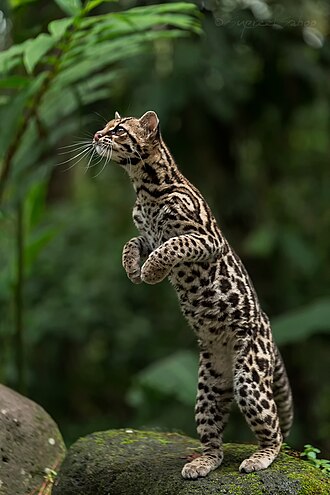
小斑虎猫 是虎猫及长尾虎猫的近亲。它们栖息在中美洲及南美洲的热带雨林。它们是夜间活动的,猎食啮齿目及鸟类。它们体长约40-50厘米,尾巴长30-40厘米。虽然它们较一般的家猫大,但却较轻,只有2-3公斤重。
摘自维基百科「小斑虎貓」,CC BY-SA 4.0
- 学名
- Leopardus tigrinus
- 分类等级
- 种
- 上级类群
- 虎猫属
- 大类
- 哺乳动物
- 命名
- 约翰·克里斯蒂安·丹尼尔·冯·施雷贝尔,1775 年
- 保护状况(IUCN)
- 易危物种
- 数据库
- NCBI 分类 · GBIF · IUCN 红色名录
百科正文
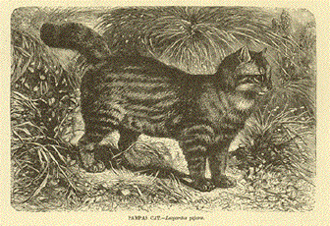
小斑虎猫可以与潘帕斯猫、长尾虎猫或家猫杂交。
亚种
小斑虎猫有以下的亚种:
L. t. tigrinus:指名亚种,即圭亚那虎猫(Guiana tiger cat),分布在东委内瑞拉、圭亚那及巴西东北。
L. t. guttulus:分布在巴西中部及南部、乌拉圭、巴拉圭及阿根廷北部。
L. t. oncilla
L. t. pardinoides:分布在西委内瑞拉、哥伦比亚及厄瓜多尔。
以上内容摘自维基百科「小斑虎貓」,按 CC BY-SA 4.0 使用,去掉了参考文献、外部链接等尾部小节,公式改写成了纯文本。全文、配图和出处见原文。
英文维基百科补充中文条目比较短,下面是英文条目「Oncilla」的原文
The oncilla (Leopardus tigrinus), also known as the northern tiger cat, little spotted cat, and tigrillo, is a small spotted cat ranging from Central America to central Brazil. It is listed as Vulnerable on the IUCN Red List, and the population is threatened by deforestation and conversion of habitat to agricultural land.
In 2013, it was proposed to assign the oncilla populations in southern Brazil, Paraguay, and Argentina to a new species, the southern tiger cat (L. guttulus), after it was found that it does not interbreed with the oncilla population in northeastern Brazil. In 2024, a similar argument was put forth with regards to the Andean montane cloud forest sub-population; for a third species to be recognized, now known as the clouded tiger cat (L. pardinoides). In 2026, a genetic analysis of Leopardus species in South America proposed that the L. tigrinus complex comprised five species, adding the tilcayo (L. tilcayo).
Characteristics
The oncilla resembles the margay (L. wiedii) and the ocelot (L. pardalis), but it is smaller, with a slender build and narrower muzzle. Oncillas are one of the smallest wild cats in South America, reaching a body length of 38 to 59 cm (15 to 23 in) with a 20 to 42 cm (7.9 to 16.5 in) long tail. While this is somewhat longer than the average domestic cat, the oncilla is generally lighter, weighing 1.5 to 3 kg (3.3 to 6.6 lb).
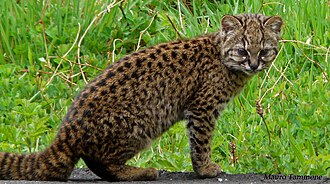
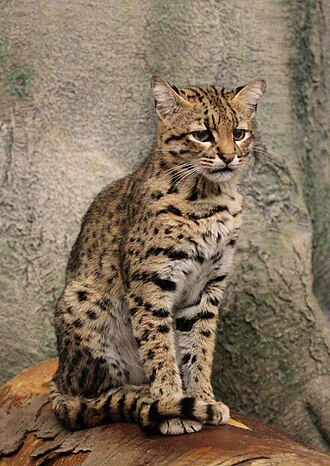
The fur is thick and soft, ranging from light brown to dark ochre, with numerous dark rosettes across the back and flanks. The underside is pale with dark spots and the tail is ringed. The backs of the ears are black with bold white spots.
Distribution and habitat
The oncilla is distributed from a disjunct population in Costa Rica and Panama, and throughout the Amazon basin to central Brazil. It was recorded in Costa Rica's cloud forests, in the northern Andes at elevations of 1,500 to 3,000 m (4,900 to 9,800 ft) and in dry Cerrado and Caatinga landscapes of northern Brazil.
In Panama, it was recorded in Darién, and in Volcán Barú National Parks.
In Colombia, it was recorded in the Cordillera Occidental at elevations of 1,900 to 4,800 m (6,200 to 15,700 ft) in Los Nevados National Natural Park, and in Antioquia Department.
Ecology and behavior
The oncilla is a primarily terrestrial animal, but also an adept climber. It is an obligate carnivore that hunts rodents, lizards, birds, eggs, invertebrates, and occasionally also tree frogs. It stalks its prey from a distance, and once in range, it pounces to catch and kill the prey.
Most oncillas are nocturnal, but in the Brazilian Caatinga – where diurnal lizards are their main food source – they are active during daylight. Young oncillas have been observed to purr; adults are known to make short, gurgling calls when close to one another.
Reproduction
Estrus lasts from three to nine days, with older cats having shorter cycles.
Taxonomy
The following are the traditionally recognized subspecies:
Leopardus tigrinus tigrinus, eastern Venezuela, Guyana, northeastern Brazil; the nominate subspecies
Leopardus tigrinus guttulus, Atlantic forest central and southern Brazil, Uruguay, Paraguay, northern Argentina (later recognised as a separate species, the southern tigrina)
Leopardus tigrinus oncilla, Central America
Leopardus tigrinus pardinoides, western Venezuela, Colombia, Ecuador, Peru
Although the Central American oncilla is listed as a separate subspecies, based on analysis of mitochondrial DNA, Johnson et al. (1999) found strongly supported differences between L. t. oncilla in Costa Rica and L. t.
Threats
The oncilla is mainly threatened by deforestation and poaching. Oncillas are killed for their pelts, which are highly prized and often sold or made into clothing. Reports in 1972 and 1982 in South America showed that the oncilla is one of the four most heavily hunted of all the small wild cats.
Another factor contributing to oncilla mortality is human expansion and conversion of land for settlements. Coffee plantations are most often established in cloud forest habitats, causing the reduction of preferred habitats.
Conservation
The oncilla has been classified as Vulnerable on the IUCN Red List. It is listed on CITES Appendix I, prohibiting all international commercial trade in oncillas or products made from them. Hunting is still allowed in Ecuador, Guyana, Nicaragua and Peru.
以上节选摘自英文维基百科「Oncilla」,按 CC BY-SA 4.0 使用,去掉了参考文献、外部链接等尾部小节,公式改写成了纯文本。篇幅所限,较长的小节只摘了开头一部分,有的小节没有收;全文、配图和出处见原文。