格物

图:Keijuu · CC0 · Wikimedia Commons
- 学名
- Leopardus colocola
- 分类等级
- 种
- 上级类群
- 虎猫属
- 大类
- 哺乳动物
- 命名
- 胡安·伊格纳西奥·莫利纳,1782 年
- 保护状况(IUCN)
- 近危物种
- 异名
- Oncifelis colocola
- 特有于
- 智利
- 数据库
- NCBI 分类 · GBIF · IUCN 红色名录
百科正文
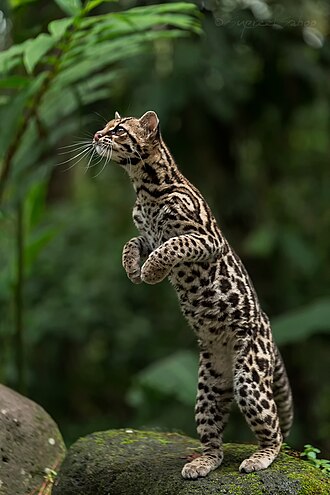
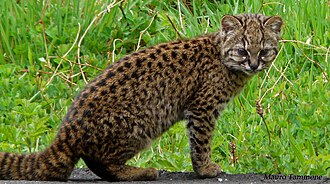
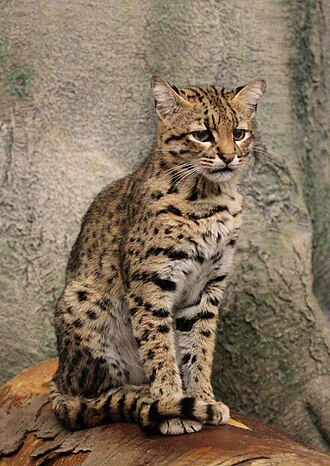
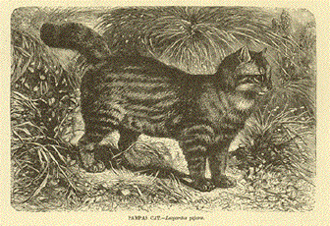
南美草原猫体型很小,一般体长只有55-70厘米,体重3-7公斤。体毛颜色多为灰色,黄色和暗褐色,并有暗褐色的条纹。通常一胎两仔,平均寿命为9到16年。
以上内容摘自维基百科「南美草原貓」,按 CC BY-SA 4.0 使用,去掉了参考文献、外部链接等尾部小节,公式改写成了纯文本。全文、配图和出处见原文。
英文维基百科补充中文条目比较短,下面是英文条目「Pampas cat」的原文
The Pampas cat (Leopardus colocola) is a small wild cat native to South America. It is listed as Near Threatened on the IUCN Red List as habitat conversion and destruction may cause the population to decline in the future.
It is named after the Pampas, but occurs in grassland, shrubland, and dry forest at elevations up to 5,000 m (16,000 ft).
There was a proposal to divide the Pampas cat into three distinct species, based primarily on differences in pelage colour/pattern and cranial measurements. Accordingly, three species were recognised in the 2005 edition of Mammal Species of the World: the colocolo (L. colocolo), the Pantanal cat (L. braccatus), and the Pampas cat (L. pajeros) with a more restricted definition. This split at species level was not supported by subsequent phylogeographic analysis, although some geographical substructure was recognised, and some authorities continue to recognise the Pampas cat as a single species. In the 2017 revision of felid taxonomy by the Cat Specialist Group, the Pampas cat is recognized as a single species with seven subspecies. An analysis of 142 skins collected across South America revealed morphological differences between these museum specimens. It was therefore proposed to recognize five distinct species within the Pampas cat complex.
Characteristics
The Pampas cat is a little bigger than a domestic cat and has a bushier tail. Its size varies between regions, ranging in body length from 46 to 75 cm (18 to 30 in) with a 23–29 cm (9.1–11.4 in) long tail. Six variants of its pelage occur, but all have two dark lines on the cheeks:
Type 1. Reddish or dark grey with rusty-cinnamon stripes on the flanks, a cinnamon upper side of the ears with black edges and tips, four or five reddish rings on the tail (outer two are darker), dark brown stripes on the legs, black chest spots, and whitish underparts with rusty-ochraceous stripes. This type occurs in central Chile in subtropical, xerophytic forests at altitudes of up to 1,800 m (5,900 ft).
Taxonomy
Felis colocola was the scientific name proposed by Juan Ignacio Molina in 1782 for a cat from Chile. The subgenus Lynchailurus was proposed in 1851 by Nikolai Severtzov for Felis pajeros Desmarest.
An extensive morphological analysis of Pampas cat specimens from across the species's range revealed differences in cranial measurements, and pelage colour and pattern. Therefore, the Pampas cat group was divided into three distinct species with 11 subspecies. This species division was recognised in the 2005 edition of Mammal Species of the World, although the number of subspecies was reduced:
- Leopardus colocola (colocolo)
- L. c. colocola – subtropical forests of central Chile
- L. c. wolffsohni (Garcia-Perea, 1994) – in spiny shrublands and páramo of northern Chile
- Leopardus braccatus (Pantanal cat)
Distribution and habitat
The Pampas cat ranges throughout most of Argentina and Uruguay into the Gran Chaco and Cerrado of Bolivia, Paraguay and Brazil, and north through the Andes mountain chain through Ecuador and possibly marginally into southwestern Colombia. It occurs in a wide range of habitats and inhabits elevations between 1,800 and 5,000 m (5,900 and 16,400 ft) in páramo, marginally also in puna grassland and locally in dry forest. Where its range overlaps with the Andean mountain cat in northwestern Argentina, it occurs at lower elevations on average. In central to northwestern Argentina, the Pampas cat is found at elevations below 1,240 m (4,070 ft) in grassland, mesophytic and dry forest, and shrubland. In southern Argentina and far southern Chile, it is found in Patagonian steppes and shrubland at altitudes below 1,100 m (3,600 ft).
Ecology and behaviour
Little is known about the Pampas cat's hunting and breeding habits. It is thought to prey mainly on small mammals and birds. Guinea pigs are thought to form a large part of its diet, along with viscachas, other rodents, and the ground-dwelling tinamou order of birds. Though some have suggested it is chiefly nocturnal, others suggest it is mainly diurnal.
Litters are relatively small, usually consisting of only one or two kittens, and occasionally three. The kittens weigh around 130 g (4.6 oz) at birth. The average lifespan is nine years, but some have lived for over 16 years.
以上节选摘自英文维基百科「Pampas cat」,按 CC BY-SA 4.0 使用,去掉了参考文献、外部链接等尾部小节,公式改写成了纯文本。篇幅所限,较长的小节只摘了开头一部分,有的小节没有收;全文、配图和出处见原文。