格物

图:Jim Sanderson · CC BY-SA 3.0 · Wikimedia Commons
- 学名
- Leopardus jacobita
- 分类等级
- 种
- 上级类群
- 虎猫属
- 大类
- 哺乳动物
- 命名
- Emilio Cornalia,1865 年
- 保护状况(IUCN)
- 濒危 (保育状况)
- 异名
- Leopardus jacobitus
- 数据库
- NCBI 分类 · GBIF · IUCN 红色名录
百科正文
特征
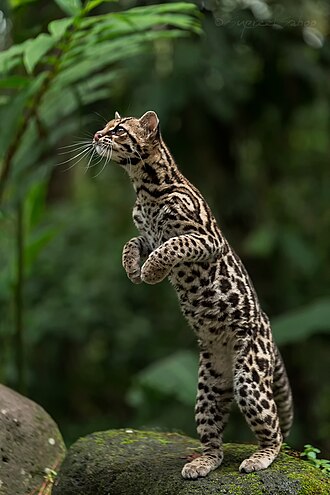
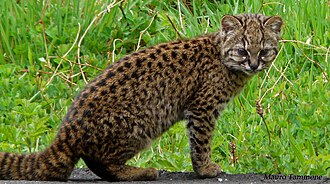
山原猫的外观像雪豹,栖息在海拔3500-4800米的地方,远远高于林木线。它们约有家猫的大小,但尾巴较长,毛色呈银灰色,有斑纹及斑点。它们体长约60厘米,尾巴长42厘米,肩高36厘米,体重5.5公斤。
分布
山原猫是所知最少及最为稀少的猫科之一,对它们的认识都是来自仅有的观察及一些标本。它们未被驯养。估计它们只生活在秘鲁、玻利维亚、智利及阿根廷安地斯山脉的高山上。
保育状况
山原猫喜欢栖息在高山环境,其分布亦受当地的猎物情况所影响。总有效群体大小可能是低于2500只,因失去猎物及栖息地、被猎杀及没有多于250只的亚群等缘故而有下降的趋势。由于它们只居于高山上,人类居住的山谷成为了屏障,分隔了它们的群族。它们在玻利维亚及智利因祭祀用途而受到猎杀。
它们的数量稀少,较同样生活在高海拔的南美草原猫更为稀疏。在其分布地,它们的遗传多样性非常低。
以上内容摘自维基百科「山原貓」,按 CC BY-SA 4.0 使用,去掉了参考文献、外部链接等尾部小节,公式改写成了纯文本。全文、配图和出处见原文。
英文维基百科补充中文条目比较短,下面是英文条目「Andean mountain cat」的原文
The Andean mountain cat (Leopardus jacobita) is a small wild cat native to the high Andes that has been listed as Endangered on the IUCN Red List because fewer than 1,500 individuals are thought to exist in the wild.
The Andean mountain cat was first described by Emilio Cornalia, who named it in honor of Jacobita Mantegazza. It is a monotypic species.
Characteristics
The Andean mountain cat has ashy-gray fur, a grey head, and rounded ears. The nose and lips are black, and the areas around them are white; two dark brown lines run from the corners of the eyes across the cheeks. There are black spots on the forelegs, yellowish-brown blotches on the flanks, and up to two narrow, dark rings on the hind limbs. The long, bushy tail has six to nine rings, which are dark brown to black. The markings of juveniles are darker and smaller than those of adults. The skulls of adult specimens range in length from 100.4 to 114.8 mm (3.95 to 4.52 in) and are larger than those of the pampas cat and the domestic cat.
On the back and the tail, the hair is 40–45 mm (1.6–1.8 in) long. Its rounded footprints are 4 cm (1.6 in) long and 3.5 cm (1.4 in) wide. Its pads are covered with hair. Adult individuals range from 57.7 to 85 cm (22.7 to 33.5 in) in head-to-body length with a 41.3 to 48.5 cm (16.3 to 19.1 in) long tail, a shoulder height of about 36 cm (14 in) and a body weight of up to 5.5 kg (12 lb).
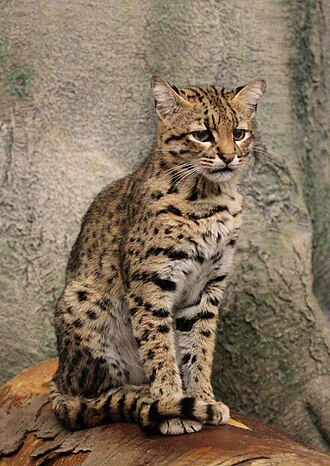
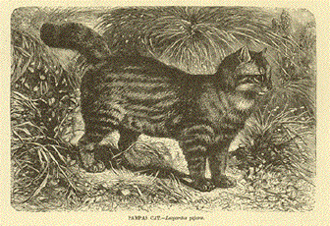
The Andean mountain cat and pampas cat look similar. This similarity makes it difficult to identify which cat is observed and estimate their populations correctly, especially when attempting to gain correct information from the observations of individuals who have seen one of these cats but are unaware of specific features to distinguish between them.
Distribution and habitat
The Andean mountain cat lives only at high elevations in the Andes. Records in Argentina indicate that it lives at elevations from 1,800 m (5,900 ft) in the southern Andes to over 4,000 m (13,000 ft) in Chile, Bolivia and central Peru. This terrain is arid, sparsely vegetated, rocky and steep showing that the Andean Mountain Cat prefers a temperate and terrestrial habitat. The population in the Salar de Surire Natural Monument was estimated at five individuals in an area of 250 km2 (97 sq mi). Results of a survey in the Jujuy Province of northwestern Argentina indicates a density of seven to twelve individuals per 100 km2 (39 sq mi) at an elevation of about 4,200 m (13,800 ft).
Deep valleys fragment its habitat in the Andes, and its preferred prey, mountain viscachas (Lagidium), occurs in patchy colonies. Across this range, the level of genetic diversity is very low.
Behavior and ecology
The Andean cat is sympatric with the pampas cat and the cougar. The viscacha comprises 93.9% of the biomass consumed in the Andean cat's diet, while the pampas cat depends on it for 74.8%. Both cats depend on specific prey for their dietary needs. In some areas, the mountain viscacha makes up 53% of the Andean cat's prey items despite making up the vast majority of the biomass that it consumes. This difference is because the mountain viscacha is significantly larger in biomass than the other prey animals that the Andean cat hunts. Other prey and food groups include small reptiles, birds, and other small mammals, such as tuco-tuco. They also hunt frequently during the same periods. During one study, both the Andean cat and the pampas cat were seen most frequently during moonless nights; the second most sightings of these cats were during full moons.
Based on residents' observations of Andean cats in coupled pairs with their litters, it is thought that the mating season is in July and August. Due to kittens being seen in April and October, the mating season could extend into November or December, although not much information is known about their breeding habits. A litter usually consists of one or two offspring born in the spring and summer months.
Threats and conservation
Such factors as habitat loss and degradation, hunting, and disease threaten the Andean cat. The Andean Cat is listed on the IUCN Red List, the US Federal List, and the CITES Appendix I. It is protected in all the countries of its range. The Andean Cat Alliance was formed in 2003 by representatives from Argentina, Bolivia, Peru, and Chile to foster research and conservation of the Andean cat.
In culture
The Andean mountain cat is traditionally considered a sacred animal by indigenous Aymara and Quechua people.
以上节选摘自英文维基百科「Andean mountain cat」,按 CC BY-SA 4.0 使用,去掉了参考文献、外部链接等尾部小节,公式改写成了纯文本。篇幅所限,较长的小节只摘了开头一部分,有的小节没有收;全文、配图和出处见原文。