格物
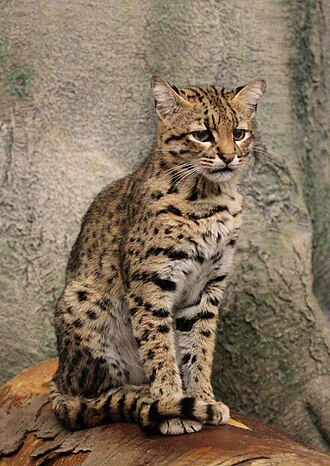
图:Greg Hume · CC BY-SA 3.0 · Wikimedia Commons
- 学名
- Leopardus geoffroyi
- 分类等级
- 种
- 英文名
- Geoffroy's cat
- 上级类群
- 虎猫属
- 大类
- 哺乳动物
- 命名
- 阿尔西德·多尔比尼、保罗·热尔韦,1844 年
- 保护状况(IUCN)
- 无危物种
- 数据库
- NCBI 分类 · GBIF · IUCN 红色名录
百科正文
命名
乔氏猫是以19世纪法国动物学家艾蒂安·若弗鲁瓦·圣伊莱尔(Étienne Geoffroy Saint-Hilaire)来命名的。他发现了乔氏猫与其他物种的不同。
分布
乔氏猫分布在安地斯山脉、潘帕斯平原及大厦谷。
特征
乔氏猫约长60厘米,高31厘米,大小如家猫,重2-4公斤,个别可以重达8公斤。它们有黑色的斑点,毛色则会按地区而有所分别:在北部,一般都是呈黄褐色;在南部,一般都是呈灰色。无论是在野外或饲养底下,它们都很易患上黑变病。
食性及繁殖
乔氏猫主要猎食啮齿目、细小的蜥蜴、昆虫,且有时吃青蛙及鱼类。它们是顶级掠食者,位于食物链的顶部。虽然它们似乎数量很丰富,但一些保育人士认为它们大量被猎杀而需要关注。
怀孕的雌猫会很小心选择产子的地方。幼猫成长得很快,只需约6星期就可以完全活动。
以上内容摘自维基百科「喬氏貓」,按 CC BY-SA 4.0 使用,去掉了参考文献、外部链接等尾部小节,公式改写成了纯文本。全文、配图和出处见原文。
英文维基百科补充中文条目比较短,下面是英文条目「Geoffroy's cat」的原文
Geoffroy's cat (Leopardus geoffroyi) is a small wild cat native to the southern and central regions of South America. It is around the size of a domestic cat. It is listed as Least Concern on the IUCN Red List due to it being widespread and abundant over its range.
Taxonomy
Geoffroy's cat was named Felis geoffroyi in 1844 by Alcide d'Orbigny and Paul Gervais in honour of Étienne Geoffroy Saint-Hilaire; D'Orbigny had collected three specimens that on the banks of Rio Negro in Patagonia during his travels in South America between 1826 and 1833. Five subspecies have been described in the 19th century:
- L. g. geoffroyi: central Argentina
- L. g. euxantha: northern Argentina, western Bolivia
- L. g. leucobapta: Patagonia
- L. g. paraguae: Paraguay, southeastern Brazil, Uruguay and northern Argentina
L. g. salinarum based on a specimen collected in Córdoba Province, Argentina.
Since 2017, Geoffroy's cat is considered a monotypic species.
Early genetic studies showed Geoffroy's cat to be most closely related to the kodkod. A 2026 study showed the tilcayo visually resembling the more northerly relatives such as the oncilla as a closer relative.
Characteristics
The Geoffroy's cat is about the size of a domestic cat, but has numerous black spots and dark bands on the cheeks, head and neck as well as on the tail and limbs. The background colour of its fur varies from a brownish-yellow coat in the northern part of its range to a more grayish coat in the south. The underbelly hair is cream-coloured or even white. The backs of the ears are black with white spots. Black individuals are common.
Its size is about 60 cm (24 in) in head and body with a relatively short tail of about 31 cm (12 in). It weighs between 2 and 5 kg (4.4 and 11.0 lb), though individuals up to 7.8 kg (17 lb) have been reported. Males are usually larger than females, and Geoffroy's cat in the south are larger than those from the north.
It has a bite force quotient at the canine tip of 106.3.
Distribution and habitat
The Geoffroy's cat is distributed in Argentina, Bolivia, Brazil, Chile, Paraguay and Uruguay. It inhabits pampas and savanna landscapes in the Gran Chaco from southern Bolivia to the Straits of Magellan ranging at elevations from sea level up to 3,800 m (12,500 ft) in the Andes. It prefers open woodland or scrubland with plenty of cover, but also occurs in grasslands and marshy areas. It is thought to be rare in Chile.
Ecology and behaviour
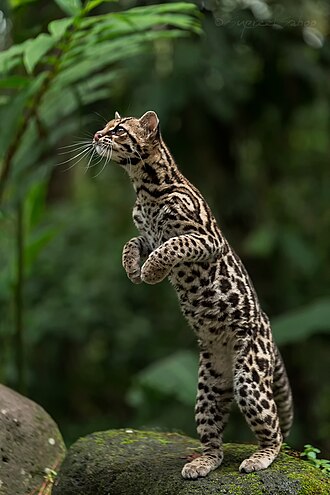
The Geoffroy's cat is nocturnal and a solitary hunter that contacts conspecifics only during the mating season. Geoffroy's cats have been observed to stand up on their hind legs to scan the surrounding landscape and use their tail as a support, an unusual behaviour among cats. It is able to climb trees but rarely does, except to leave faeces to scent mark its territory.
It preys primarily on rodents, hares, other small mammals, birds, snakes, small lizards, insects, and occasionally frogs and fish. Females maintain home ranges about 2 to 6 km2 (0.77 to 2.32 sq mi) in size, while males range over up to 12 km2 (4.6 sq mi).
Reproduction
The breeding season for Geoffroy's cats lasts from October to March. During this time, the female comes into estrus for periods of up to twelve days, between three and five weeks apart. Mating during this time is brief and frequent, often taking place on a high ledge or similar site.
Gestation lasts for 72–78 days. Most births occur between December and May. Litters consist of one to three kittens, and one or two is more common.
The kittens are born blind and helpless, weighing about 65 to 95 g (2.3 to 3.4 oz), and develop rather slowly compared to the domestic cat. The eyes open after eight to nineteen days, and they begin to eat solid food at six or seven weeks. Kittens become independent of their mother at around eight months, but are generally not sexually mature until 18 months for females and 24 months for males.
Conservation
From the 1960s to the 1980s, Geoffroy's cats were hunted extensively for their pelts for the international fur trade, but little trade took place after 1988 and the species was upgraded to CITES Appendix I status in 1992.
Legislation introduced in the late 1980s made hunting and domestic trade of Geoffroy's cat's pelts illegal in Argentina, Bolivia, Brazil, Chile, Paraguay, and Uruguay. International trade in Cites Appendix I listed species is now prohibited, except for non-commercial purposes.
以上内容摘自英文维基百科「Geoffroy's cat」,按 CC BY-SA 4.0 使用,去掉了参考文献、外部链接等尾部小节,公式改写成了纯文本。全文、配图和出处见原文。