格物

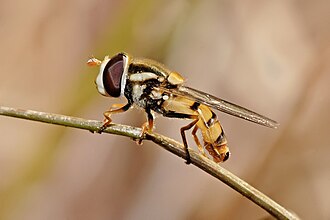
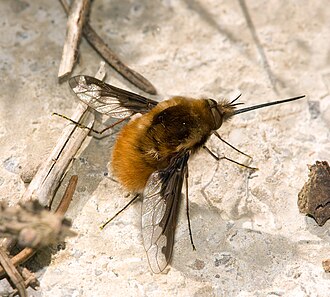
图:Thomas Bresson · CC BY 2.0 · Wikimedia Commons
- 学名
- Tachinidae
- 分类等级
- 科
- 上级类群
- 双翅目
- 大类
- 昆虫
- 命名
- Jean-Baptiste Robineau-Desvoidy,1830 年
- 用途
- 生物虫害防治
- 数据库
- NCBI 分类 · GBIF
百科正文
特征
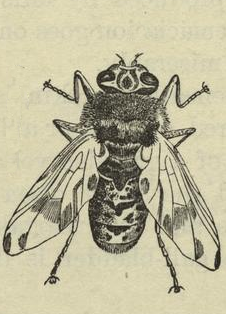
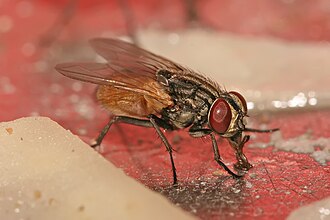
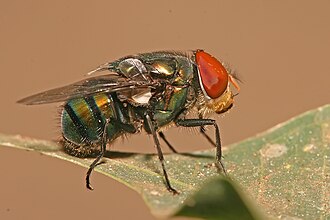
寄生蝇的外观极之多样。成虫可以像丽蝇般色彩鲜艳,或是像家蝇般色彩单调。寄生蝇是有最多刚毛及较为粗壮的。它们的触角有三节,小盾板底明显胀起,触角芒无毛。腋瓣一般都非常的大。第四翅脉向外弯曲。
寄生蝇的分类有很多问题。现时大部分都是基于成虫的形态特征,但也有根据繁殖习性及未成熟阶段来分类的。
分布
寄生蝇在世界各地不同的环境也能生存。其物种广泛分布在新热带界、新北界、埃塞俄比亚界、古北界、东洋界、澳大拉西亚及大洋洲。
寄生
大部分寄生蝇的幼虫是拟寄生的,即会在生物体内生长,最终杀死寄主;少部分则是寄生的,即不会杀死寄主。它们会寄生在蝴蝶及蛾的毛虫、甲虫成虫及幼虫、锯蝇幼虫、多种半翅目及草蜢,并百足虫的体内。所以寄生蝇是害虫的天敌,一些物种甚至会作为生物性虫害控制。很多寄生蝇都因而被引入到北美洲。不过,某些寄生蝇却是蚕的害虫。
繁殖
寄生蝇的繁殖方法各有不同。雌蝇可以在寄主的皮肤上产卵、将卵透过产卵管放入寄主的体内、或是产在寄主栖息的环境让寄主自己吞下。一些寄生蝇会在毛虫巢穴之外产卵,待幼虫自行寻找寄主。另外一些寄生蝇会埋伏等待寄主经过,将之杀死,并在尸体上产卵,让幼虫吃寄主的组织。
食性
寄生蝇一般都会吃花粉,是一些植物的重要花粉传播者,尤其是位于山区的地方。
以上内容摘自维基百科「寄生蠅」,按 CC BY-SA 4.0 使用,去掉了参考文献、外部链接等尾部小节,公式改写成了纯文本。全文、配图和出处见原文。
英文维基百科补充中文条目比较短,下面是英文条目「Tachinidae」的原文
The Tachinidae are a large and variable family of true flies within the insect order Diptera, with more than 8,200 known species and many more to be discovered. Over 1,300 species have been described in North America alone. Insects in this family commonly are called tachinid flies or simply tachinids. As far as is known, they all are protelean parasitoids, or occasionally parasites, of arthropods, usually other insects. The family is known from many habitats in all zoogeographical regions and is especially diverse in South America.
Taxonomy
Just like that of all Diptera, the taxonomy of Tachinidae is complex. The name Tachinidae was first validly proposed by Robineau-Desvoidy in 1830, but in the form "Tachinariae." Robineau-Desvoidy, 1830 thus has priority despite the name correction, and this applies to Tachinidae (for the family) and to Tachininae (for the subfamily), in accordance with the ICZN rules on the formation of group names (Article 36.1).
There may be confusion between this family name and its homonym used by Fleming in 1921 to describe a family of Coleoptera.
Life cycle
Reproductive strategies vary greatly between tachinid species, largely, but not always clearly, according to their respective life cycles. Many species are generalists rather than specialists. Comparatively few are restricted to a single host species, so there is little tendency towards the close co-evolution one finds in the adaptations of many specialist species to their hosts, such as are typical of protelean parasitoids among the Hymenoptera.
Larvae (maggots) of most members of this family are parasitoids (developing inside a living host, ultimately killing it). In contrast, a few are parasitic (not generally killing the host).
Oviposition
Probably the majority of female tachinids lay white, ovoid eggs with flat undersides onto the skin of the host insect. Imms mentions the genera Gymnosoma, Thrixion, Winthemia, and Eutachina as examples. In a closely related strategy some genera are effectively ovoviviparous (some authorities prefer the term ovolarviparous) and deposit a hatching larva onto the host. For example, this occurs in Tachinidae species which parasitize the butterfly Danaus chrysippus in Ghana. The free larvae immediately bore into the host's body. Illustrative genera include Exorista and Voria.
Description
Tachinid flies are extremely varied in appearance. Some adult flies may be brilliantly colored and resemble blow-flies (family Calliphoridae). Most however are rather drab, some resembling house flies. However, tachinid flies commonly are more bristly and more robust. Also, they usually have a characteristic appearance. They have three-segmented antennae, a diagnostically prominent postscutellum bulging beneath the scutellum (a segment of the mesonotum). They are aristate flies, and the arista usually is bare, though sometimes plumose. The calypters (small flaps above the halteres) are usually very large. Their fourth long vein bends away sharply.
Diet of adult flies and pollination
Worldwide, many Diptera families act as significant pollinators, ranging from generalist nectar and pollen feeders to specialised long-tongued species adapted for floral nectar consumption. Their effectiveness as pollinators is enhanced by their frequent flower visitation and ability to carry large pollen loads.
Adult Tachinids visit flowers primarily to obtain nectar for energy and pollen for essential nutrients such as proteins, lipids, and vitamins, which enhance longevity and fecundity.
As biological pest control
Some tachinid flies parasitize pest species. This has allowed them to be used as biological control agents by farmers. Some Tachinidae are generalists; for instance, Compsilura concinnata uses at least 200 different hosts, and thus is less safe to be used as biological controls because they will attack non-pest species, resulting in population decline. Others are more specialized and are safer; for instance, Istocheta aldrichi, which only attacks the Japanese beetle.
Evolution
This clade appears to have originated in the middle Eocene. The oldest known putatively tachinid fossil (Lithexorista) dates from the Eocene Green River Formation in Wyoming.
以上节选摘自英文维基百科「Tachinidae」,按 CC BY-SA 4.0 使用,去掉了参考文献、外部链接等尾部小节,公式改写成了纯文本。篇幅所限,较长的小节只摘了开头一部分,有的小节没有收;全文、配图和出处见原文。