 格物
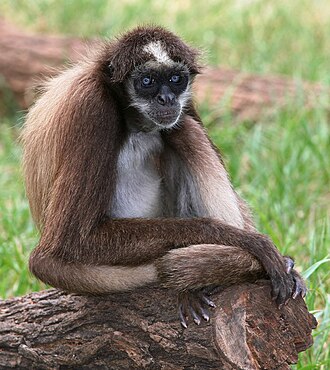
图:http://www.birdphotos.com edit by Fir0002 · CC BY-SA 3.0 · Wikimedia Commons
- 学名
- Platyrrhini
- 分类等级
- 小目
- 英文名
- New World monkey
- 上级类群
- 类人猿下目
- 大类
- 哺乳动物
- 命名
- 艾蒂安·若弗鲁瓦·圣伊莱尔,1812 年
- 数据库
- NCBI 分类
下级类群(4)

百科正文
特征
灵长类包括660多个现生种和其他化石种类,分为原猴类、新世界猴、旧世界猴、类人猿(人类)四个类群。新世界猴与旧世界猴的主要区别在于鼻部。新世界猴的鼻部软骨间隔很宽,鼻孔开向侧方,鼻孔间距较宽,旧世界猴的鼻间距则很窄;此外,新世界猴有12个前臼齿,而旧世界猴与猿类一样只有8个。
分类
狨猴科 Callitrichidae:狨、狮面狨
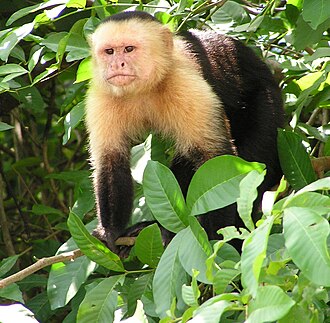
卷尾猴科 Cebidae:卷尾猴和松鼠猴。
夜猴科 Aotidae:夜猴。
僧面猴科 Pitheciidae:丛尾猴、僧面猴、秃猴。
蜘蛛猴科 Atelidae:吼猴、蜘蛛猴和绒毛猴。
以上内容摘自维基百科「闊鼻小目」,按 CC BY-SA 4.0 使用,去掉了参考文献、外部链接等尾部小节,公式改写成了纯文本。全文、配图和出处见原文。
英文维基百科补充中文条目比较短,下面是英文条目「New World monkey」的原文
New World monkeys are the five families of primates that are found in the tropical regions of Mexico, Central and South America: Callitrichidae, Cebidae, Aotidae, Pitheciidae, and Atelidae. The five families are ranked together as the Ceboidea , the only extant superfamily in the parvorder Platyrrhini .
Platyrrhini is derived from the Greek for "broad nosed", and their noses are flatter than those of other simians, with sideways-facing nostrils. Monkeys in the family Atelidae, such as the spider monkey, are the only primates to have prehensile tails. New World monkeys' closest relatives are the other simians, the Catarrhini ("down-nosed"), comprising Old World monkeys and apes. New World monkeys descend from African simians that colonized South America, a line that split off about 40 million years ago.
Evolutionary history
About 40 million years ago, the Simiiformes infraorder split into the parvorders Platyrrhini (New World monkeys) and Catarrhini (apes and Old World monkeys) somewhere on the African continent. Platyrrhini are currently conjectured to have dispersed to South America on a raft of vegetation across the Atlantic Ocean during the Eocene epoch, possibly via several intermediate now submerged islands. Several other groups of animals made the same journey across the Atlantic, notably including caviomorph rodents. At the time the New World monkeys dispersed to South America, the Isthmus of Panama had not yet formed, so ocean currents, unlike today, favoured westward dispersal, the climate was quite different, and the width of the Atlantic Ocean was less than the present 2,800 km (1,700 mi) width by about a third (possibly 1,000 km (600 mi) less, based on the current estimate of the Atlantic mid-ocean ridge formation processes spreading rate of 25 millimetres per year (1 in/year)).
Classification
The following is the listing of the various platyrrhine families, as defined by Rylands & Mittermeier (2009), and their position in the Order Primates:
Order Primates
Suborder Strepsirrhini: lemurs, lorises, galagos, etc.
- Suborder Haplorrhini: tarsiers + monkeys, including apes
- Infraorder Tarsiiformes: tarsiers
- Infraorder Simiiformes
- Parvorder Catarrhini: Old World monkeys, apes (including humans)
- Parvorder Platyrrhini: New World monkeys
- Superfamily Ceboidea
- Family Callitrichidae: marmosets and tamarins
- Family Cebidae: capuchins and squirrel monkeys
- Family Aotidae: night or owl monkeys (douroucoulis)
- Family Pitheciidae: titis, sakis, and uakaris
- Family Atelidae: howler, spider, woolly spider, and woolly monkeys
The arrangement of the New World monkey families, indeed the listing of which groups consist of families and which consist of lower taxonomic groupings, has changed over the years. McKenna & Bell (1997) used two families: Callitrichidae and Atelidae, with Atelidae divided into Cebinae, Pitheciinae, and Atelinae.
Rosenberger (2002 following Horowitz 1999) demoted Callitrichidae to a subfamily, putting it under the newly raised Cebidae family.
Groves (2005) used four families, but as a flat structure.
Characteristics
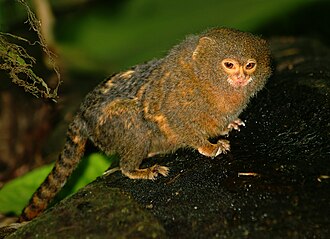
New World monkeys are small to mid-sized primates, ranging from the pygmy marmoset (the world's smallest monkey), at 14 to 16 cm (5.5 to 6.5 in) and a weight of 120 to 190 g (4.2 to 6.7 oz), to the southern muriqui, at 55 to 70 cm (22 to 28 in) and a weight of 12 to 15 kg (26 to 33 lb). New World monkeys differ slightly from Old World monkeys in several aspects. The most prominent phenotypic distinction is the nose, which is the feature used most commonly to distinguish between the two groups. The clade for New World monkeys, Platyrrhini, means "flat nosed". The noses of New World monkeys are flatter than the narrow noses of Old World monkeys, and have side-facing nostrils.
New World monkeys are the only monkeys with prehensile tails—in comparison with the shorter, non-grasping tails of the anthropoids of the Old World. Prehensility has evolved at least two distinct times in platyrrhines, in the Atelidae family (spider monkeys, woolly spider monkeys, howler monkeys, and woolly monkeys), and in capuchin monkeys (Cebus).
以上节选摘自英文维基百科「New World monkey」,按 CC BY-SA 4.0 使用,去掉了参考文献、外部链接等尾部小节,公式改写成了纯文本。篇幅所限,较长的小节只摘了开头一部分,有的小节没有收;全文、配图和出处见原文。