 格物
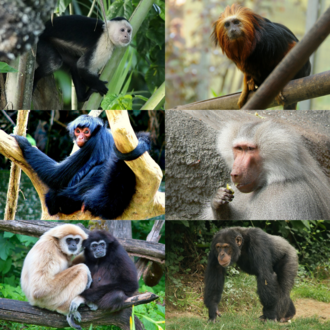
图:Cebus_capucinus_(Cahuita).jpg: Hans Hillewaert Ateles_panisc… · CC BY 3.0 · Wikimedia Commons
- 学名
- Simiiformes
- 分类等级
- 下纲
- 上级类群
- 简鼻亚目
- 大类
- 哺乳动物
- 命名
- 恩斯特·海克尔,1866 年
- 数据库
- NCBI 分类
下级类群(4)
百科正文
分类及演化
类人猿下目分成三类。阔鼻小目于约4000万年前分支出来,只余下狭鼻小目留在旧世界。狭鼻小目再于2500万年前分支开成旧世界猴及猿。猴是一个并系群。早期分类将灵长目分为原猴亚目及类人猿亚目。
- 以下是类人猿下目的分类:
- 类人猿下目 Simiiformes
- †疑猴科 Amphipithecidae
- †曙猿科 Eosimiidae
- 阔鼻小目 Platyrrhini
- 狭鼻小目 Catarrhini
以上内容摘自维基百科「類人猿下目」,按 CC BY-SA 4.0 使用,去掉了参考文献、外部链接等尾部小节,公式改写成了纯文本。全文、配图和出处见原文。
英文维基百科补充中文条目比较短,下面是英文条目「Simian」的原文
The simians, anthropoids, or higher primates (simian from Latin: simis, lit. 'monkey') are primates of the infraorder Simiiformes , containing all animals traditionally called monkeys and apes. More precisely, they consist of the parvorders Platyrrhini (New World monkeys) and Catarrhini, the latter of which consists of the family Cercopithecidae (Old World monkeys in the stricter sense) and the superfamily Hominoidea (apes – including humans).
The simians are sister group to the tarsiers (Tarsiiformes), together forming the haplorhines. The radiation occurred about 60 million years ago (during the Cenozoic era); 40 million years ago, simians colonized South America, giving rise to the New World monkeys. The remaining simians (catarrhines) split about 25 million years ago into Cercopithecidae and Hominoidea.
Biological key-features
Biological features common to all or most simians include genetic similarities, similarities in eye location and the muscles close to the eyes, internal similarities between ears, dental similarities, and similarities on foot bone structure. The earliest simians were small primates with varied diets, forward-facing eyes, acute color vision for daytime lifestyles, and brains devoted more to vision and less to smell. Living simians in both the New World and the Old World have larger brains than other primates, but they evolved these larger brains independently.
Simians characteristically have relatively large brains, fused mandibles, binocular and color vision, and the females have a single fused uterus. They also have fewer teeth and are more sexually dimorphic in terms of body size and anatomy.
The traits that separate New World simians from Old World simians are the nostrils and their dentation (teeth).
Taxonomy
In earlier classification, New World monkeys, Old World monkeys, apes, and humans – collectively known as simians or anthropoids – were grouped under Anthropoidea (; from Ancient Greek ἄνθρωπος (ánthrōpos) 'human' and -οειδής (-oeidḗs) 'resembling, connected to, etc.'), while the strepsirrhines and tarsiers were grouped under the suborder "Prosimii". Under modern classification, the tarsiers and simians are grouped under the suborder Haplorhini, while the strepsirrhines are placed in suborder Strepsirrhini. Strong genetic evidence for this is that five SINEs are common to all haplorhines whilst absent in strepsirrhines — even one being coincidental between tarsiers and simians would be quite unlikely.
Evolution
One theory for the origin of anthropoid primates is that they originated in Africa, with taxa appearing as early as Altiatlasius potentially being suggested to be stem group anthropoids. However, there is also a competing theory suggesting that they may have originated in Asia during the middle to late Eocene, having crossed the Tethys Sea on natural rafts or floating islands alongside other Asian mammals.
The New World monkeys in parvorder Platyrrhini split from the rest of the simian line about 40 million years ago (mya), leaving the parvorder Catarrhini occupying the Old World. This latter group split about 25 mya between the Cercopithecidae and the apes, making Cercopithecidae more closely related to the apes than to the Platyrrhini.
Classification
The following is the listing of the various simian families, and their placement in the order Primates:
- Order Primates
- Suborder Strepsirrhini: nontarsier prosimians
- Suborder Haplorhini: tarsiers and monkeys, including apes
- Infraorder Tarsiiformes
- Infraorder Simiiformes
- Parvorder Platyrrhini: New World monkeys
- Family Callitrichidae: marmosets and tamarins
- Family Cebidae: capuchins and squirrel monkeys
- Family Aotidae: night or owl monkeys (douroucoulis)
- Family Pitheciidae: titis, sakis, and uakaris
- Family Atelidae: howler, spider, and woolly monkeys
- Parvorder Catarrhini
- Superfamily Cercopithecoidea: Old World monkeys
- Family Cercopithecidae
- Superfamily Hominoidea
- Family Hylobatidae: gibbons
- Family Hominidae: great apes, including humans
- †Amphipithecidae
- †Eosimiidae
- †Aseanpithecus
Below is a cladogram with some of the extinct simian species with the more modern species emerging within the Eosimiidae. The simians originated in Asia, while the crown simians were in Afro-Arabia.
以上节选摘自英文维基百科「Simian」,按 CC BY-SA 4.0 使用,去掉了参考文献、外部链接等尾部小节,公式改写成了纯文本。篇幅所限,较长的小节只摘了开头一部分,有的小节没有收;全文、配图和出处见原文。