 格物
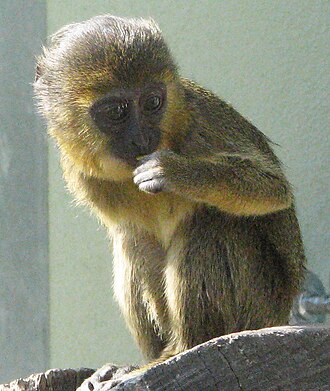
图:Photo Christophe Chauvin Christophe Chauvin Janekvorik · Public domain · Wikimedia Commons
生命之树 › 真核生物 › 动物界 › 真后生动物亚界 › 两侧对称动物 › 后口动物总门 › 脊索动物门 › 脊椎动物亚门 › 有颌下门 › 肉鳍鱼总纲 › 四足形类 › 希望螈目 › 四足总纲 › 哺乳动物 › 兽型类 › 全兽类 › 兽亚纲 › 有胎盘类 › 北方真兽高目 › 灵长总目 › 灵长目 › 简鼻亚目 › 类人猿下目
狭鼻小目小目
Catarrhini
狭鼻小目(Catarrhini)是灵长目简鼻亚目中三个小目之一,包含了旧世界猴(猴总科)及猿(人猿总科)。后者再细分为长臂猿科及人科。以往认为人类及其已灭绝的近亲或祖先是一个独立的科,而人科则被分类在猩猩科中。
摘自维基百科「狹鼻小目」,CC BY-SA 4.0
- 学名
- Catarrhini
- 分类等级
- 小目
- 上级类群
- 类人猿下目
- 大类
- 哺乳动物
- 命名
- 艾蒂安·若弗鲁瓦·圣伊莱尔,1812 年
- 数据库
- NCBI 分类
下级类群(1)
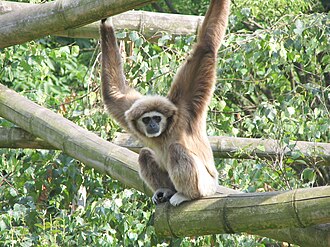
- 人猿总科 Hominoidea 总科
百科正文
狭鼻小目的动物鼻孔都是狭窄及向下的。它们不像阔鼻小目,一般都是白天活动,而尾巴并非卷尾。它们的指甲都是扁平的,上下齿式都是2.1.2.3。
狭鼻小目大部分物种都是两性异形的,且大都不是一夫一妻的。很多但不是全部物种都以群族方式生活。它们是非洲及亚洲的原住民。
分类及演化
猿及旧世界猴于4000万年前从新世界猴中分裂出来。主要的狭鼻小目于2500万年前出现,而于1800万年前长臂猿科从人科中分支出来。
- 狭鼻小目 Catarrhini
- †渐新猿科 Oligopithecidae
- †原上猿总科 Propliopithecoidea
- †原上猿科 Propliopithecidae
- †上猿总科 Pliopithecoidea
- †醉猿科 Dionysopithecidae
- †上猿科 Pliopithecidae
- †科 Crouzeliinae
- †树猿总科 Dendropithecoidea
- †树猿科 Dendropithecidae
- †总科/超科 Saadanioidea
- †萨丹猴科 Saadaniidae
- †总科/超科 Parapithecoidea
- †副僧面猴科 Parapithecidae
- 猴总科 Cercopithecoidea
- 猴科 Cercopithecidae
- 人猿总科 Hominoidea
- †原康修尔猿科 Proconsulidae
- †非洲古猿科 Afropithecidae
- 长臂猿科 Hylobatidae
- 人科 Hominidae
以上内容摘自维基百科「狹鼻小目」,按 CC BY-SA 4.0 使用,去掉了参考文献、外部链接等尾部小节,公式改写成了纯文本。全文、配图和出处见原文。
英文维基百科补充中文条目比较短,下面是英文条目「Catarrhini」的原文
The parvorder Catarrhini (known commonly as catarrhine monkeys, Old World anthropoids, or Old World monkeys) consists of the Cercopithecoidea (Old World monkeys) and Hominoidea (apes). In 1812, Geoffroy grouped those two groups together and established the name Catarrhini, "Old World monkeys" (singes de l'Ancien Monde in French). Its sister in the infraorder Simiiformes (simians) is the parvorder Platyrrhini (New World monkeys). There has been some resistance to directly designate apes (and thus humans) as monkeys despite the scientific evidence, so "Old World monkey" may be taken to mean the Cercopithecoidea or the Catarrhini. That apes are monkeys was already realized by Georges-Louis Leclerc, Comte de Buffon in the 18th century. Linnaeus placed this group in 1758, together with what we now recognise as the tarsiers and the New World monkeys, in a single genus "Simia" (sans Homo). The Catarrhini are all native to Africa and Asia. Members of this parvorder are called catarrhines.
The Catarrhini are the sister group to the New World monkeys, the Platyrrhini. Some six million years before the ape-Cercopithecoidea bifurcation, the Platyrrhini emerged within "monkeys" by migration to South America from Afro-Arabia (the Old World), likely by ocean.
Description
The technical distinction between the New World platyrrhines and Old World catarrhines is the shape of their noses. The platyrrhines (from Ancient Greek platy-, "flat", and rhin-, "nose") have nostrils which face sideways. The catarrhines (from Ancient Greek katà-, "down", and rhin-, "nose") have nostrils that face downwards. Catarrhines also never have prehensile tails, and have flat fingernails and toenails, a tubular ectotympanic (ear bone), and eight, not 12, premolars, giving them a dental formula of 2.1.2.32.1.2.3, indicating 2 incisors, 1 canine, 2 premolars, and 3 molars on each side of the upper and lower jaws.
Most catarrhine species show considerable sexual dimorphism and do not form a pair bond. Most, but not all, species live in social groups. Like the platyrrhines, the catarrhines are generally diurnal, and have grasping hands and (with the exception of bipedal humans) grasping feet.
The apes—in both traditional and phylogenic nomenclature—are exclusively catarrhine species. In traditional usage, ape describes any tailless, larger, and more typically ground-dwelling species of catarrhine. "Ape" may be found as part of the common name of such species of monkeys, such as the Barbary ape and Black ape. In phylogenic usage, the term ape applies only to the superfamily Hominoidea. This grouping comprises two families: Hylobatidae, the lesser apes (gibbons); and Hominidae, the great apes, including orangutans, gorillas, chimpanzees, humans, and related extinct genera, such as the prehuman australopithecines and the giant orangutan relative Gigantopithecus.
Classification and evolution
According to Schrago & Russo, New World monkeys split from their Old World kin about 35 million years ago (Mya). They use the major catarrhine division between cercopithecoids and hominoids of about 25 Mya (which they argue is strongly supported by the fossil evidence), as a calibration point, and from this also calculate the gibbons separating from the great apes (including humans) about 15-19 Mya.
According to Begun and Harrison, the Catarrhini split from their New World monkey kin about 44 - 40 Mya, with the first catarrhines appearing in Africa and Arabia, and not appearing in Eurasia (outside Arabia) until 18-17 Mya.
Catarrhini lost the enzyme Alpha-galactosidase, present in all other mammal lineages, sometime after the split from platyrrhini. It is hypothesized that an ancient pathogen containing Alpha-galactosidase may be responsible, as only individuals with mutations that "turned off" the gene for Alpha-galactosidase would have produced antibodies against the pathogen and survived.
The distinction between apes and monkeys is complicated by the traditional paraphyly of monkeys: apes emerged as a sister group of Old World monkeys in the catarrhines, which are a sister group of New World monkeys. Therefore, cladistically, apes, catarrhines and related contemporary extinct groups such as Parapithecidae are monkeys as well, for any consistent definition of "monkey". "Old World Monkey" may also legitimately be taken to be meant to include all the catarrhines, including apes and extinct species such as Aegyptopithecus, in which case the apes, Cercopithecoidea and Aegyptopithecus emerged within the Old World Monkeys.
以上节选摘自英文维基百科「Catarrhini」,按 CC BY-SA 4.0 使用,去掉了参考文献、外部链接等尾部小节,公式改写成了纯文本。篇幅所限,较长的小节只摘了开头一部分,有的小节没有收;全文、配图和出处见原文。