 格物
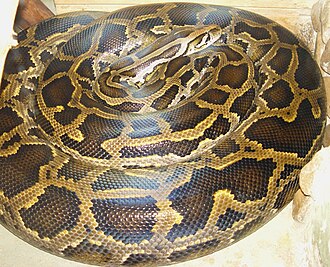
图:This photography was created by Mariluna. Other photos see h… · CC BY-SA 3.0 · Wikimedia Commons
- 学名
- Python
- 分类等级
- 属
- 上级类群
- 蟒科
- 大类
- 爬行动物
- 命名
- 弗朗索瓦·马里·多丹,1803 年
- 数据库
- NCBI 分类 · GBIF
下级类群(10)


百科正文
地理分布
蟒蛇主要分布于非洲撒哈拉沙漠等热带地区(不包括马达加斯加南部及西南部)、巴基斯坦、印度、斯里兰卡、尼科巴群岛、缅甸、中南半岛、华南、香港、江门、海南岛、菲律宾及印尼等多个地区。
以上内容摘自维基百科「蟒屬」,按 CC BY-SA 4.0 使用,去掉了参考文献、外部链接等尾部小节,公式改写成了纯文本。全文、配图和出处见原文。
英文维基百科补充中文条目比较短,下面是英文条目「Python (genus)」的原文
Python is a genus of constricting snakes in the Pythonidae family native to the tropics and subtropics of the Eastern Hemisphere.
The name python was proposed by François Marie Daudin in 1803 for non-venomous flecked snakes.
Currently, 10 python species are recognized as valid taxa.
Three formerly considered python subspecies have been promoted, and a new species recognized.
Taxonomy
The generic name Python was proposed by François Marie Daudin in 1803 for non-venomous snakes with a flecked skin and a long split tongue.
In 1993, seven python species were recognized as valid taxa.
On the basis of phylogenetic analyses, between seven and 13 python species are recognized.
Distribution and habitat
In Africa, pythons are native to the tropics south of the Sahara, but not in the extreme south-western tip of southern Africa (Western Cape) or in Madagascar. In Asia, they occur from Bangladesh, Nepal, India, Pakistan, and Sri Lanka, including the Nicobar Islands, through Myanmar, east to Indochina, southern China, Hong Kong and Hainan, as well as in the Malayan region of Indonesia and the Philippines.
Invasive
Some suggest that P. bivittatus and P. sebae have the potential to be problematic invasive species in South Florida. In early 2016, after a culling operation yielded 106 pythons, Everglades National Park officials suggested that "thousands" may live within the park, and that the species has been breeding there for some years. More recent data suggest that these pythons would not withstand winter climates north of Florida, contradicting previous research suggesting a more significant geographic potential range.
Uses
Python skin is used to make clothing, such as vests, belts, boots and shoes, or fashion accessories such as handbags. It may also be stretched and formed as the sound board of some string musical instruments, such as the erhu spike-fiddle, sanxian and the sanshin lutes.
With a high demand of snake skin in the current fashion industry, countries in Africa and Southern Asia partake in the legal and illegal selling of python skin. Providing an extremely low pay for the hunters with an extremely high selling product for the consumers, there is an enormous gap between the beginning and end of the snake skin trade.
As pets
Many Python species, such as P. regius, P. brongersmai, P. bivittatus and M. reticulatus, are popular to keep as pets due to their ease of care, docile temperament, and vibrant colors, with some rare mutations having been sold for several thousands of dollars. Pythons in the pet trade are sourced from the wild, or from captive females that were taken from the wild ('captive-born'), or from parents that themselves were born in a captive setting ('captive-bred') Despite controversy that has arisen from media reports, with proper safety procedures pet pythons are relatively safe to own.
Etymology
The word 'Python' is derived from the Latin word 'pȳthon' and the Greek word 'πύθων', both referring to Python, "the serpent slain, according to the myth, near Delphi by Apollo, who was fabled to have been called Pythius in commemoration of this victory".
以上内容摘自英文维基百科「Python (genus)」,按 CC BY-SA 4.0 使用,去掉了参考文献、外部链接等尾部小节,公式改写成了纯文本。全文、配图和出处见原文。