格物
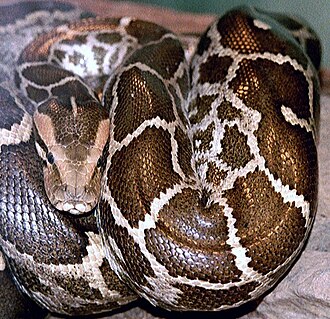
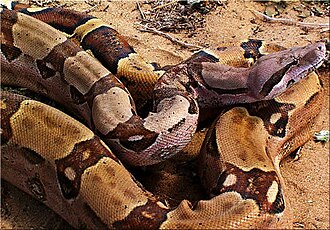
图:Tigerpython · CC BY-SA 3.0 · Wikimedia Commons
- 学名
- Pythonidae
- 分类等级
- 科
- 英文名
- python
- 上级类群
- 有鳞目
- 大类
- 爬行动物
- 命名
- 费卿格,1826 年
- 数据库
- NCBI 分类 · GBIF
下级类群(5)
百科正文
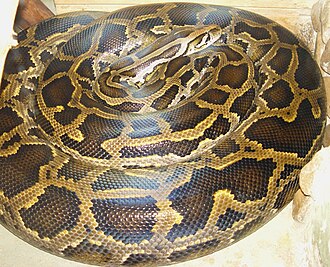
蟒蛇在全世界不少国家也有人把其当作宠物饲养。虽然蟒蛇的牙没有毒性,但由于蟒蛇体型巨大,可以吞下中大型的动物(例如:猪或羊),对人类有一定程度的危险。若没有有关经验,一般是不许饲养的。
分类
蟒科过去曾被视为蚺科(Boidae)的姐妹群而归类于蚺总科(Booidae),蟒科甚至有时会被归类为蚺科一个亚科,称为蟒亚科(Pythoninae),但是,现在的基因分子研究结果显示,蟒科与美洲闪鳞蛇科(Loxocemidae)才是姐妹群,两者再与闪鳞蛇科(Xenopeltidae)一起组成单系群,即蟒总科(Pythonoidea)。
- 蟒科 Pythonidae Fitzinger,1826
- 侏儒蟒属 Antaresia Wells & Wellington,1984
- 巴布亚蟒属 Apodora Kluge,1993
- 盾蟒属 Aspidites Peters,1877
- 环纹蟒属 Bothrochilus Fitzinger,1843
- 白吻蟒属 Leiopython Hubrecht,1879
- 岩蟒属 Liasis Gray,1842
- 树蟒属 Morelia Gray,1842
- 蟒属 Python Daudin,1803
保育状况
除被列入附录Ⅰ的亚种外的所有种均被列为《濒危野生动植物种国际贸易公约》附录II的物种,被限制出口及贸易。
以上内容摘自维基百科「蟒科」,按 CC BY-SA 4.0 使用,去掉了参考文献、外部链接等尾部小节,公式改写成了纯文本。全文、配图和出处见原文。
英文维基百科补充中文条目比较短,下面是英文条目「Pythonidae」的原文
The Pythonidae, commonly known as pythons, are a family of non-venomous snakes found in Africa, Asia, and Australia. Among its members are some of the largest snakes in the world. Ten genera and 39 species are currently recognized. Being naturally non-venomous, pythons must constrict their prey to induce cardiac arrest prior to consumption. Pythons will typically strike at and bite their prey of choice to gain hold of it; they then must use physical strength to constrict their prey, by coiling their muscular bodies around the animal, effectively suffocating it before swallowing whole. This is in stark contrast to venomous snakes such as the rattlesnake, for example, which delivers a swift, venomous bite but releases, waiting as the prey succumbs to envenomation before being consumed. Collectively, the pythons are well-documented and studied as constrictors, much like other non-venomous snakes, including the boas and even kingsnakes of the New World.
Pythons are indigenous to the tropics of the Old World, including sub-Saharan Africa, subtropical to tropical Asia, and Australia, Pythons are ambush predators that primarily kill prey by constriction, causing cardiac arrest. Pythons are oviparous, laying eggs that females incubate until they hatch. They possess premaxillary teeth, with the exception of adults in the Australian genus Aspidites. While many species are available in the exotic pet trade, caution is needed with larger species due to potential danger. The taxonomy of pythons has evolved, and they are now known to be more closely related to sunbeam snakes and the Mexican burrowing python.
Pythons are frequently poached for their skins, with the export market for skins from Southeast Asia estimated at a billion dollars in 2012. They are also sold and consumed as meat. They can carry diseases, such as salmonella and leptospirosis, which can be transmitted to humans. Pythons are also used in African traditional medicine to treat ailments like rheumatism and mental illnesses. Their body parts, including blood and organs, are believed to have various healing properties. In some African cultures, pythons have significant roles in folklore and mythology, often symbolizing strength or having sacred status.
Conservation
Many species have been hunted aggressively, which has greatly reduced the population of some, such as the Indian python (Python molurus) and the ball python (Python regius).
Captivity
Most species in this family are available in the exotic pet trade. However, caution must be exercised with the larger species, as they can be dangerous; rare cases of large specimens killing their owners have been documented.
以上节选摘自英文维基百科「Pythonidae」,按 CC BY-SA 4.0 使用,去掉了参考文献、外部链接等尾部小节,公式改写成了纯文本。篇幅所限,较长的小节只摘了开头一部分,有的小节没有收;全文、配图和出处见原文。