 格物
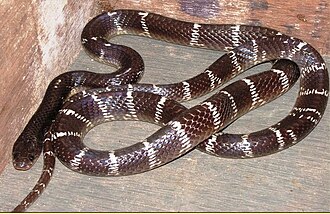
图:Jayendra Chiplunkar · CC BY-SA 3.0 · Wikimedia Commons
- 学名
- Bungarus caeruleus
- 分类等级
- 种
- 英文名
- Common Krait
- 上级类群
- 环蛇属
- 大类
- 爬行动物
- 命名
- 约翰·戈特洛布·特埃努斯·施奈德,1801 年
- 保护状况(IUCN)
- 无危物种
- 数据库
- NCBI 分类 · GBIF · IUCN 红色名录
百科正文
特征
印度环蛇身体的花样上有细白色环带与黑色相间,白环纹通常以两个为一组,并成交叉状排列。这种蛇的平均体长为1米左右,最长可达到1.75米。雄性的体型要比雌性的大,尾巴也较长。
地理分布
印度环蛇主要分布于印度半岛以及巴基斯坦和斯里兰卡等地。
栖息地
这种蛇的活动范围很广泛,在农田、低谷地区以及森林里,都可以找到它们。而它们对鼠类的喜爱亦使得它们常出没于老鼠洞、下水管道以及人类居所附近。另外它们也常见于水源充足的地方。
习性
正如其他的环蛇,印度环蛇是夜行性的动物,它们主要在晚上活动。一般而言,它们很少会在白天攻击人类,因为它们在白天的反应远不及在晚上的快。当受到威胁时,印度环蛇会把身体卷成一团并尽量掩护其头部。在一定的情况下,这种蛇会发出低嘶声并准备攻击或逃跑。印度环蛇属于最危险的环蛇之一,虽然它很少主动袭击人类,但被它咬伤的人死亡率能高达70%。
食性
印度环蛇主要以其他蛇类、蜥蜴、鼠类、蛙类等为食。
毒性
印度环蛇的毒性非常强,平均2-3毫克的毒液就足以致命。其毒液里含有剧烈的神经毒素,不少专家相信,印度环蛇的毒性比一般眼镜蛇的毒性要强得多。这种毒素会影响生物的神经系统,如大脑等,但由于环蛇多在晚上出动,而且性格也不太凶猛,因此被这种蛇咬伤的个案很少发生。但值得注意的是,被印度环蛇咬伤后,起初只会有轻微的疼痛感,有的更是完全没有感觉。这种现象很多时都会给受害者一个错觉,以为自己没有大碍,可是大部分被印度环蛇咬伤的人可能会在几分钟后心脏麻痹毒发死亡。
以上内容摘自维基百科「青環蛇」,按 CC BY-SA 4.0 使用,去掉了参考文献、外部链接等尾部小节,公式改写成了纯文本。全文、配图和出处见原文。
英文维基百科补充中文条目比较短,下面是英文条目「Common krait」的原文
The common krait (Bungarus caeruleus) is a highly venomous snake species belonging to the genus Bungarus in the family Elapidae. It has a black or bluish-black body with narrow white crossbands, typically reaching a length of 0.91 to 1.22 m (3 to 4 ft). It is widely distributed across India, Pakistan, Bangladesh, Sri Lanka and Nepal, inhabiting grasslands, agricultural fields, and human settlements. It is known for its potent neurotoxic venom and responsible for the majority of medically significant snakebites in the Indian subcontinent.
Description
The average length of the common krait is 0.9 m (2 ft 11 in), but it can grow to 1.75 m (5 ft 9 in). Males are longer than females, with proportionately longer tails. The head is flat and the neck is hardly visible. The body is cylindrical, tapering towards the tail. The tail is short and rounded. The eyes are rather small, with rounded pupils, indistinguishable in life. The head shields are normal, with no loreals; four shields occur along the margin of the lower lip; the third and fourth supraoculars touch the eye. The scales are highly polished, in 15–17 rows; the vertebral row is distinctly enlarged and hexagonal. Ventrals number 185–225 and caudals 37–50, and are entirely intact.
Their coloration is generally black or bluish-black, with about 40 thin, white crossbars, which may be indistinct or absent anteriorly. Albino specimens can be found, although such cases are extremely rare.
Distribution and habitat
The common krait is widely distributed across South Asia, including India, Pakistan, Bangladesh, Sri Lanka, Nepal and possibly Bhutan. Its range extends westward into Afghanistan and potentially parts of Iran. Within India, it occurs throughout the country including the Andaman and Nicobar Islands.
This snake inhabits a diverse range of environments, including scrub jungles, grasslands, agricultural fields, semi-desert areas, rocky terrains, and suburban gardens. It is frequently found in human-modified landscapes such as plantations and cultivated lands. The common krait often takes refuge in termite mounds, rat burrows, or under debris. It is particularly associated with areas near water sources, such as streams, canals, and ponds.
The common krait demonstrates high adaptability to various habitats and is common in rural areas, where rodent populations are abundant. During the monsoon season, it often enters houses in search of shelter or prey.
Behaviour and ecology
The common krait is a nocturnal snake, most active during the night when it hunts for prey and moves about its environment. During the day, it remains inactive and hides in concealed locations such as rodent burrows, termite mounds, or under debris. This secretive behavior makes it difficult to spot during daylight hours. Despite its potent venom, the common krait is generally non-aggressive and prefers to avoid confrontation. When threatened, it often coils itself tightly with its head tucked underneath as a defensive posture. It may flatten its body or make sudden movements as a warning but rarely bites unless provoked. At night, however, it can become more active and aggressive if disturbed. Records of people sleeping on the ground getting bitten are common.
Diet
The common krait feeds primarily on other snakes, including venomous snakes like other kraits and vipers. It also feeds on small rodents, lizards, birds and frogs.
Venom
The common krait is responsible for the majority of medically significant snakebites in the Indian subcontinent as its neurotoxic venom is one of the most potent venoms on humans among Indian snakes.
Bites without envenomation, i.e. dry bites are not uncommon.
In mice, the LD50 values of its venom are 0.325 mg/kg subcutaneously, 0.169 mg/kg intravenously, and 0.089 mg/kg intraperitoneally.
The average venom yield is 10 mg (0.15 gr) dry weight. The estimated lethal dose for humans is 2–3 mg (0.031–0.046 gr).
Venom composition
The venom is dominated by phospholipases A2 (PLA2), constituting approximately 64.5% of its proteome, with presynaptic β-bungarotoxins (similar to β-caerulotoxins) being the primary neurotoxic components. These toxins irreversibly damage motor nerve terminals by depleting synaptic vesicles and disrupting acetylcholine release, leading to neuromuscular blockade.
以上节选摘自英文维基百科「Common krait」,按 CC BY-SA 4.0 使用,去掉了参考文献、外部链接等尾部小节,公式改写成了纯文本。篇幅所限,较长的小节只摘了开头一部分,有的小节没有收;全文、配图和出处见原文。