 格物
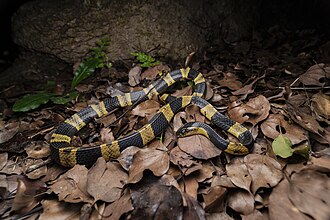
图:Lawrence Hylton · CC BY 4.0 · Wikimedia Commons
生命之树 › 真核生物 › 动物界 › 真后生动物亚界 › 两侧对称动物 › 后口动物总门 › 脊索动物门 › 脊椎动物亚门 › 有颌下门 › 肉鳍鱼总纲 › 四足形类 › 希望螈目 › 四足总纲 › 爬行动物 › 鳞龙形下纲 › 鳞龙超目 › 有鳞目 › 眼镜蛇科 › 环蛇属
金环蛇种
Bungarus fasciatus
金环蛇,俗称金甲带、金包铁、金脚带、花扇柄(客家话)、雨伞柄(潮州话)或佛蛇等,是环蛇属的一种,是毒性很强的蛇。一般来说,金环蛇和其他环蛇属的蛇一样,动作缓慢,不爱攻击人类,主要以小型脊椎动物为食。金环蛇的毒性较其近亲银环蛇弱,但仍然属剧毒蛇,而数量也较银环蛇为稀有。
摘自维基百科「金環蛇」,CC BY-SA 4.0
- 学名
- Bungarus fasciatus
- 分类等级
- 种
- 英文名
- Banded krait
- 上级类群
- 环蛇属
- 大类
- 爬行动物
- 命名
- 约翰·戈特洛布·特埃努斯·施奈德,1801 年
- 保护状况(IUCN)
- 无危物种
- 数据库
- NCBI 分类 · GBIF · IUCN 红色名录
百科正文
特征
金环蛇全长在一米左右,最长可达一点八米;全身有固定间距的黑黄相间环带,黑色环纹比黄色环纹略宽,幼蛇环带为黑色及灰色;金环蛇躯干有高脊棱,头部椭圆形,略粗于颈部,有矛形花纹,尾巴短钝。
习性及生境
夜行性,栖息于植被茂密和水源充足的小丘和低谷地带,捕食其他蛇类,蜥蜴及小型脊椎动物。
个性温驯胆小,受扰时像其近亲银环蛇般迅速逃走或将头部藏于蛇身下,被捕时则不停晃动身体,但不像银环蛇般剧烈。
繁殖
5月底产卵,每次产卵8-12枚。
潜在危险及毒性
有剧毒,有竖立前毒牙。剧毒足以致命。平均一次排毒量27.5毫克。神经毒为主。人致死剂量10毫克。香港曾有数宗被咬的死亡个案。
日间较温驯,夜间警觉性极高。
分布区域
主要生活在印度东北部和东南亚地区,分布于中国的江西、福建、广东、香港、海南岛、广西和云南。
保护
本种于2023年被收录入《有重要生态、科学、社会价值的陆生野生动物名录》。
以上内容摘自维基百科「金環蛇」,按 CC BY-SA 4.0 使用,去掉了参考文献、外部链接等尾部小节,公式改写成了纯文本。全文、配图和出处见原文。
英文维基百科补充中文条目比较短,下面是英文条目「Banded krait」的原文
The banded krait (Bungarus fasciatus) is a venomous species of elapid endemic to Asia, from Indian subcontinent through Southeast Asia to Southern China. With a maximum length exceeding 2 m (6 ft 7 in), it is the longest krait with a distinguishable gold and black pattern. While this species is generally considered timid and docile, resembling other members of the genus, its venom is highly neurotoxic which is lethal to humans. Although toxicity of the banded krait based upon murine LD50 experiments is lower than that of many other kraits, its venom yield is the highest due to its size.
Description
The banded krait is easily identified by its alternate black and yellow crossbands all of which encircle the body. The head is broad and depressed and it is not distinct from the neck. The eyes are black. It has arrowhead-like yellow markings on its otherwise black head and has yellow lips, lores, chin, and throat. The tail is relatively small, about one-tenth the length of the snake.
The longest banded krait measured was 2.25 m (7 ft 5 in) long, but normally the length encountered is 1.8 m (5 ft 11 in).
Scalation: 15 dorsal scale rows at midbody; sub-caudal scutes undivided throughout, 23–39; middorsal row of scales (vertebrals) hexagonal and strongly enlarged, as broad as or broader than long; anal plate undivided.
Distribution and habitat
The banded krait occurs in the whole of the Indo-Chinese subregion, the Malay Peninsula and Indonesian archipelago, and southern China. The species is common in the states of West Bengal, Odisha, Mizoram, Assam, Manipur, Bihar and Tripura of India, Nepal and Bangladesh, but becomes progressively uncommon westwards in India.
It has been recorded eastwards from central India through Nepal, Bangladesh, Myanmar, Cambodia, Thailand, Laos, Vietnam, and southern China (including Hainan and Hong Kong), Malaysia and the main Indonesian islands of Borneo (Java and Sumatra), as well as Singapore.
In India, it has been recorded from Andhra Pradesh, Bihar, Chhattisgarh, Jharkhand, Madhya Pradesh, Maharashtra, Northeast India, Odisha, Tamil Nadu, Kerala and West Bengal.
Behaviour
Banded kraits are shy, not typically seen, and are mainly nocturnal. When harassed, they will usually hide their heads under their coils, and do not generally attempt to bite, though at night they are much more active and widely considered to be more dangerous then.
During the day, they lie up in grass, pits, or drains. The snakes are lethargic and sluggish even under provocation. They are most commonly seen in the rains.
Food
The banded krait feeds mainly on other snakes, but is also known to eat fish, frogs, skinks, and snake eggs. Among the snakes taken by banded kraits are:
- Sunbeam snake Xenopeltis unicolor
- Rainbow water snake Enhydris enhydris
- Red-tailed pipe snake Cylindrophis ruffus
- Chequered keelback Fowlea piscator
- Buff-striped keelback Amphiesma stolatum
Venom
The venom of the banded krait mainly contains neurotoxins (pre- and postsynaptic neurotoxins) with LD50 values of 2.4 mg/kg–3.6 mg/kg SC, 1.289 mg/kg IV and 1.55 mg/kg IP. The quantity of venom delivered averages out at 20–114 mg. Engelmann and Obst (1981) list the venom yield at 114 mg (dry weight). The major clinical effects caused by the venom of this species include vomiting, abdominal pain, diarrhoea, and dizziness. Severe envenomation can lead to respiratory failure and death may occur due to suffocation. Banded krait venom can damage the kidneys if injected.
Common names
- Manipuri language – linkhak
- Mizo language – chawnglei, tiangsir
- Kannada – kattige haavu (ಕಟ್ಟಿಗೆ ಹಾವು)
- Karbi language – maipam, rui-teron
- Assamese language – xokha (শখা), xongkhosur (শংখচোৰ), gowala (গোৱালা), bandphora
Bengali – shankhini (শঙ্খিনী), shankhamooti shaanp (শাঁখামুঠি) and rajsap (king snake) in Birbhum District কুসাপা (রাজবংশি ভাষায়)
- Burmese – ငန်းတော်ကျား ngān taw kyā
- Hindi – ahiraaj saamp
- Indonesian – welang
- Ho – Sakombiń
- Malayalam – manjavarayan (മഞ്ഞവരയൻ)
- Marathi – patteri manyar, पट्टेरी मण्यार agya manyar, sataranjya
- Odia – rana (ରଣା)
- Tamil – kattu viriyan (கட்டுவிரியன்), yennai viriyan, yettadi viriyan
- Telugu – katla paamu (కట్ల పాము) or bangaru paamu (బంగారు పాము) meaning the golden snake
- Tulu – kadambale
以上节选摘自英文维基百科「Banded krait」,按 CC BY-SA 4.0 使用,去掉了参考文献、外部链接等尾部小节,公式改写成了纯文本。篇幅所限,较长的小节只摘了开头一部分,有的小节没有收;全文、配图和出处见原文。