 格物
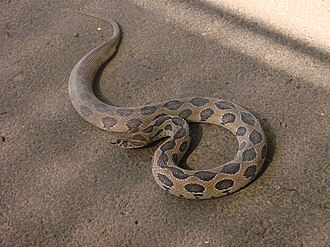
图:AChawla · CC BY-SA 3.0 · Wikimedia Commons
- 学名
- Viperinae
- 分类等级
- 亚科
- 上级类群
- 蝰蛇科
- 大类
- 爬行动物
- 命名
- Nicolaus Michael Oppel,1811 年
- 数据库
- NCBI 分类
下级类群(9)

百科正文
蝰蛇广泛分布在欧洲、亚洲和非洲,包括约12属,66种。大多数都生活在热带和亚热带,但极北蝰(Vipera berus)却可能分布在非常靠北的地区,甚至北极圈附近。
分类
- 常见的有以下几属:
- 树蝰属 Atheris
- 咝蝰属 Bitis
- 角蝰属 Cerastes
- 山蝰属 Daboia
- 锯鳞蝰属 Echis
- 蝰属 Vipera
以上内容摘自维基百科「蝰亚科」,按 CC BY-SA 4.0 使用,去掉了参考文献、外部链接等尾部小节,公式改写成了纯文本。全文、配图和出处见原文。
英文维基百科补充中文条目比较短,下面是英文条目「Viperinae」的原文
Viperinae, or viperines, are a subfamily of vipers endemic to Europe, Asia and Africa. They are distinguished by their lack of the heat-sensing pit organs that characterize their sister group, the subfamily Crotalinae. Currently, 13 genera are recognized. Most are tropical and subtropical, although one species, Vipera berus, even occurs within the Arctic Circle. Like all vipers, they are venomous.
The common names "pitless vipers", "true vipers", "Old World vipers", and "true adders" all refer to this group.
Description
Members of this subfamily range in size from Bitis schneideri, which grows to a maximum total length (body and tail) of 280 mm (11 in), to the Gaboon viper, which reaches a maximum total length of over 2 m (6.6 ft). Most species are terrestrial, but a few, such as those of the genus Atheris, are completely arboreal.
Although the heat-sensing pits that characterize the Crotalinae are clearly lacking in the viperines, a supernasal sac with sensory function has been described in a number of species. This sac is an invagination of the skin between the supranasal and nasal scales and is connected to the ophthalmic branch of the trigeminal nerve. The nerve endings here resemble those in the labial pits of boas. The supernasal sac is present in the genera Daboia, Pseudocerastes and Causus, but is especially well developed in the genus Bitis. Experiments have shown that strikes are not only guided by visual and chemical cues, but also by heat, with warmer targets being struck more frequently than colder ones.
Geographic range
Viperinae are found in Europe, Asia, and Africa, but not in Madagascar.
Reproduction
Generally, members of this subfamily are ovoviviparous, although a few, such as Pseudocerastes, Cerastes, and some Echis species are oviparous (egg-laying).
Taxonomy
In the last 50 years, two genera previously included in the Viperinae were considered so distinctive within the Viperidae that separate subfamilies were created for them:
Genus Azemiops — moved to subfamily Azemiopinae by Liem, Marx & Rabb (1971).
Genus Causus — recognition of subfamily Causinae Cope, 1860 was proposed by Groombridge (1987) and further supported by Cadle (1992).
Nevertheless, these groups, together with the genera currently recognized as belonging to the Viperinae, are still often referred to collectively as the true vipers.
Broadley (1996) recognized a new tribe, Atherini, for the genera Atheris, Adenorhinos, Montatheris and Proatheris, the type genus for which is Atheris.
以上内容摘自英文维基百科「Viperinae」,按 CC BY-SA 4.0 使用,去掉了参考文献、外部链接等尾部小节,公式改写成了纯文本。全文、配图和出处见原文。