 格物
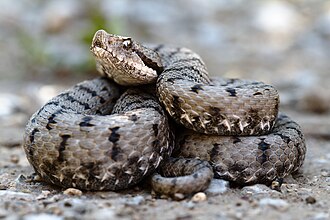
图:Felix Reimann · CC BY-SA 3.0 · Wikimedia Commons
生命之树 › 真核生物 › 动物界 › 真后生动物亚界 › 两侧对称动物 › 后口动物总门 › 脊索动物门 › 脊椎动物亚门 › 有颌下门 › 肉鳍鱼总纲 › 四足形类 › 希望螈目 › 四足总纲 › 爬行动物 › 鳞龙形下纲 › 鳞龙超目 › 有鳞目 › 蝰蛇科 › 蝰亚科
蝰属属
Vipera
蝰属 是蛇亚目蝰蛇科蝰亚科下的一个有毒蛇属,其分布范围相当广泛,既出没于北非,亦有品种分布于北极圈、英国与及亚洲。其学名“Vipera”来源于拉丁语中的“Vivus”及“Pario”,意指“活体”、“生产”,似乎针对大部分蝰蛇卵胎生的特性。目前共有23个品种已被确认。
摘自维基百科「蝰屬」,CC BY-SA 4.0
- 学名
- Vipera
- 分类等级
- 属
- 英文名
- vipers
- 上级类群
- 蝰亚科
- 大类
- 爬行动物
- 命名
- 约瑟夫斯·尼古劳斯·劳伦蒂,1768 年
- 数据库
- NCBI 分类 · GBIF
下级类群(18)
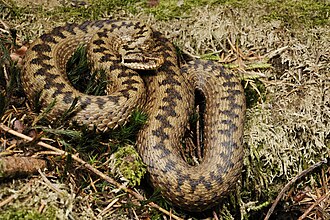
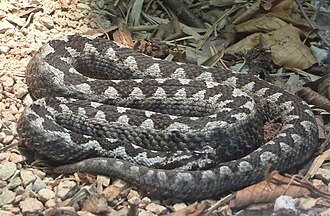
- 极北蝰 Vipera berus 种
- 沙蝰 Vipera ammodytes 种
- 毒蝰 Vipera aspis 种
- 草原蝰 Vipera ursinii 种
- Vipera latastei 种
- Vipera seoanei 种
- Vipera darevskii 种
- 高加索蝰蛇 Vipera kaznakovi 种
- Vipera barani 种
- Vipera dinniki 种
- Vipera nikolskii 种
- Vipera eriwanensis 种
- 山地蝰 Vipera monticola 种
- Vipera lotievi 种
- Vipera transcaucasiana 种
- Vipera orlovi 种
- 东方蝰 Vipera renardi 种
- Vipera pontica 种
百科正文
特征
蝰蛇体型较小,头部与颈部铺有细碎鳞片(部分品种头额位置长有较大片的鳞块),头颈间有明显分野。背鳞为龙骨结构,肛鳞与尾下鳞排列成对。
地理分布
蝰属既可见于欧洲英国、地中海群岛、爱琴海一带,亦可见于北非的摩洛哥、阿尔及利亚突尼斯等地区。也有一些品种分布于北极圈,东至北亚的库页岛及朝鲜亦有蝰蛇的踪影。
栖息地
大部分的蝰蛇都选择栖息于较寒冷的环境,位处纬度越低(较接近赤道)的蝰蛇,越会向海拔较高、气候较干燥的地区发展。相反,位处纬度越高的蝰蛇,则会选择较多植被及较潮湿的地方栖息。
生态行为
所有蝰蛇都属于陆行性蛇类。繁殖方面,蝰属的蛇都是卵胎生动物。
毒性
蝰蛇的毒素主要包含神经毒素及血毒素,遭其咬击所导致的中毒情况变幻莫测。一些体型较小的北方蝰蛇(如极北蝰)分泌毒素分量较少,而另一些蝰蛇(如沙蝰)则能向生物注射分量极重的毒液。总结而言,被蝰属下的蛇类所咬的伤害,很少能达到与钝鼻蝰或山蝰相等的威力。
以上内容摘自维基百科「蝰屬」,按 CC BY-SA 4.0 使用,去掉了参考文献、外部链接等尾部小节,公式改写成了纯文本。全文、配图和出处见原文。
英文维基百科补充中文条目比较短,下面是英文条目「Vipera」的原文
Vipera (; commonly known as the palaearctic vipers and Eurasian vipers) is a genus of snakes in the subfamily Viperinae of the family Viperidae. The genus has a very wide range, being found from North Africa to just within the Arctic Circle, and from Great Britain to Pacific Asia. The Latin name vīpera is possibly derived from the Latin words vivus and pario, meaning "alive" and "bear" or "bring forth"; likely a reference to the fact that most vipers bear live young. 21 species are recognized as being valid. Like all other vipers, the members of this genus are venomous.
Description
Members of the genus Vipera tend to be stout and small in size. The largest of them, V. ammodytes, can reach a maximum total length (including tail) of 95 cm (37 in), and the smallest, V. monticola, reaches a maximum total length of 40 cm (16 in).
The head of the members of this genus is clearly distinct from the body, triangular in shape, and in most species covered in small scales. However, some species, notably V. berus, have small plates on the top of the head. Most species have large supraocular scales that tend to extend beyond the posterior margin of the eye. Some species also have some sort of "horn" on the head, either right behind the nasal scale, or behind the supraocular scales.
The color scheme and camouflage of the members of this genus vary widely, from a grayish ground color with dark brown transverse bands to browner colors with grey transverse bands edged with black in the case of V. ammodytes.
Geographic range
Vipera species can be found all around the Old World, hence the common name of the genus, "Old World vipers". They can be found most notably in Europe, from Portugal to Turkey. They can also be found on some islands in the Mediterranean Sea (Sicily, Elba and Montecristo), and in Great Britain. They can also be found in the Maghreb region of Africa with species living in Morocco (V. monticola) and northern parts of Algeria and Tunisia in the case of V. latastei. Many species can also be found in the Caucasus Mountains, parts of Iraq, Jordan, Israel and Syria. Only one species (V. berus) discovered so far lives in East Asia, most notably North Korea, northern China and northern Mongolia.
Habitat
Most Vipera species prefer cooler environments. Those found at lower latitudes tend to prefer higher altitudes and dryer, rocky habitats, while the species that occur at more northern latitudes prefer lower elevations and environments that have more vegetation and moisture.
Behavior
All species of the genus Vipera are terrestrial.
Reproduction
All Vipera species are viviparous, giving birth to live young.
Venom
Most Vipera species have venom that contains both neurotoxic and haemotoxic components. Bites vary widely in severity.
V. ammodytes is most likely the species with the most toxic venom. In a study solely involving mice, John Haynes Brown (1973) showed that the LD50 is about 1.2/mg/kg through an IV, 1.5 mg/Kg when injected in the peritoneum (IP), and 2.0 mg/kg when administered subcutaneously (SC).
V. berus venom is considered to be on the lower end of the scale when it comes to toxicity. Minton (1974) suggests that the LD50 values for mice are about 0.55 mg/kg IV, 0.80 mg/kg IP, and 6.45 mg SC. Venom yield tends to be lower in this species with Minton citing 10–18 mg per bite in specimens 48–62 cm (19–24 in), while Brown suggest only 6 mg for the same sized specimens.
However, bites from Vipera species are rarely as severe as those from larger Macrovipera or Daboia.
Fossil record
The oldest species of the genus Vipera is the Early Miocene V. antiqua from Southern Germany. The earliest known V. antiqua fossil has been dated to 22.5 million years ago. A very large indeterminate Vipera was found in the Early Pliocene deposits of Mallorca. This species surpassed in size all modern relatives, with a length of nearly 2 m (6 ft 7 in), and was one of the biggest predators of its ecosystem.
Species
* Not including the nominate subspecies.
T: type species
Nota bene: A taxon author in parentheses indicates that the species was originally described in a genus other than Vipera.
以上内容摘自英文维基百科「Vipera」,按 CC BY-SA 4.0 使用,去掉了参考文献、外部链接等尾部小节,公式改写成了纯文本。全文、配图和出处见原文。