格物
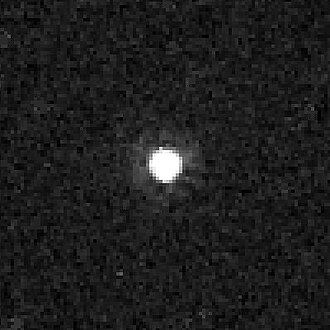
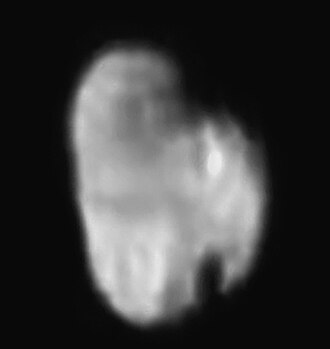
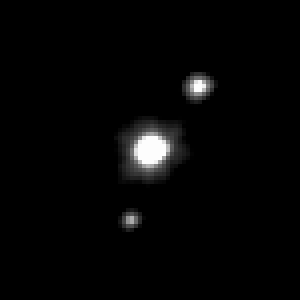
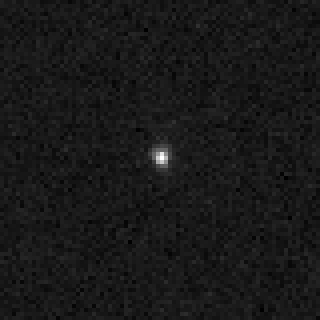
图:Hubble Space Telescope/Michael E. Brown · Public domain · Wikimedia Commons
- 类型
- 冥族小天体
- 发现 / 发明时间
- 2001 年
- 发现者 / 提出者
- 深度黄道巡天、马克·布伊
- 命名来源
- 伊克西翁
- 学科
- 天文学
- 前一项
- 小行星28977
- 后一项
- 小行星28979
相关科学家
百科正文
伊克西翁的光变曲线分析显示其亮度变化只有很小的偏差,表示它是一个椭球体,接近于矮行星的形状,表面则布满着反照率较小的暗点。它的直径约为697公里,是第五大的冥族小天体。它在可见光下呈中度红色,并具有由托林和水冰混合物制成的表面。
物理特征
伊克西翁是除冥王星之外第一个当时估计比谷神星大的海王星外天体(TNO),即使在发现一年后的2002年,估计直径仍然超过1000公里,虽然此估计是250 GHz的虚假检测结果,但后来的观察并未证实这一点。最近的估计显示伊克西翁具有高反照率,比谷神星小。2020年至2023年间的恒星掩星观测表明,伊克西翁是一个近乎球形的天体,平均直径为697公里。
伊克西翁在可见光下呈中度红色(略微红色,比创神星更红)。相较其他中型红色QB1天体,其有更高的反照率(> 0.15)。在其光谱中波长为0.8μm时可能存在吸收特征,这通常与水对表面材料的改变有关。在近红外线中,伊克西翁的光谱平坦而无特征,并没有1.5和2μm的水冰吸收带。这与伐楼拿相反,伐楼拿在近红外线中具有红色光谱斜坡以及突出的吸水带。可见光和红外光谱结果都表明,伊克西翁的表面由水冰、黑碳和托林混合物(它是通过照射水和有机化合物的包合物形成的共聚物)组成。甚大望远镜(VLT)对伊克西翁的彗星活动进行了检测,但并没有发现彗发。伊克西翁目前距离太阳大约41天文单位,当伊克西翁接近近日点时,或许会形成彗发和暂时性大气层。
以上内容摘自维基百科「小行星28978」,按 CC BY-SA 4.0 使用,去掉了参考文献、外部链接等尾部小节,公式改写成了纯文本。全文、配图和出处见原文。
英文维基百科补充中文条目比较短,下面是英文条目「28978 Ixion」的原文
28978 Ixion (; provisional designation 2001 KX76) is a large trans-Neptunian object. It is located in the Kuiper belt, a region of icy objects orbiting beyond Neptune in the outer Solar System. Ixion is classified as a plutino, a dynamical class of objects in a 2:3 orbital resonance with Neptune. It was discovered in May 2001 by astronomers of the Deep Ecliptic Survey at the Cerro Tololo Inter-American Observatory, and was announced in July 2001. The object is named after the Greek mythological figure Ixion, who was a king of the Lapiths.
In visible light, Ixion appears dark and moderately red in color due to organic compounds covering its surface. Water ice has been suspected to be present on Ixion's surface, but may exist in trace amounts hidden underneath a thick layer of organic compounds. Ixion has a measured diameter of 697 km (433 mi), making it the fourth-largest known plutino. It appears to be a transitional object between irregularly-shaped small Solar System bodies and spherical dwarf planets. Ixion is currently not known to have a natural satellite, so its mass and density are unknown.
History
Discovery
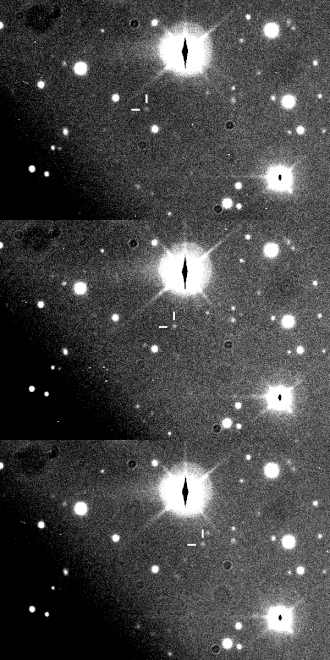
Ixion was discovered on 22 May 2001 by a team of astronomers at the Cerro Tololo Inter-American Observatory in Chile. Led by Robert L. Millis, the discovery took place through the Deep Ecliptic Survey, an astronomical survey for Kuiper belt objects located near the ecliptic plane, using telescopes of the National Optical Astronomy Observatory. On the night of 22 May 2001, American astronomers James Elliot and Lawrence Wasserman identified Ixion in digital images of the southern sky taken with the 4-meter Víctor M. Blanco Telescope at Cerro Tololo.
Orbit
Ixion orbits the Sun's barycenter with a semi-major axis of 39.5 astronomical units (AU), putting it in the Kuiper belt beyond Neptune's orbit. Ixion takes 248 years to complete one orbit, which places it in a 2:3 mean-motion resonance with Neptune. For every two revolutions it makes around the Sun, Neptune makes exactly three. It is therefore a member of the plutinos, a large population of trans-Neptunian objects named after its largest member Pluto.
Ixion's orbit closely resembles that of Pluto's, as both are plutinos. Ixion has an orbital eccentricity of 0.24 and an inclination of 19.6° with to the ecliptic, slightly greater than Pluto's inclination of 17°.
Rotation
The rotation period of Ixion is uncertain; various photometric measurements suggest that it displays very little variation in brightness, with a small light curve amplitude of less than 0.15 magnitudes. Initial attempts to determine Ixion's rotation period were conducted by astronomer Ortiz and colleagues in 2001 but yielded inconclusive results. Although their short-term photometric data was insufficient for Ixion's rotation period to be determined based on its brightness variations, they were able to constrain Ixion's light curve amplitude below 0.15 magnitudes.
Physical characteristics
Size, shape, and brightness
Observations of stellar occultations from 2020 to 2023 have shown that Ixion is a nearly spheroidal body with an area equivalent diameter of 697 km (433 mi). The shape of Ixion is slightly flattened, with its longest diameter being 727 km (452 mi) and its shortest diameter being 668 km (415 mi). Ixion's shape shows little change between different dates of occultation observations, indicating that it is mostly axisymmetric about its rotation axis (having a slightly triaxial shape). Compared to Pluto and its moon Charon, Ixion is less than one-third the diameter of Pluto and three-fifths the diameter of Charon.
Exploration
The New Horizons spacecraft, which successfully flew by Pluto in 2015, observed Ixion from afar using its long range imager on 13 and 14 July 2016. The spacecraft detected Ixion at magnitude 20.2 from a range of 15 AU (2.2 billion km; 1.4 billion mi), and was able to observe it from a high phase angle of 64°, enabling the determination of the light scattering properties and photometric phase curve behavior of its surface.
In a study published by Ashley Gleaves and colleagues in 2012, Ixion was considered as a potential target for an orbiter mission concept, which would be launched on an Atlas V 551 or Delta IV HLV rocket.
以上节选摘自英文维基百科「28978 Ixion」,按 CC BY-SA 4.0 使用,去掉了参考文献、外部链接等尾部小节,公式改写成了纯文本。篇幅所限,较长的小节只摘了开头一部分,有的小节没有收;全文、配图和出处见原文。