格物
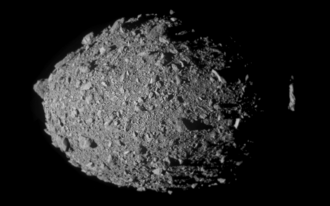
图:NASA/Johns Hopkins APL · Public domain · Wikimedia Commons
- 类型
- 小行星卫星、双小行星
- 发现 / 发明时间
- 2003 年
- 发现者 / 提出者
- 彼得·普拉韦奇
- 学科
- 天文学
相关科学家
百科正文
英文维基百科补充中文条目比较短,下面是英文条目「Dimorphos」的原文
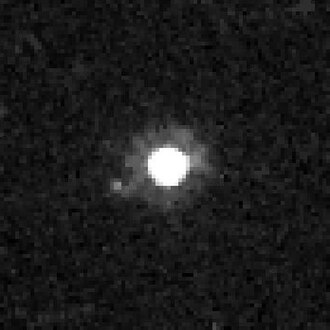
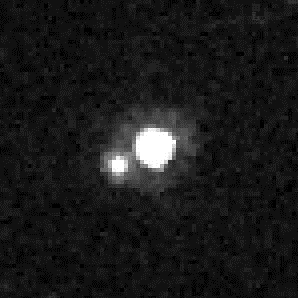
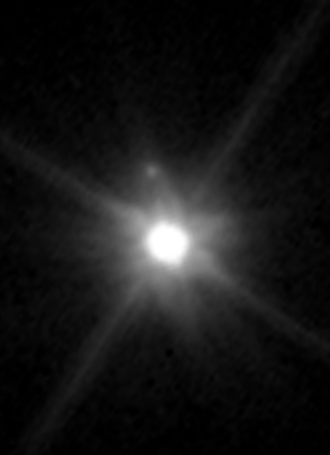
Dimorphos (formal designation (65803) Didymos I; provisional designation S/2003 (65803) 1) is a natural satellite or moon of the near-Earth asteroid 65803 Didymos, with which it forms a binary system. The moon was discovered on 20 November 2003 by Petr Pravec in collaboration with other astronomers worldwide. Dimorphos has a diameter of 177 meters (581 ft) across its longest extent.
Dimorphos is the second smallest asteroid photographed and visited by a spacecraft, after Kamoʻoalewa. It was the target of the Double Asteroid Redirection Test (DART), a NASA space mission that deliberately collided a spacecraft with the moon on 26 September 2022 to alter its orbit around Didymos. Before the impact by DART, Dimorphos had a shape of an oblate spheroid with a surface covered in boulders but virtually no craters. The moon is thought to have formed when Didymos shed its mass due to its rapid rotation, which formed an orbiting ring of debris that conglomerated into a low-density rubble pile that became Dimorphos today.
The DART impact reduced Dimorphos's orbital period around Didymos by 33 minutes and ejected over 1 million kilograms (2.2×10^6 lb) of debris into space, producing a dust plume that temporarily brightened the Didymos system and developed a 10,000-kilometer (6,200 mi)-long dust tail that persisted for several months. The DART impact is predicted to have caused global resurfacing and deformation of Dimorphos's shape, leaving an impact crater several tens of meters in diameter. Post-impact observations of brightness fluctuations within the Didymos system suggest that the impact may have either significantly deformed Dimorphos into an ellipsoidal shape or may have sent it into a chaotically tumbling rotation. If Dimorphos was in a tumbling rotation state, the moon will be subjected to irregular tidal forces by Didymos before it will eventually return to a tidally locked state within several decades. The ESA mission Hera is planned to arrive at the Didymos system in 2026 to further study the effects of DART's impact on Dimorphos.
Surface
Five boulders (saxa) and six craters have been given names of traditional drums from several cultures. They are approximately 10 meters across or smaller:
以上节选摘自英文维基百科「Dimorphos」,按 CC BY-SA 4.0 使用,去掉了参考文献、外部链接等尾部小节,公式改写成了纯文本。篇幅所限,较长的小节只摘了开头一部分,有的小节没有收;全文、配图和出处见原文。