格物
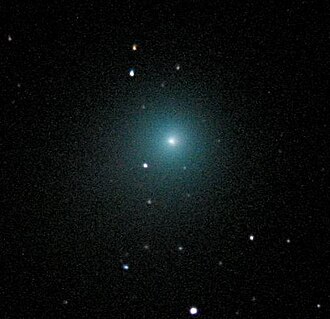
图:Ralf Weber · Attribution · Wikimedia Commons
- 发现 / 发明时间
- 2004 年
- 发现者 / 提出者
- 唐纳·梅克贺兹
- 学科
- 天文学
相关科学家
百科正文
轨道
考虑到该彗星的轨道偏心率,不同历元可以对该天体的远日点距离(最大距离)产生截然不同的二体最佳拟合解。 对于如此高偏心率的物体,太阳重心坐标比日心坐标更稳定。JPL Horizons 2050年纪元的轨道元素指出该彗星有537天文单位的半长轴和大约12,400年的公转周期。
以上内容摘自维基百科「梅克赫茲彗星」,按 CC BY-SA 4.0 使用,去掉了参考文献、外部链接等尾部小节,公式改写成了纯文本。全文、配图和出处见原文。
英文维基百科补充中文条目比较短,下面是英文条目「C/2004 Q2 (Machholz)」的原文
Comet Machholz, formally designated as C/2004 Q2, is a non-periodic comet discovered by Donald Machholz on 27 August 2004. It reached naked eye brightness in January 2005. Unusual for such a relatively bright comet, its perihelion was farther from the Sun than the Earth's orbit.
Physical characteristics
During its closest approach to Earth in January 2005, ground observations from La Palma, Spain revealed that the comet may have a rotation period of 9.1±0.2 hours, although a 2012 study regarding the morphological structures in its coma suggested it may have a rotation period of 0.74 days instead.
Between December 2004 and January 2005, observations from Lulin and La Silla observatories spotted two jets of carbon and cyanogen (CN) compounds that form a spiral-like structure within the coma, which were caused by two active surface regions in its nucleus. In March 2005, the GALEX spacecraft observed the comet in far-ultraviolet (FUV) light, where it determined that ionized methane (CH4) molecules dominated its coma, which explained the shorter than expected lifetime of carbon molecules detected. Spectral analysis of this comet's chemical composition suggest that it may have formed in a relatively inner region of the solar nebula than other typical Oort cloud comets, at a distance of at least 5.0 AU (750 million km) from the Sun. Additionally, the methane molecules frozen in the comet and its ratio relative to water indicate formation at relatively high temperatures compared to other comets.
Near-infrared measurements of the comet has indicated that its surface material generate an outflow in the form of fragments that separated into gas and dust under sublimation on time scales of the order of days.
Its nucleus has a mean diameter of 6.0 km (3.7 mi).
Orbit
Given the orbital eccentricity of this object, different epochs can generate quite different heliocentric unperturbed two-body best-fit solutions to the aphelion distance (maximum distance) of this object. For objects at such high eccentricity, the Suns barycentric coordinates are more stable than heliocentric coordinates. Using JPL Horizons the barycentric orbital elements for epoch 2050 generate a semi-major axis of 537 AU (80.3 billion km) and a period of approximately 12,400 years.
以上内容摘自英文维基百科「C/2004 Q2 (Machholz)」,按 CC BY-SA 4.0 使用,去掉了参考文献、外部链接等尾部小节,公式改写成了纯文本。全文、配图和出处见原文。