格物
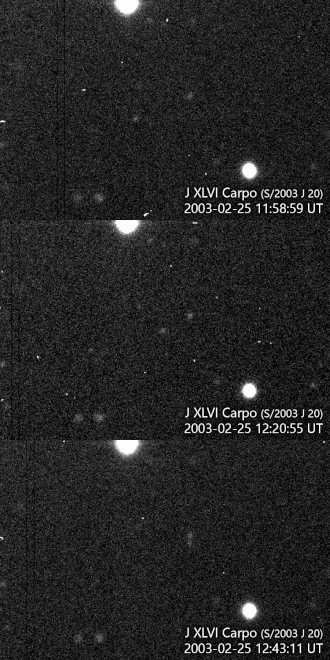
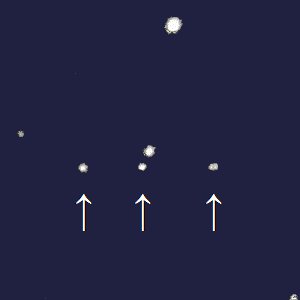
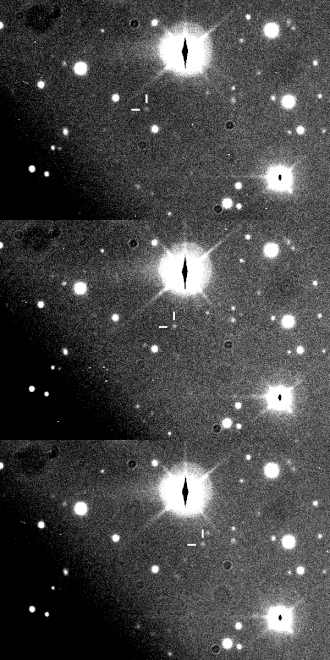
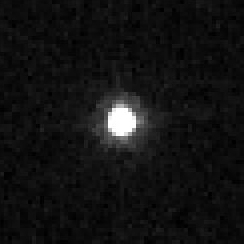
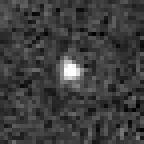
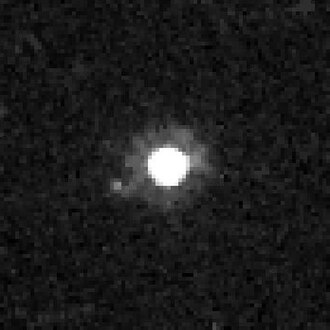
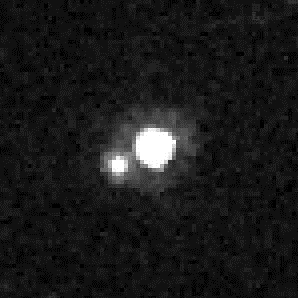
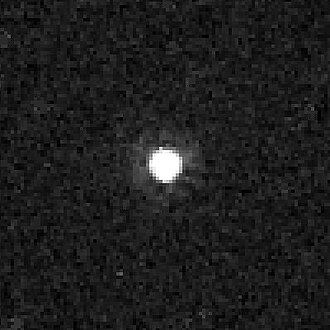
图:Brett J. Gladman/Canadian Astronomy Data Centre · CC BY-SA 4.0 · Wikimedia Commons
- 类型
- 不规则卫星
- 发现 / 发明时间
- 2003 年
- 发现者 / 提出者
- 斯科特·谢泼德、布雷特·J·格拉德曼、约翰·J·卡弗拉尔斯、大卫·朱维特、Jan Kleyna
- 命名来源
- 卡耳波
- 学科
- 天文学
相关科学家

百科正文
概述
木卫四十六(S/2003 J 20)的直径约3公里,轨道半径(平均)17145000公里,公转周期458.625天,轨道倾斜56°,离心率0.2736。
以上内容摘自维基百科「木卫四十六」,按 CC BY-SA 4.0 使用,去掉了参考文献、外部链接等尾部小节,公式改写成了纯文本。全文、配图和出处见原文。
英文维基百科补充中文条目比较短,下面是英文条目「Carpo (moon)」的原文
Carpo, also Jupiter XLVI, is a small outer natural satellite of Jupiter. It was discovered by a team of astronomers from the University of Hawaiʻi led by Scott S. Sheppard in 2003, and was provisionally designated as S/2003 J 20 until it received its name in early 2005. It was named in March 2005 after Ancient Greek deity Carpo, one of the Horae, and a daughter of Zeus (Jupiter).
Carpo has a diameter of about 3 km (1.9 mi) for an absolute magnitude of 16.2. Like all irregular moons of Jupiter, Carpo's orbit is highly variable over time due to gravitational perturbations by the Sun and other planets. On average, Carpo's orbit has a semi-major axis of 17.0 million km (10.6 million mi), a high eccentricity of 0.42, and a very high inclination of 54° with respect to the ecliptic.
Carpo was long thought to be an outlier prograde satellite not part of any group, until S/2018 J 4 was found. The orbital inclination of satellites such as Carpo is limited by the Kozai effect, which induces a periodic exchange between the inclination and eccentricity of the orbit. If the inclination is large enough, the eccentricity can in turn grow so large that the periapsis of the satellite (called the perijove in the case of moons of Jupiter) would be in the immediate vicinity of the Galilean moons (Io, Europa, Ganymede and Callisto). The satellite would eventually collide with one of these, or a close encounter would eject it altogether from the Jovian system. Due to the Kozai effect, Carpo's argument of periapsis never precesses and instead librates about 90° with respect to the ecliptic, which keeps Carpo's perijove always above Jupiter and its apojove below (see orbit animation below).
以上内容摘自英文维基百科「Carpo (moon)」,按 CC BY-SA 4.0 使用,去掉了参考文献、外部链接等尾部小节,公式改写成了纯文本。全文、配图和出处见原文。