格物
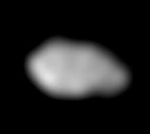
图:NASA/JPL · Public domain · Wikimedia Commons
- 类型
- 牧羊卫星、规则卫星
- 发现 / 发明时间
- 1979 年
- 发现者 / 提出者
- 斯蒂芬·辛诺特
- 命名来源
- 墨提斯
- 学科
- 天文学
相关科学家
百科正文
轨道
木卫十六属于木星的内圈卫星群,是第四小也是最接近木星的卫星,它离木星只有 128,000 公里(1.79个木星半径),这是在木星环的主环以内,而且它的离心率和轨道倾角常非小,离心率大约只有0.0002,而轨道倾角也只有0.06°。木卫十六在木星的同步轨道以内(木卫十五也是),所以它会受到木星的潮汐力影响而慢慢的缩小轨道,这导致有一天它会坠入木星。
物理性质
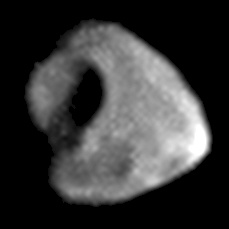
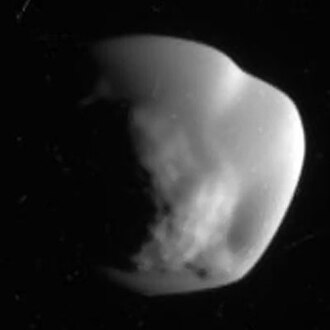
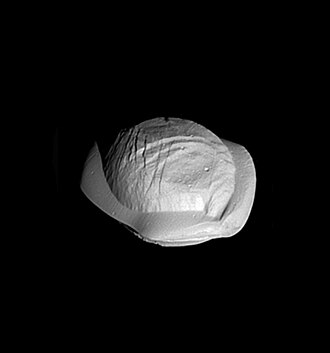
木卫十六非常不规则,大小是60×40×34 km,木卫十六的质量和密度并不是很确定,但根据同类型的卫星估计,它的密度大约0.86g/cm3(跟木卫五类似),则它的质量大约是7×1016kg。木卫十六表面有许多坑洞,而木卫十六多半呈现暗红色的。木卫十六公转与自转同步,也就是说它的一面永远朝向木星。这跟木星的内圈卫星群类似。它的背对木星的一面比面对木星的一面的亮度多1.3倍,可能是因为面跟背对木星的一面比较容易会发生小行星撞击,而被撞击时会喷出较亮的物质(冰等),因此比面对木星的那一面会比较亮。
与木星环的关系
木卫十六是在木星环主环的1000公里以内,而且它的轨道就在一个500公里宽的木星环缝隙。最近研究发现,木星环绝大部分的成分都是由木卫十六或木星的内圈卫星群来的,这可能是因为小行星撞击木星卫星,而较小的木星卫星引力不大不容易收回,则剩下的物质就环绕木星形成木星环。
以上内容摘自维基百科「木卫十六」,按 CC BY-SA 4.0 使用,去掉了参考文献、外部链接等尾部小节,公式改写成了纯文本。全文、配图和出处见原文。
英文维基百科补充中文条目比较短,下面是英文条目「Metis (moon)」的原文
Metis, also known as Jupiter XVI, is the innermost known moon of Jupiter. It was discovered in 1979 in images taken by Voyager 1, and was named in 1983 after the Titaness Metis, the first wife of Zeus and the mother of Athena. Additional observations made between early 1996 and September 2003 by the Galileo spacecraft allowed its surface to be imaged.
It is one of the four inner moons of Jupiter. Metis is tidally locked to Jupiter, and its shape is strongly asymmetrical, with the largest diameter being almost twice as large as the smallest one. It is also one of the two moons known to orbit Jupiter in less than the length of Jupiter's day, the other being Adrastea. It orbits within the main ring of Jupiter, and is thought to be a major contributor of ring material.
Discovery and observations
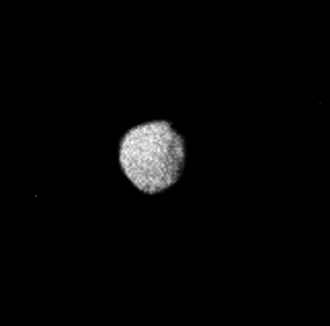
Metis was discovered in 1979 by Stephen P. Synnott in images taken by the Voyager 1 probe and was provisionally designated as S/1979 J 3. In 1983, it was officially named after the mythological Metis, a Titaness who was the first wife of Zeus (the Greek prototype for the Roman god Jupiter) who between her and Zeus bore a daughter, Athena. This name was approved as part of an exemption from the IAU convention, which dictates that prograde moons of Jupiter must receive names ending in "a". The photographs taken by Voyager 1 showed Metis only as a dot, and hence knowledge about Metis was very limited until the arrival of the Galileo spacecraft. Galileo imaged almost all of the surface of Metis and put constraints on its composition by 1998.
Physical characteristics
Metis has an irregular shape and measures 60 km × 40 km × 34 km across, which makes it the second smallest of the four inner satellites of Jupiter. The bulk composition and mass of Metis are not known, but it is likely that its mean density is higher than 1.5 g/cm3, assuming its gravity is strong enough such that objects anywhere on its surface are always accelerated inward. Its mass can therefore be estimated as ~6.2×10¹⁶ kg or higher.
The surface of Metis is dark and appears to be reddish in color. While image resolution is not enough for individual craters to be identified, its irregular shape is indicative of a heavy collisional history. There is a substantial asymmetry between the leading and trailing hemispheres: the leading hemisphere is 1.3 times brighter than the trailing one. The asymmetry is probably caused by the higher velocity and frequency of impacts on the leading hemisphere, which excavates a bright material (presumably ice) from its interior. The geometric albedo of Metis is approximately 0.061±0.003.
Orbit and rotation
Metis is the innermost of Jupiter's four small inner moons. It orbits Jupiter at a distance of ~128,000 km (1.79 Jupiter radii) within Jupiter's main ring. Metis's orbit has very small eccentricity (~0.0002) and inclination (~ 0.06°) relative to the equator of Jupiter.
Due to tidal locking, Metis rotates synchronously with its orbital period (about 7 hours), with its longest axis aligned towards Jupiter. Jupiter casts a shadow on all of Metis for 68 minutes each Metian day.
Metis lies inside Jupiter's synchronous orbit radius (as does Adrastea), and as a result, tidal forces slowly cause its orbit to decay. If its density is similar to Amalthea's, Metis's orbit lies within the fluid Roche limit; however, because it has not broken up, it must lie outside its rigid Roche limit.
Relationship with Jupiter's rings
Metis's orbit lies ~1,000 km within the main ring of Jupiter. It orbits within a ~500 km wide "gap" or "notch" in the ring. The gap is clearly somehow related to the moon but the origin of this connection has not been established. Metis supplies a significant part of the main ring's dust. This material appears to consist primarily of material that is ejected from the surfaces of Jupiter's four small inner satellites by meteorite impacts. It is easy for the impact ejecta to be lost from the satellites into space because the satellites' surfaces lie fairly close to the edge of their Roche spheres due to their low density.
以上内容摘自英文维基百科「Metis (moon)」,按 CC BY-SA 4.0 使用,去掉了参考文献、外部链接等尾部小节,公式改写成了纯文本。全文、配图和出处见原文。