格物
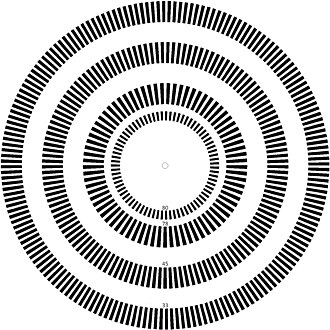
图:P.Sasonoff · CC BY-SA 4.0 · Wikimedia Commons
- 发现 / 发明时间
- 约 1830 年代
- 发现者 / 提出者
- 西蒙·冯施坦普费尔
- 学科
- 数学
- 上级概念
- optical toy、设备、科学仪器
- 带来的结果
- 闪光灯效应
- 用途
- stroboscopy
相关科学家
百科正文
频闪观测器是一个可以转动的圆盘,圆盘上有狭缝,能发出脉冲光。频闪观测器大多用来量度水波、脑波的频率。
以上内容摘自维基百科「頻閃觀測器」,按 CC BY-SA 4.0 使用,去掉了参考文献、外部链接等尾部小节,公式改写成了纯文本。全文、配图和出处见原文。
英文维基百科补充中文条目比较短,下面是英文条目「Stroboscope」的原文
A stroboscope, also known as a strobe, is an instrument used to make a cyclically moving object appear to be slow-moving, or stationary. It consists of either a rotating disk with slots or holes or a lamp such as a flashtube which produces brief repetitive flashes of light. Usually, the rate of the stroboscope is adjustable to different frequencies. When a rotating or vibrating object is observed with the stroboscope at its vibration frequency (or a submultiple of it), it appears stationary. Thus stroboscopes are also used to measure frequency.
The principle is used for the study of rotating, reciprocating, oscillating or vibrating objects. Machine parts and vibrating string are common examples. A stroboscope used to set the ignition timing of internal combustion engines is called a timing light.
Mechanical
In its simplest mechanical form, a stroboscope can be a rotating cylinder or disc with evenly spaced holes or slots placed in the line of sight between the observer and the moving object. If the rotational speed is perfectly synchronised with the speed of the observed system or with an exact multiple of that speed, the system appears motionless, while it can be seen in apparently slowed-down motion if the rotational speed is adjusted to be slightly out of synch. The illusion is caused by temporal aliasing, and is commonly known as the stroboscopic effect.
Electronic
In electronic versions, the perforated disc is replaced by a lamp capable of emitting brief and rapid flashes of light. Typically a gas-discharge or solid-state lamp is used, because they are capable of emitting light nearly instantly when power is applied, and extinguishing just as fast when the power is removed.
By comparison, incandescent lamps have a brief warm-up when energized, followed by a cool-down period when power is removed.
History
Joseph Plateau of Belgium is generally credited with the introduction of the stroboscope in 1833, as a fast spinning disc with pictures between radial slits that appear animated when their reflection in a mirror is viewed through the slits. Plateau's device became known as the "Phenakistiscope". There was an almost simultaneous and independent invention of the device by the Austrian Simon Ritter von Stampfer, which he named the "stroboscopische Scheiben", and it is his term which is used today. The etymology is from the Greek words στρόβος - strobos, meaning "whirlpool" and σκοπεῖν - skopein, meaning "to look at".
Besides the popular success of optical toys as methods for producing moving pictures (see also: zoetrope and flip book) that eventually lead to the development of cinematography, publications by Plateau and Stampfer also inspired early pioneers to employ for instance rotating mirrors, or vibrating mirrors known as mirror galvanometers.{citation needed}
Applications
Stroboscopes play an important role in the study of stresses on machinery in motion, and in many other forms of research. Bright stroboscopes are able to overpower ambient lighting and make stop-motion effects apparent without the need for dark ambient operating conditions.
They are also used as measuring instruments for determining cyclic speed. As a timing light they are used to set the ignition timing of internal combustion engines.
In medicine, stroboscopes are used to view the vocal cords for the diagnosis of conditions that have produced dysphonia (hoarseness). The patient hums or speaks into a microphone which in turn activates the stroboscope at either the same or a slightly different frequency. The light source and a camera are positioned by endoscopy.
Another application of the stroboscope can be seen on many gramophone turntables. The edge of the platter has marks at specific intervals so that when viewed under fluorescent lighting powered at mains frequency, provided the platter is rotating at the correct speed, the marks appear to be stationary.
Fechner color
Rapid flashing of the stroboscopic light can give the illusion that white light is tinged with color, known as Fechner color. Within certain ranges, the apparent color can be controlled by the frequency of the flash. Effective stimuli frequencies go from 3 Hz upwards, with optimal frequencies of about 4–6 Hz. The colours are an illusion generated in the mind of the observer and not a real color. The Benham's top demonstrates the effect.
以上节选摘自英文维基百科「Stroboscope」,按 CC BY-SA 4.0 使用,去掉了参考文献、外部链接等尾部小节,公式改写成了纯文本。篇幅所限,较长的小节只摘了开头一部分,有的小节没有收;全文、配图和出处见原文。