格物
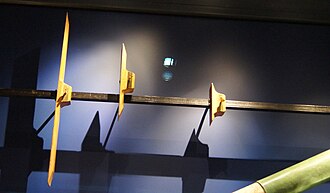
图:Rudolf H. Boettcher · CC BY-SA 4.0 · Wikimedia Commons
十字测天仪1350
Jacob's staff
calibrated wooden rod with sliding crosspiece used for measuring the altitude of celestial bodies or the height of distant objects
十字测天仪是西方航海家曾使用的一种测量工具,其基本结构为带有长度刻度的主杆与垂直安装的活动横杆组成,主要通过观测目标物与使用者之间的相对高度和角度来进行测量并确定自己所处的位置。
摘自维基百科「十字测天仪」,CC BY-SA 4.0
- 发现 / 发明时间
- 1350 年
- 发现者 / 提出者
- 莱维·本·热尔松
- 命名来源
- 雅各
- 上级概念
- 导航仪器、测量仪器、astronomical instrument
百科正文
英文维基百科补充中文条目比较短,下面是英文条目「Jacob's staff」的原文
Jacob's staff is a measuring tool with several variations. It is also known as cross-staff, a ballastella, a fore-staff, a ballestilla, or a balestilha. In its most basic form, a Jacob's staff is a stick or pole with length markings, often with a smaller segment attached perpendicularly. The simplest use of a Jacob's staff is to make qualitative judgements of the height and angle of an object relative to the user of the staff.
Most staffs are much more complicated than that, and usually contain a number of measurement and stabilization features. The two most frequent uses are:
in astronomy and navigation for a simple device to measure angles, later replaced by the more precise sextants;
in surveying (and scientific fields that use surveying techniques, such as geology and ecology) for a vertical rod that penetrates or sits on the ground and supports a compass or other instrument.
Etymology
The origin of the name of the instrument is not certain. Some refer to the Biblical patriarch Jacob, specifically in the Book of Genesis (Gen 32:11). It may also take its name after its resemblance to Orion, referred to by the name of Jacob on some medieval star charts. Another possible source is the Pilgrim's staff, the symbol of St James (Jacobus in Latin). The name cross staff simply comes from its cruciform shape.
In astronomy and navigation
In navigation the instrument is also called a cross-staff and was used to determine angles, for instance the angle between the horizon and Polaris or the sun to determine a vessel's latitude, or the angle between the top and bottom of an object to determine the distance to said object if its height is known, or the height of the object if its distance is known, or the horizontal angle between two visible locations to determine one's point on a map.
The Jacob's staff, when used for astronomical observations, was also referred to as a radius astronomicus. With the demise of the cross-staff, in the modern era the name "Jacob's staff" is applied primarily to the device used to provide support for surveyor's instruments.
History
The original Jacob's staff was developed as a single pole device, in the 14th century, that was used in making astronomical measurements. It was first described by the French-Jewish mathematician Levi ben Gerson of Provence, in his "Book of the Wars of the Lord" (translated in Latin as well as Hebrew). He used a Hebrew name for the staff that translates to "Revealer of Profundities", while the term "Jacob's staff" was used by his Christian contemporaries. Its invention was likely due to fellow French-Jewish astronomer Jacob ben Makir, who also lived in Provence in the same period. Attribution to 15th century Austrian astronomer Georg Purbach is less likely, because Purbach was not born until 1423. (Such attributions may refer to a different instrument with the same name.) Its origins may be traced to the Chaldeans around 400 BCE.
In surveying
In surveying, the term jacob staff refers to a monopod, a single straight rod or staff made of nonferrous material, pointed and metal-clad at the bottom for penetrating the ground. It also has a screw base and occasionally a ball joint on the mount, and is used for supporting a compass, transit, or other instrument.
The term cross-staff may also have a different meaning in the history of surveying. While the astronomical cross-staff was used in surveying for measuring angles, two other devices referred to as a cross-staff were also employed.
Cross-head, cross-sight, surveyor's cross or cross - a drum or box shaped device mounted on a pole. It had two sets of mutually perpendicular sights. This device was used by surveyors to measure offsets. Sophisticated versions had a compass and spirit levels on the top. The French versions were frequently eight-sided rather than round.
Optical square - an improved version of the cross-head, the optical square used two silvered mirrors at 45° to each other. This permitted the surveyor to see along both axes of the instrument at once.
- In the past, many surveyor's instruments were used on a Jacob's staff. These include:
- Cross-head, cross-sight, surveyor's cross or cross
- Graphometer
- Circumferentor
- Holland circle
- Miner's dial
- Optical square
- Surveyor's sextant
- Surveyor's target
- Abney level
Some devices, such as the modern optical targets for laser-based surveying, are still in common use on a Jacob's staff, called nowadays a surveying pole.
以上节选摘自英文维基百科「Jacob's staff」,按 CC BY-SA 4.0 使用,去掉了参考文献、外部链接等尾部小节,公式改写成了纯文本。篇幅所限,较长的小节只摘了开头一部分,有的小节没有收;全文、配图和出处见原文。