格物
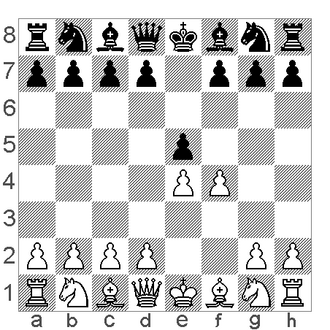
图:No machine-readable author provided. Fenya~commonswiki assum… · CC BY-SA 3.0 · Wikimedia Commons
- 发现 / 发明时间
- 1497 年
- 发现者 / 提出者
- Luis Ramírez de Lucena
- 属于
- 国际象棋用语
- 上级概念
- 神偷艳贼、开放性开局
百科正文
1.e4 e5 2.f4
王翼弃兵(英语:King's Gambit)的理念是白方在开局时就攻击对方的中心兵。于19世纪风极一时。20世纪初期,由于黑方防御技术的深入研究,其使用者开始减少。20世纪后期,职业棋局中基本不使用这种开局。
- 根据黑方第2步的着法,分为
- 接受王翼弃兵
- 拒绝王翼弃兵
- 佛克比尔反弃兵
等等。
以上内容摘自维基百科「王翼棄兵」,按 CC BY-SA 4.0 使用,去掉了参考文献、外部链接等尾部小节,公式改写成了纯文本。全文、配图和出处见原文。
英文维基百科补充中文条目比较短,下面是英文条目「King's Gambit」的原文
- The King's Gambit is a chess opening that begins with the moves:
- 1. e4 e5
- 2. f4
White offers a pawn to divert Black's e-pawn from the center. If Black accepts the gambit, White will usually target the weak square f7, defended only by the king. A downside to the King's Gambit is that it weakens White's own king's position. Black can also decline the gambit, usually by the Falkbeer Countergambit (2...d5) or the Classical Defense (2...Bc5).
The King's Gambit is one of the oldest documented openings, appearing in the earliest of chess books, Luis Ramírez de Lucena's Repetición de Amores y Arte de Ajedrez (1497). It was examined by the 17th-century Italian chess player Giulio Cesare Polerio. It is considered an opening characteristic of Romantic chess, known for giving rise to extremely sharp and unusual positions. It was one of the most popular openings until the late 19th century, when improvements in defensive technique led to a decline in popularity.
History
The King's Gambit is a very old chess opening. One early variation is so old it features a move no longer possible under the modern rules of chess (1.e4 e5 2.f4 exf4 3.d4 Qh4+ 4.g3 fxg3 5.Ke1-g2). The opening is recorded in a work credited to the medieval writer Luis Ramírez de Lucena, the earliest game in the ChessBase MegaDatabase to feature it dates from 1560, and the Spanish priest Ruy López de Segura (c. 1530 – c. 1580) was the first to publish analysis of it. The opening's reputation was enhanced by Gioachino Greco, who used it excellently on several occasions in the early 17th century.
The King's Gambit was most popular during the era of Romantic chess, when bold attacking tactics were more important to chess-playing gentlemen than positional strategy.
King's Gambit Accepted: 2...exf4
After Black accepts the gambit, 3.Nf3 (the King's Knight's Gambit) is the most popular move, the main alternative being 3.Bc4, the Bishop's Gambit. It develops the knight and prevents 3...Qh4+. Black's two main approaches are to attempt to hold on to the pawn with...g5, sometimes after preparing the move with...h6, or to return the pawn with an early...d5 in order to facilitate development. These two strategies can also be combined.
Although Black usually accepts the gambit pawn, two methods of declining the gambit, the Classical Defense (2...Bc5) and the Falkbeer Countergambit (2...d5), are also popular.
Classical Variation: 3.Nf3 g5
The Classical Variation arises after 3.Nf3 g5. Black defends the f4-pawn, and threatens to kick the f3-knight with...g4, or else to consolidate with...Bg7 and...h6. The main continuations traditionally have been 4.h4 and 4.Bc4.
King's Gambit Declined
Black can decline the offered pawn, or offer a countergambit.
Falkbeer Countergambit: 2...d5
The Falkbeer Countergambit is named after the 19th-century Austrian master Ernst Falkbeer. It begins 1.e4 e5 2.f4 d5. White usually plays 3.exd5 in response, as 3.fxe5 Qh4+ 4.g3 Qxe4+ wins White's rook. In the traditional line, Black plays 3...e4, sacrificing a pawn in return for quick and easy development. It was once considered good for Black and scored well, but White obtains some advantage with the response 4.d3!, and the line fell out of favor after the 1930s. If Black plays 3...exf4 instead, this transposes to the Modern Variation of KGA. White can also play 3.Nf3 instead of 3.exd5, known as the Blackburne Attack, whose typical continuation is 3...dxe4 4.Nxe5.
Related lines
In several lines of the Vienna Game White offers a sort of delayed King's Gambit. After 1.e4 e5 2.Nc3 Nf6 3.f4, Black should reply 3...d5, since 3....exf4?! 4.e5 forces the knight to retreat. Unlike after 2...Nf6 3.f4, 2...Nc6 3.f4 can be met with 3...exf4. White may also offer the gambit in the Bishop's Opening, e.g. 1.e4 e5 2.Bc4 Nc6 3.f4, though this is uncommon.
ECO
The Encyclopaedia of Chess Openings has ten codes for the King's Gambit, C30 through C39.
- C30: 1.e4 e5 2.f4 (King's Gambit)
- C31: 1.e4 e5 2.f4 d5 (Falkbeer Countergambit)
- C32: 1.e4 e5 2.f4 d5 3.exd5 e4 4.d3 Nf6 (Morphy, Charousek, etc.)
- C33: 1.e4 e5 2.f4 exf4 (King's Gambit Accepted)
- C34: 1.e4 e5 2.f4 exf4 3.Nf3 (King's Knight's Gambit)
- C35: 1.e4 e5 2.f4 exf4 3.Nf3 Be7 (Cunningham Defense)
- C36: 1.e4 e5 2.f4 exf4 3.Nf3 d5 (Abbazia Defense)
- C37: 1.e4 e5 2.f4 exf4 3.Nf3 g5 4.Nc3 /4.Bc4 g4 5.0-0 (Muzio Gambit, etc.)
- C38: 1.e4 e5 2.f4 exf4 3.Nf3 g5 4.Bc4 Bg7 (Philidor, Hanstein, etc.)
- C39: 1.e4 e5 2.f4 exf4 3.Nf3 g5 4.h4 (Allgaier, Kieseritzky, etc.)
以上节选摘自英文维基百科「King's Gambit」,按 CC BY-SA 4.0 使用,去掉了参考文献、外部链接等尾部小节,公式改写成了纯文本。篇幅所限,较长的小节只摘了开头一部分,有的小节没有收;全文、配图和出处见原文。