格物
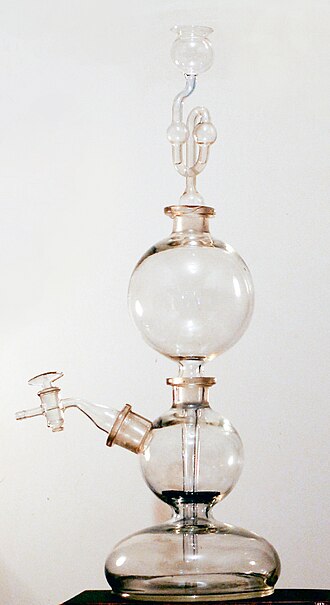
图:nl:User:Josh · CC BY-SA 3.0 · Wikimedia Commons
- 发现 / 发明时间
- 1860 年
- 发现者 / 提出者
- 启普
- 命名来源
- 启普
- 学科
- 化学
- 上级概念
- 实验室设备、实验室玻璃器皿、燃气发生器
相关科学家
百科正文
构造
启普发生器由球形漏斗、容器和导气管三部分组成,外形类似一个雪人。
用法
使用前将发生器横放,将固体从容器上的导气管插口放入容器,然后放正仪器,插紧导气管,液体反应物从球形漏斗倒入,由球形漏斗流到容器底部,再上升到中部跟固体接触而发生反应,产生的气体从导气管放出。
导气管口有活塞用于控制反应进行。当活塞关上时,容器中部气压增大,把液体压回容器底部直至不与固体接触为止,此时反应停止。
使用条件
启普发生器是用固体与液体试剂在常温条件(不用加热)下反应制取气体的装置。不能加热,否则容易引起容器炸裂。对于可溶性固体、固体呈粉末状,或者反应过程中产生高温的情况则不能使用该仪器制取。另外,一些会产生糊状物质从而导致启普发生器堵塞的反应也不能使用该仪器制取。
以上内容摘自维基百科「啟普發生器」,按 CC BY-SA 4.0 使用,去掉了参考文献、外部链接等尾部小节,公式改写成了纯文本。全文、配图和出处见原文。
英文维基百科补充中文条目比较短,下面是英文条目「Kipp's apparatus」的原文
Kipp's apparatus, also called a Kipp generator, is an apparatus designed for preparation of small volumes of gases. It was invented around 1844 by the Dutch pharmacist Petrus Jacobus Kipp and widely used in chemical laboratories and for demonstrations in schools into the second half of the 20th century.
It later fell out of use, at least in laboratories, because most gases then became available in small gas cylinders. These industrial gases are much purer and drier than those initially obtained from a Kipp apparatus without further processing.
Design and operation
The apparatus is usually made of glass, or sometimes of polyethylene, and consists of three vertically stacked chambers, roughly resembling a snowman. The upper chamber extends downward as a tube that passes through the middle chamber into the lower chamber. There is no direct path between the middle and upper chambers, but the middle chamber is separated from the lower chamber by a retention plate, such as a conical piece of glass with small holes, which permits the passage of liquid and gas. The solid material (e.g., iron sulfide) is placed into the middle chamber in lumps sufficiently large to avoid falling through the retention plate. The liquid, such as an acid, is poured into the top chamber. Although the acid is free to flow down through the tube into the bottom chamber, it is prevented from rising there by the pressure of the gas contained above it, which is able to leave the apparatus only by a stopcock near the top of the middle chamber. This stopcock may be opened, initially to permit the air to leave the apparatus, allowing the liquid in the bottom chamber to rise through the retention plate into the middle chamber and react with the solid material. Gas is evolved from this reaction, which may be drawn off through the stopcock as desired.
Examples for prepared gases and their educts
For successful use in a Kipp's apparatus, the solid material has to be available in lumps large enough to stay on the retention plate without falling through its holes.
Hydrogen from iron flakes or zinc and hydrochloric acid or diluted sulfuric acid respectively.
- Carbon dioxide from pieces of marble (calcium carbonate) and hydrochloric acid
- Hydrogen sulfide from iron(II) sulfide and hydrochloric acid
- Acetylene from calcium carbide and water
Methane from aluminium carbide and lukewarm water, deuterated methane (CD4) from aluminium carbide and heavy water
Chlorine from potassium permanganate, calcium hypochlorite, or manganese dioxide and hydrochloric acid; also from barium ferrate and hydrochloric acid
Oxygen from calcium hypochlorite and hydrogen peroxide with a bit of nitric acid; also from barium ferrate and dilute sulfuric acid
- Ozone from barium peroxide and concentrated sulfuric acid
- Nitric oxide from copper turnings and diluted nitric acid
- Nitrogen dioxide from copper turnings and concentrated nitric acid
Ammonia from magnesium nitride and water, deuterated ammonia when heavy water is used; also from calcium oxide and solution of ammonium chloride
Carbon monoxide from pumice impregnated with oxalic acid and concentrated sulfuric acid
Further gas treatments
The prepared gas is usually impure, contaminated with fine aerosol of the reagents and water vapor. The gases may need to be filtered, washed and dried before further use.
Hydrogen can be washed from sulfane, arsine and oxygen with subsequent bubbling through solutions of lead acetate, silver nitrate, and alkaline pyrogallic acid.
Acidic gases (e.g. hydrogen sulfide, hydrogen chloride, sulfur dioxide) can be dried with concentrated sulfuric acid, or with phosphorus pentoxide. Basic gases (e.g. ammonia) can be dried with calcium oxide, sodium hydroxide or soda lime.
Disposal of the gases can be done by burning the flammable ones (carbon monoxide, hydrogen, hydrocarbons), absorbing them in water (ammonia, hydrogen sulfide, sulfur dioxide, chlorine), or reacting them with a suitable reagent.
Variants
Many variants of the gas production apparatus exist. Some are suitable for production of larger amounts of gases (Gay-Lussac and Verkhovsky), some for smaller amounts (Kiryushkin, U-tube).
A Döbereiner's lamp is a small modified Kipp's apparatus for production of hydrogen. The hydrogen is led over a platinum sponge catalyst, where it reacts with air oxygen, heats the catalyst and ignites from it, producing a gentle flame. It was commercialized for lighting fires and pipes. It's said that in 1820s over a million of the "tinderboxes" ("Feuerzeug") was sold.
以上节选摘自英文维基百科「Kipp's apparatus」,按 CC BY-SA 4.0 使用,去掉了参考文献、外部链接等尾部小节,公式改写成了纯文本。篇幅所限,较长的小节只摘了开头一部分,有的小节没有收;全文、配图和出处见原文。