格物
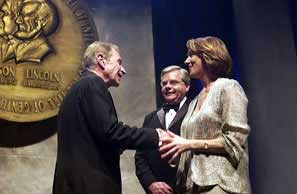
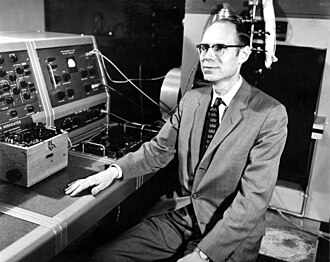
图:Photo from www.uspto.gov. Transferred from en.wikipedia to C… · Public domain · Wikimedia Commons
- 出生
- 1933 年 1 月 18 日,波特兰
- 逝世
- 2013 年 9 月 12 日,旧金山
- 国籍
- 美国
- 学科
- 工程与发明
- 职业
- 发明家、电气工程师、音频工程师
- 母校
- 圣何塞州立大学、Sequoia High School(1951 年)、斯坦福大学(理学士,1957 年)、剑桥大学彭布罗克学院(博士,1961 年)
- 工作单位
- 杜比实验室
所获奖项(12)
- 1978奥斯卡科学与工程奖
- 1988Academy Award of Merit
- 1995Technical Grammy Award
- 1997国家技术奖章
- 1997IEEE Masaru Ibuka Consumer Electronics Award
- 2004美国发明家名人堂
- 2010IEEE爱迪生奖章
- —大英帝国官佐
- —艾美奖
- —马歇尔奖学金
- —star on Hollywood Walk of Fame
- —Progress Medal (SMPTE)
学会与院士
百科正文
生平
雷·杜比在波特兰出生,在旧金山长大。
大学曾就读圣荷西州立大学,后转学至斯坦福大学,期间,因第二次世界大战,至美国陆军服役,中断了两年学业。在中学时期及就读大学期间,他曾在Ampex打工。1957年,取得斯坦福大学电机工程硕士学位。获马歇尔奖学金,至英国剑桥大学攻读物理学,1961年,取得博士学位。
1965年,在英国创建杜比实验室。
家庭
1966年他与Dagmar结婚,两人育有两个儿子Tom Dolby和David Dolby,Tom生于1975年,后来成为一名畅销书作家。
主要荣誉
1987年,大英帝国勋章
1989年,第61届奥斯卡奖科技贡献奖
1997年,国家技术与创新奖章(National Medal of Technology and Innovation)
以上内容摘自维基百科「雷·杜比」,按 CC BY-SA 4.0 使用,去掉了参考文献、外部链接等尾部小节,公式改写成了纯文本。全文、配图和出处见原文。
英文维基百科补充中文条目比较短,下面是英文条目「Ray Dolby」的原文
Ray Milton Dolby (; January 18, 1933 – September 12, 2013) was an American engineer and inventor of the noise reduction system known as Dolby NR, which has been said to have "transformed sound reproduction".
In the 1950s he contributed to development of the video tape recorder while at Ampex, and in 1965 he founded Dolby Laboratories in London. There he invented and patented a method of noise reduction for use in analog recording which was widely adopted for the cassette tape. The company moved to California in 1976 and went on to develop audio and video formats for films, home video recorders, home theater, television broadcasts, and video streaming services.
Early life and education
Dolby was born in Portland, Oregon, the son of Esther Eufemia (née Strand) and Earl Milton Dolby, an inventor. He attended Sequoia High School (class of 1951) in Redwood City, California. As a teenager in the decade following World War II, he held part-time and summer jobs at Ampex in Redwood City, working with their first audio tape recorder in 1949. While at San Jose State College and later at Stanford University (interrupted by two years of Army service), he worked on early prototypes of video tape recorder technologies for Alexander M. Poniatoff and Charlie Ginsburg.
In 1957, Dolby received his B.Sc. in electrical engineering from Stanford.
Career
As a non degree-holding "consultant", Dolby played a key role in the effort that led Ampex to unveil their prototype Quadruplex videotape recorder in April 1956 which soon entered production.
After Cambridge, Dolby acted as a technical advisor to the United Nations in India until 1965, when he returned to England, where he founded Dolby Laboratories in London with a staff of four. In that same year, 1965, he invented the Dolby noise-reduction system, a form of audio signal processing for analog tape recorders. His first U.S. patent application was made in 1969, four years later. The system was first used by Decca Records in the UK.
The Dolby B consumer noise-reduction system works by compressing (boosting) low-level high-frequency sounds during recording and expanding (decreasing) them symmetrically during playback, which also decreases inherent tape noise. This reduces the audible level of tape hiss.
Death and legacy
Dolby died of leukemia on September 12, 2013, at his home in San Francisco at the age of 80. Dolby was survived by his wife Dagmar, two sons, Tom and David, and four grandchildren. Kevin Yeaman, president and chief executive of Dolby Laboratories, said, "Today we lost a friend, mentor and true visionary." Neil Portnow, president of the National Academy of Recording Arts and Sciences, said Dolby had "changed the way we listen to music and movies for nearly 50 years" and that Dolby's "technologies have become an essential part of the creative process for recording artists and filmmakers, ensuring his remarkable legacy for generations to come."
In his will, Dolby bequeathed £35 million to Pembroke College, Cambridge, reportedly the largest single donation received by any college in the university's history.
Awards and honors
1971 — AES Silver Medal
1979 — 51st Academy Awards — Academy Award, Scientific or Technical (Scientific and Engineering Award) [plaque]
1983 — SMPTE Progress Medal For his contributions to theater sound and his continuing work in noise reduction and quality improvements in audio and video systems and as a prime inventor of the videotape recorder
- 1985 — SMPTE Alexander M. Poniatoff Gold Medal
- 1986 — honorary Officer of the Most Excellent Order of the British Empire (OBE)
- 1988 — Eduard Rhein Ring of Honor from the German Eduard Rhein Foundation
1989 — 61st Academy Awards — Academy Award, Scientific or Technical (Academy Award of Merit) [statuette]
- 1989 — Emmy Award by the National Academy of Television Arts and Sciences (NATAS)
- 1992 — AES Gold Medal
- 1995 — Special Merit/Technical Grammy Award
- 1997 — U.S. National Medal of Technology
- 1997 — IEEE Masaru Ibuka Consumer Electronics Award
U.S. patents
U.S. patent 3,631,365, Frequency selective, symmetric signal compressor/expander (Dolby noise reduction); application filed October 20, 1969, patent granted December 28, 1971
以上节选摘自英文维基百科「Ray Dolby」,按 CC BY-SA 4.0 使用,去掉了参考文献、外部链接等尾部小节,公式改写成了纯文本。篇幅所限,较长的小节只摘了开头一部分,有的小节没有收;全文、配图和出处见原文。
同一学科、同时代的科学家

同一学科的科学家
更多 ›