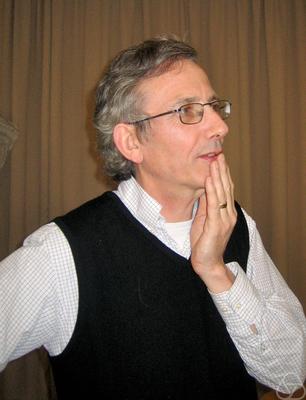
格物
- 出生
- 1690 年 3 月 18 日,柯尼斯堡
- 逝世
- 1764 年 11 月 20 日,莫斯科
- 国籍
- 普鲁士王国、俄罗斯帝国
- 学科
- 数学、博物与综合
- 职业
- 数学家、科学家、大学教师、行政主管
- 母语 / 工作语言
- 德语、法语、俄语
- 母校
- 柯尼斯堡大学(1710 年)
- 工作单位
- 彼得堡科学院(1725—)
研究领域
主要贡献
代表成就
以他 / 她命名
学会与院士
百科正文
哥德巴赫出生于柯尼斯堡(格奥尼格斯别尔格,今俄罗斯加里宁城),本学法学,由于在访问欧洲各国期间结识了伯努利家族而对数学研究有了兴趣。1725年到俄国,被选为彼得堡科学院院士,1728年起担任俄国沙皇彼得二世的教师,1742年移居莫斯科,进入俄国外交部供职。哥德巴赫同欧洲许多著名的数学家有来往,他长期保持与莱布尼茨、欧拉和尼古拉斯·伯努利等人的通信,为后人留下了大量宝贵的数学资料。
他在同瑞士数学家欧拉的长期通信中讨论了数学方面的许多问题。1742年6月7日的信中提出:任何一个整数n≥6可以用三个素数的和来表示。同月30日欧勒的回信指出,为解决这个问题,需要充分证明:每一个偶数都是两个素数的和。这些论点可归结为:任何一个偶数n≥4是两个素数的和,任何一个奇数n≥7是三个素数的和。这就是“哥德巴赫猜想”。为证明这个问题,许多数学家作出过努力,包括中国的数学家陈景润。此外他还研究了微积分和级数问题。
以上内容摘自维基百科「克里斯蒂安·哥德巴赫」,按 CC BY-SA 4.0 使用,去掉了参考文献、外部链接等尾部小节,公式改写成了纯文本。全文、配图和出处见原文。
英文维基百科补充中文条目比较短,下面是英文条目「Christian Goldbach」的原文
Christian Goldbach ( GOHLD-bahk, German: [ˈkʁɪsti̯a(ː)n ˈɡɔltbax]; 18 March 1690 – 20 November 1764) was a Prussian mathematician connected with some important research mainly in number theory; he also studied law and took an interest in and a role in the Russian court. After traveling around Europe in his early life, he landed in Russia in 1725 as a professor at the newly founded Saint Petersburg Academy of Sciences. Goldbach jointly led the academy in 1737. However, he relinquished duties in the academy in 1742 and worked in the Russian Ministry of Foreign Affairs until his death in 1764. He is remembered today for Goldbach's conjecture and the Goldbach–Euler theorem. He had a close friendship with famous mathematician Leonhard Euler, serving as inspiration for Euler's mathematical pursuits.
Biography
Early life
Born in the Duchy of Prussia's capital Königsberg, part of Brandenburg-Prussia, Goldbach was the son of a pastor. He studied at the Royal Albertus University. After finishing his studies he went on long educational trips from 1710 to 1724 through Europe, visiting other German states, England, the Netherlands, Italy, and France, meeting with many famous mathematicians, such as Gottfried Leibniz, Leonhard Euler, and Nicholas I Bernoulli. These acquaintances started Goldbach's interest in mathematics. He briefly attended Oxford University in 1713 and, while he was there, Goldbach studied mathematics with John Wallis and Isaac Newton. Also, Goldbach's travels fostered his interest in philology, archaeology, metaphysics, ballistics, and medicine. Between 1717 and 1724, Goldbach published his first few papers which, while minor, credited his mathematical ability. Back in Königsberg, he became acquainted with Georg Bernhard Bilfinger and Jakob Hermann.
Saint Petersburg Academy of Sciences
Goldbach followed Bilfinger and Hermann to the newly opened St. Petersburg Academy of Sciences in 1725. Christian Wolff had invited and had written recommendations for all the Germans who traveled to Saint Petersburg for the academy except Goldbach. Goldbach wrote to the president-designate of the academy, petitioning for a position in the academy, using his past publications and knowledge in medicine and law as qualifications. Goldbach was then hired to a five-year contract as a professor of mathematics and historian of the academy. As historian of the academy, he recorded each academy meeting from the opening of the school in 1725 until January 1728. Goldbach worked with famous mathematicians like Leonhard Euler, Daniel Bernoulli, Johann Bernoulli, and Jean le Rond d'Alembert.
Contributions
Goldbach is most noted for his correspondence with Leibniz, Euler, and Bernoulli, especially in his 1742 letter to Euler stating his Goldbach's conjecture. He also studied and proved some theorems on perfect powers, such as the Goldbach–Euler theorem, and made several notable contributions to analysis. He also proved a result concerning Fermat numbers that is called Goldbach's theorem.
Impact on Euler
It is Goldbach and Euler's correspondence that contains some of Goldbach's most important contributions to mathematics, specifically number theory. Goldbach and Euler's friendship survived Goldbach's move to Moscow in 1728 and communication ensued. Their correspondence spanned 196 letters over 35 years written in Latin, German, and French. These letters spanned a wide range of topics, including various mathematics topics. Goldbach was the leading influence on Euler's interest and work in number theory. Most of the letters discuss Euler's research in number theory as well as differential calculus. Until the late 1750s, Euler's correspondence on his number theory research was almost exclusively with Goldbach.
Goldbach's earlier mathematical work and ideas in letters to Euler directly influenced some of Euler's work. In 1729, Euler solved two problems pertaining to sequences which had stumped Goldbach. Ensuingly, Euler outlined the solutions to Goldbach. Also, in 1729 Goldbach closely approximated the Basel problem, which prompted Euler's interest and concurring breakthrough solution. Goldbach, through his letters, kept Euler focused on number theory in the 1730s by discussing Fermat's conjecture with Euler. Euler subsequently offered a proof to the conjecture, crediting Goldbach with introducing him to the subfield.
以上节选摘自英文维基百科「Christian Goldbach」,按 CC BY-SA 4.0 使用,去掉了参考文献、外部链接等尾部小节,公式改写成了纯文本。篇幅所限,较长的小节只摘了开头一部分,有的小节没有收;全文、配图和出处见原文。
同一学科、同时代的科学家
同一学科的科学家
更多 ›