格物
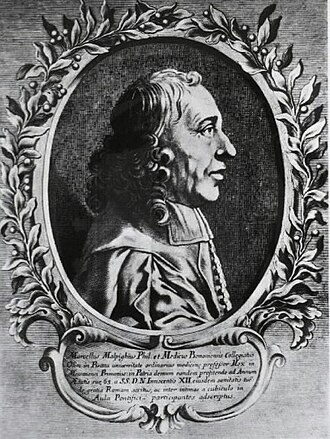
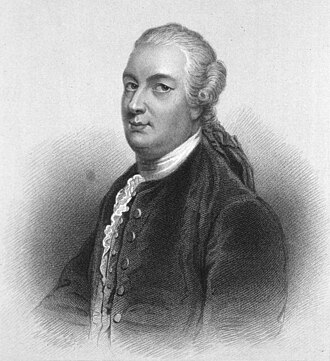
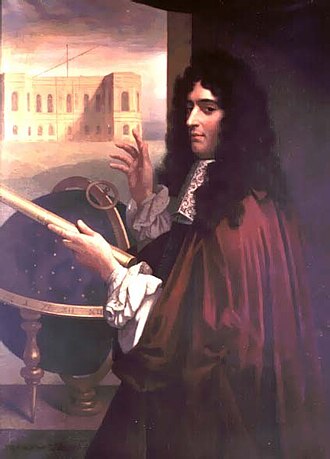
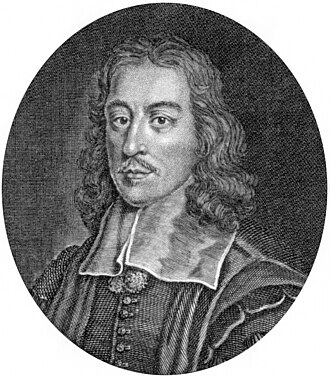
图:User Magnus Manske on en.wikipedia · Public domain · Wikimedia Commons
- 出生
- 1628 年 3 月 10 日,克雷瓦尔科雷
- 逝世
- 1694 年 11 月 29 日,罗马
- 国籍
- 教皇国
- 学科
- 生物学、医学
- 职业
- 动物学家、解剖学家、植物学家、昆虫学家
- 母语 / 工作语言
- 拉丁语
- 母校
- 博洛尼亚大学
- 工作单位
- 博洛尼亚大学、比萨大学
研究领域
师承
来自 Wikidata 的「博士导师」「师从」「博士生」「学生」记录,可能不全。
所获奖项(1)
- —荷兰下议院议员
学会与院士
百科正文
生平
生于克雷瓦尔科雷的一个农民家庭。17岁入博洛尼亚大学就读。1668年成为英国皇家学会会员。马氏管就是根据他命名的。
以上内容摘自维基百科「马尔切洛·马尔皮吉」,按 CC BY-SA 4.0 使用,去掉了参考文献、外部链接等尾部小节,公式改写成了纯文本。全文、配图和出处见原文。
英文维基百科补充中文条目比较短,下面是英文条目「Marcello Malpighi」的原文
Marcello Malpighi (10 March 1628 – 30 November 1694) was an Italian biologist and physician, who is referred to as the "founder of microscopical anatomy, histology and father of physiology and embryology". Malpighi's name is borne by several physiological features related to the biological excretory system, such as the Malpighian corpuscles and Malpighian pyramids of the kidneys and the Malpighian tubule system of insects. The splenic lymphoid nodules are often called the "Malpighian bodies of the spleen" or Malpighian corpuscles. The botanical family Malpighiaceae is also named after him. He was the first person to see capillaries in animals, and he discovered the link between arteries and veins that had eluded William Harvey. Malpighi was one of the earliest people to observe red blood cells under a microscope, after Jan Swammerdam. His treatise De polypo cordis (1666) was important for understanding blood composition, as well as how blood clots. In it, Malpighi described how the form of a blood clot differed in the right against the left sides of the heart.
The use of the microscope enabled Malpighi to discover that insects do not use lungs to breathe, but small holes in their skin called tracheae. Malpighi also studied the anatomy of the brain and concluded this organ is a gland. In terms of modern endocrinology, this deduction is correct because the hypothalamus of the brain has long been recognized for its hormone-secreting capacity.
Because Malpighi had a wide knowledge of both plants and animals, he made contributions to the scientific study of both. The Royal Society of London published two volumes of his botanical and zoological works in 1675 and 1679. Another edition followed in 1687, and a supplementary volume in 1697. In his autobiography, Malpighi speaks of his Anatome Plantarum, decorated with the engravings of Robert White, as "the most elegant format in the whole literate world."
His study of plants led him to conclude that plants had tubules similar to those he saw in insects like the silkworm (using his microscope, he probably saw the stomata, through which plants exchange carbon dioxide with oxygen). Malpighi observed that when a ring-like portion of bark was removed on a trunk a swelling occurred in the tissues above the ring, and he correctly interpreted this as growth stimulated by food coming down from the leaves, and being blocked above the ring.
Early years
Malpighi was born on 10 March 1628 at Crevalcore near Bologna, Italy. The son of well-to-do parents, Malpighi was educated in his native city, entering the University of Bologna at the age of 17. In a posthumous work delivered and dedicated to the Royal Society in London in 1697, Malpighi says he completed his grammatical studies in 1645, at which point he began to apply himself to the study of peripatetic philosophy.
Career
In 1653, his father, mother, and grandmother being dead, Malpighi left his family villa and returned to the University of Bologna to study anatomy. In 1656, he was made a reader at Bologna, and then a professor of physics at Pisa, where he began to abandon the disputative method of learning and apply himself to a more experimental method of research.
Research
Around the age of 38, and with a remarkable academic career behind him, Malpighi decided to dedicate his free time to anatomical studies. Although he conducted some of his studies using vivisection and others through the dissection of corpses, his most illustrative efforts appear to have been based on the use of the microscope.
Years in Rome
In 1691 Pope Innocent XII invited him to Rome as papal physician. He taught medicine in the Papal Medical School and wrote a long treatise about his studies which he donated to the Royal Society of London.
Marcello Malpighi died of apoplexy (an old-fashioned term for a stroke or stroke-like symptoms) in Rome on 30 November 1694, at the age of 66. In accordance with his wishes, an autopsy was performed. The Royal Society published his studies in 1696. Asteroid 11121 Malpighi is named in his honour.
以上节选摘自英文维基百科「Marcello Malpighi」,按 CC BY-SA 4.0 使用,去掉了参考文献、外部链接等尾部小节,公式改写成了纯文本。篇幅所限,较长的小节只摘了开头一部分,有的小节没有收;全文、配图和出处见原文。
同一学科、同时代的科学家

同一学科的科学家
更多 ›