格物
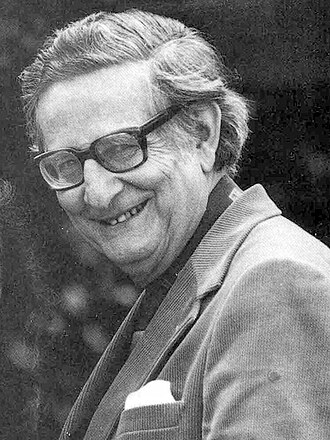
图:Sirswindon · CC BY 3.0 · Wikimedia Commons
- 出生
- 1916 年 3 月 4 日,柏林
- 逝世
- 1997 年 9 月 4 日,伦敦
- 国籍
- 英国、德国
- 学科
- 博物与综合
- 职业
- 心理学家、大学教师、科学家
- 母语 / 工作语言
- 英语
- 母校
- 伦敦大学学院、伦敦大学
- 工作单位
- 伦敦国王学院
研究领域
师承
博士导师1
博士生2
学生1
来自 Wikidata 的「博士导师」「师从」「博士生」「学生」记录,可能不全。
所获奖项(1)
- 1994William James Fellow Award
百科正文
生平
1916年3月4日,艾森克出生于德国柏林,年轻时由于不参加纳粹反党而移居英国。他是“人格与个体差异”杂志的主编,发表了50多本书籍和900多篇学术论文。他关于种族与智力关系的研究引起了强烈的争议和责备。
1955年至1983年,艾森克担任精神病学院的心理学教授。他是现代人格科学理论的主要贡献者,并且在建立精神紊乱的行为治疗中扮演关键角色。
以上内容摘自维基百科「汉斯·艾森克」,按 CC BY-SA 4.0 使用,去掉了参考文献、外部链接等尾部小节,公式改写成了纯文本。全文、配图和出处见原文。
英文维基百科补充中文条目比较短,下面是英文条目「Hans Eysenck」的原文
Hans Jürgen Eysenck ( EYE-zenk; 4 March 1916 – 4 September 1997) was a German-born British psychologist. He is best remembered for his work on intelligence and personality, although he worked on other issues in psychology. At the time of his death, Eysenck was the most frequently cited living psychologist in peer-reviewed scientific journal literature.
Eysenck's research included claims that certain personality types had an elevated risk of cancer and heart disease and research on IQ scores and race (first published in 1971), which were a significant source of controversy. Scholars have identified errors and suspected data manipulation in Eysenck's work, and large replications have failed to confirm the relationships that he purported to find.
An enquiry on behalf of King's College London found the papers by Eysenck coauthored with Ronald Grossarth-Maticek to be "incompatible with modern clinical science", with 26 of the joint papers considered suspect. Fourteen papers were retracted in 2020, and over 60 statements of concern were issued by scientific journals in 2020 about publications by Eysenck. David Marks and Rod Buchanan, a biographer of Eysenck, have argued that 87 publications by Eysenck should be retracted.
Life
Eysenck was born in Berlin, Germany. His mother was Silesian-born film star Helga Molander, and his father, Eduard Anton Eysenck, was an actor and nightclub entertainer who was once voted the "handsomest man on the Baltic coast". His mother was Lutheran and his father was Catholic. Eysenck was brought up by his maternal grandmother who was a Jewish convert to Catholicism. Subjected to the Nuremberg laws, she was deported and died in a concentration camp.
An initial move to England in the 1930s became permanent because of his opposition to the Nazi party and its persecutions. "My hatred of Hitler and the Nazis, and all they stood for, was so overwhelming that no argument could counter it." Because of his German citizenship, he was initially unable to gain employment, and he came close to being interned during the war.
Views and their reception
Examples of publications in which Eysenck's views roused controversy include (chronologically):
A paper in the 1950s concluding that available data "fail to support the hypothesis that psychotherapy facilitates recovery from neurotic disorder".
A chapter in Uses and Abuses of Psychology (1953) entitled "What is wrong with psychoanalysis".
The Psychology of Politics (1954)
Race, Intelligence and Education (1971) (in the US: The IQ Argument).
Sex, Violence and the Media (1978).
Astrology – Science or Superstition? (1982).
Decline and Fall of the Freudian Empire (1985).
Smoking, Personality and Stress (1991).
Eysenck's attitude was summarised in his autobiography Rebel with a Cause: "I always felt that a scientist owes the world only one thing, and that is the truth as he sees it.
Posthumous reevaluation
Eysenck's work has undergone reevaluation since his death.
Psychologist Donald R. Peterson noted in letters written in 1995 and published in 2005 that years earlier he had stopped trusting Eysenck's work after he tried to replicate a study done in Eysenck's lab and concluded that the results of the original study must have been "either concocted or cooked".
2019 King's College London enquiry
In 2019 the psychiatrist Anthony Pelosi, writing for the Journal of Health Psychology, described Eysenck's work as unsafe.
Portraits
There are five portraits of Eysenck in the permanent collection of the National Portrait Gallery, London, including photographs by Anne-Katrin Purkiss and Elliott and Fry.
Biographies
Buchanan, Roderick D. (2010). Playing with Fire: The Controversial Career of Hans J. Eysenck. Oxford University Press. ISBN 978-0-19-856688-5., review in: Rose, Steven (August 2010). "Hans Eysenck's controversial career". The Lancet. 376 (9739): 407–408. doi:10.1016/S0140-6736(10)61207-X.
Corr, P. J. (2016). Hans Eysenck: A Contradictory Psychology. Macmillan Education-Palgrave. ISBN 978-0-230-24940-0.
Eysenck, Hans (1997). Rebel with a cause. Transaction Publishers. ISBN 978-1-56000-938-2.
Gibson, H. B. (1981). Hans Eysenck: The man and his work. Peter Owen. ISBN 978-0-7206-0566-2.
以上节选摘自英文维基百科「Hans Eysenck」,按 CC BY-SA 4.0 使用,去掉了参考文献、外部链接等尾部小节,公式改写成了纯文本。篇幅所限,较长的小节只摘了开头一部分,有的小节没有收;全文、配图和出处见原文。
同一学科、同时代的科学家