 格物
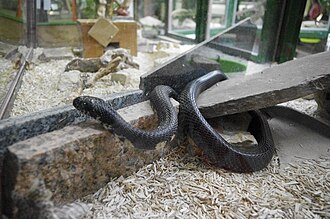
图:Traumrune · CC BY-SA 3.0 · Wikimedia Commons
生命之树 › 真核生物 › 动物界 › 真后生动物亚界 › 两侧对称动物 › 后口动物总门 › 脊索动物门 › 脊椎动物亚门 › 有颌下门 › 肉鳍鱼总纲 › 四足形类 › 希望螈目 › 四足总纲 › 爬行动物 › 鳞龙形下纲 › 鳞龙超目 › 有鳞目 › 眼镜蛇科 › 眼镜蛇属
森林眼镜蛇种
Naja melanoleuca
森林眼镜蛇,又名黑白眼镜蛇,为一种分布于非洲中西部的毒蛇,常见于低地森林及热带草原,但亦能适应更干燥的生境及擅长游泳。其为眼镜蛇属中体型最大的成员,体长可达3.1米,也是非洲最大的眼镜蛇。此蛇食性广泛,猎物涵盖昆虫及各类体型适合的爬行与哺乳动物。这种眼镜蛇机警、敏捷、危险性高,在受骚扰时会鼓起颈部并抬起前半身,作出攻击的姿势。由于不同因素,被森林眼镜蛇咬伤的人不多,但一旦被咬则需尽快就医,因其可危及生命。
摘自维基百科「森林眼鏡蛇」,CC BY-SA 4.0
- 学名
- Naja melanoleuca
- 分类等级
- 种
- 英文名
- Forest cobra
- 上级类群
- 眼镜蛇属
- 大类
- 爬行动物
- 命名
- 爱德华·哈洛韦尔(爬虫学家),1857 年
- 保护状况(IUCN)
- 无危物种
- 数据库
- NCBI 分类 · GBIF · IUCN 红色名录
百科正文
英文维基百科补充中文条目比较短,下面是英文条目「Forest cobra」的原文
The forest cobra (Naja melanoleuca), also commonly called the black cobra and the black and white-lipped cobra, is a species of
highly venomous snake in the family Elapidae. The species is native to Africa, mostly the central and western parts of the continent. It is the largest true cobra species with a record length of 3.2 metres (10 feet 6 inches).
Although it prefers lowland forest and moist savanna habitats, this cobra is highly adaptable and can be found in drier climates within its geographical range. It is a very capable swimmer and is often considered to be semi-aquatic. The forest cobra is a generalist in its feeding habits, having a highly varied diet: anything from large insects to small mammals and other reptiles. This species is alert, nervous and is considered to be a medically significant snake. When cornered or molested, it will assume the typical cobra warning posture by raising its fore body off the ground, spreading a narrow hood, and hissing loudly. Bites to humans are less common than from other African cobras due to various factors, though a bite from this species is a life-threatening emergency.
Taxonomy and evolution
The forest cobra is classified in the genus Naja of the family Elapidae. Naja melanoleuca was first described by American herpetologist Edward Hallowell in 1857. The generic name Naja is a Latinisation of the Sanskrit word nāgá (नाग) meaning "cobra". The specific epithet melanoleuca is Ancient Greek and means "of black and white". The word melano is Greek for "black", while leuca comes from the Ancient Greek word for "white". This species is also known as the black cobra and black and white-lipped cobra.
The genus Naja was first described by Josephus Nicolaus Laurenti in 1768. The species of Naja melanoleuca was first described by Edward Hallowell in 1857. The genus Naja was split into several subgenera based on various factors, including morphology, diet, and habitat.
Description
The forest cobra is Africa's largest cobra of the genus Naja and possibly the largest of all the true cobra (Naja) species in the world. The length of an average adult is 1.4 to 2.2 m (4.6 to 7.2 ft), and they regularly attain lengths of 2.7 m (8.9 ft), and lengths up to 3.2 m (10 ft) have been recorded in the wild. The mean body mass of the species in one survey, which did not exclude juvenile cobras per se, was reported at a mean of 509.5 g (1.123 lb) while large, mature forest cobras are known to obtain weights of up to 2,000 to 3,600 g (4.4 to 7.9 lb). Males and females grow to be similar in length, as there is no sexual dimorphism within this species. The head of this snake is large, broad, flattened and is slightly distinct from the neck.
Distribution and habitat
The forest cobra occurs mainly in central Africa. It has been recorded from Benin, Nigeria, Equatorial Guinea, Cameroon, Gabon, the Republic of Congo, the Democratic Republic of Congo, Central African Republic, and northern Angola.
A snake of forest or woodland, it is the only one of Africa's cobras that will live in high forest. The forest cobras are snakes that are well adapted to many environments and the habitat of the forest cobra is strongly dependent on what part of its African range the snake originates from. Forest cobras originating in the southern African regions are typically found in savanna and grassland, but they can also be found in broken rock country. They are mainly found in the tropical and subtropical rainforest regions of west and central Africa. It also inhabits mangroves in western Africa.
Behavior
The forest cobra is an agile, diurnal species that climbs well and is one of the most aquatic of the true cobras of the genus Naja. It is terrestrial, but it is a fast, graceful climber, known to ascend trees to a height of 10 m (33 ft) or more. It is quick moving and alert. It swims well and readily takes to the water; in some areas its main diet is fish and could be regarded as semi-aquatic. Although it is active mostly during the day (diurnal) in uninhabited areas, it can also be active by night (nocturnal) where it goes into urban areas. When not active, it takes cover in holes, brush piles, hollow logs, among root clusters or in rock crevices, or in abandoned termite mounds at forest fringe or clearings.
以上节选摘自英文维基百科「Forest cobra」,按 CC BY-SA 4.0 使用,去掉了参考文献、外部链接等尾部小节,公式改写成了纯文本。篇幅所限,较长的小节只摘了开头一部分,有的小节没有收;全文、配图和出处见原文。