格物
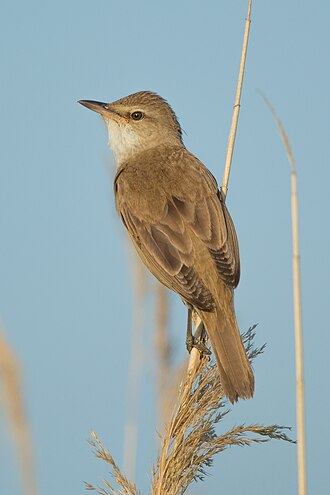
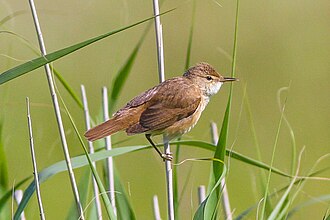
图:Andreas Trepte · CC BY-SA 2.5 · Wikimedia Commons
- 学名
- Acrocephalus arundinaceus
- 分类等级
- 种
- 英文名
- Great Reed Warbler
- 上级类群
- 苇莺属
- 大类
- 鸟类
- 命名
- 卡尔·林奈,1758 年
- 保护状况(IUCN)
- 无危物种
- 体重
- 3.15 克(出生体重)
- 数据库
- NCBI 分类 · GBIF · IUCN 红色名录
百科正文
英文维基百科补充中文条目比较短,下面是英文条目「Great reed warbler」的原文
The great reed warbler (Acrocephalus arundinaceus) is an insectivorous bird in the family Acrocephalidae. It is a medium-sized passerine bird and the largest of the warblers. It breeds throughout mainland Europe and the Western Palearctic and migrates to sub-Saharan Africa in the winter. It favours reed beds during the breeding season, while living in reed beds, bush thickets, rice fields, and forest clearings during the winter. It exhibits relatively low sexual dimorphism, and the sexes are similar in appearance. This species mates both polygynously and monogamously.
Taxonomy
The great reed warbler was formally described in 1758 by the Swedish naturalist Carl Linnaeus in the tenth edition of his Systema Naturae. He placed it with the thrushes in the genus Turdus and coined the binomial name Turdus arundinaceus. He specified the type locality as Northern Europe. Linnaeus based his entry on the Turdus musicus palustris or Bruch Beiden Rohr Drossel that had been described in 1750 by the German naturalist Jacob Theodor Klein in his book Historiae avium prodromus. The specific epithet arundinaceus is Latin meaning "like a reed" (hence "of the reeds"), from arundo, arundinis meaning "reed". The great reed warbler is now one of 42 species placed in the genus Acrocephalus that was introduced in 1811 by the German naturalist Johann Andreas Naumann and his son Johann Friedrich Naumann.
Two subspecies are recognised:
A. a. arundinaceus (Linnaeus, 1758) – Europe to north Iran and northwest Arabia
Description
The thrush-sized warbler is one of the largest species in both its current the family Acrocephalidae, and its former family, the "Sylviidae". It measures 16–21 cm (6.3–8.3 in) in length, 25 to 30 cm (9.8 to 11.8 in) in wingspan and weighs 22 to 38 g (0.78 to 1.34 oz). The adult has unstreaked brown upperparts and dull buffish-white chin and underparts. The forehead is flattened, and the bill is strong and pointed. It looks very much like a giant common reed warbler (Acrocephalus scirpaceus), but with a stronger supercilium. The sexes are identical, as with most old world warblers, but young birds are richer buff below.
The warbler's song is very loud and far-carrying. The song's main phrase is a chattering and croaking carr-carr-cree-cree-cree-jet-jet, to which the whistles and vocal mimicry typical of marsh warblers are added.
Distribution and habitat
The great reed warbler breeds in Europe and the west Palearctic. It does not breed in Great Britain, where only the closely related, smaller common reed warbler Acrocephalus scirpaceus occurs, but is an irregular visitor. Its population has in recent decades increased around the eastern Baltic Sea, while it has become rarer at the western end of its range. It is a migratory bird, wintering in tropical Africa. It migrates north at a rather late date, and some birds remain in their winter quarters until the end of April.
The mtDNA haplotype data indicate that during the last glacial period there were two allopatric populations of great reed warbler. The great reed warblers in southwestern and southeastern Europe were at that time apparently separated by the Vistulian-Würm ice sheets and the surrounding barren lands.
Behaviour
Diet
The great reed warbler has a primarily carnivorous diet. Observation of prey collection specifically during breeding season has shown the retrieval of insect larvae, moths, dragonflies, damselflies, beetles, spiders, small fish, and frogs. It has also been reported to eat fruit during non-breeding seasons. Nestlings typically feed on diptera and arachnids, though this may not be their preferred food.
Communication and courtship
Male great reed warblers have been observed to communicate via two basic song types: short songs about one second in length with few syllables, and long songs of about four seconds that have more syllables and are louder than the short variety. It has been observed that long songs are primarily used by males to attract females; long songs are only given spontaneously by unpaired males, and cease with the arrival of a female. Short songs, however, are primarily used in territorial encounters with rival males.
以上节选摘自英文维基百科「Great reed warbler」,按 CC BY-SA 4.0 使用,去掉了参考文献、外部链接等尾部小节,公式改写成了纯文本。篇幅所限,较长的小节只摘了开头一部分,有的小节没有收;全文、配图和出处见原文。